A Visit from Saint Nicholas

Clement Moore perpetrated a great crime against Church history when he penned and published the poem “A Visit from Saint Nicholas” in 1823. The mostly-benevolent Church Father known as Saint Nicholas of Myra was replaced with a magical man and equally magical reindeer who should – according to the laws of physics – immediately burst into flames and crash back to earth in a flaming ball of death and destruction the moment they attempt takeoff, simultaneously wiping out elven workshops and delivering barbecue to the North Pole. (I can only imagine Saint Nicholas’ reaction to this development . . .)

Therefore, in the spirit of historical accuracy (or – at the very least – greater historical accuracy than Mr. Clement’s epic failure), I present to you the real “Visit from Saint Nicholas.”


A Visit from Saint Nicholas

‘Twas the First Council of Nicaea, when all through the Church
Every Christian was stirring, and starting research.

Council of Nicea Sistine Chapel
The search for Truth, that is.

The Church Fathers had chosen their sides with great care,
For Nicholas of Myra soon would be there;
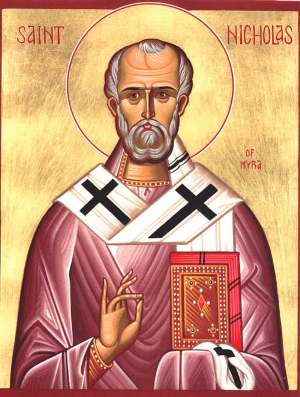
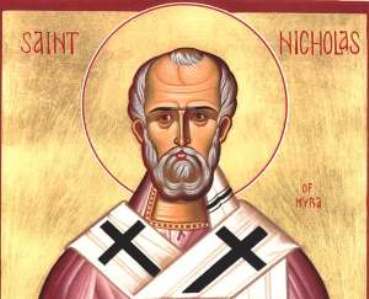
Nicholas of Myra
^ [this guy] ^

The Elders were settled all smug in their doctrine,
While allegations of heresy swarmed like a toxin;

Coptic Gnostic Cross
Gnosticism
Just say NO!

Constantine in his robes and Bishops in caps
Were just praying the Church wouldn’t collapse.
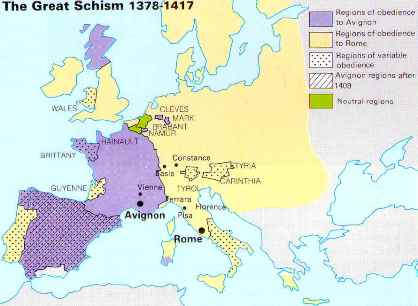
Great Schism Map
But it almost did . . . 1,000 years later.

When out of debate there arose such a clatter,
All heads turned around to see what was the matter.

Away to the Council I flew like a flash,
Threw open the doors and stopped in my tracks.

The lamps in their sockets were all aglow,
Giving lustre of mid-day to objects below,

Well, duh. That’s what lamps are for, right?

When, what to my wondering eyes should appear,
But a lively Church Council – no longer austere –

And a stately Church Father, so lively and quick,
I knew in a moment it was Bishop Nick.

Nicholas of Myra
^ [this guy] ^
in case you needed reminding

More rapid than eagles his discourses came,
And he whistled, and shouted, and I heard him proclaim:

“The deity of Christ cannot be refuted;
Equality with the Father cannot be disputed!”

From the back of the pack there came a loud call:
“That’s not what I think; no, not at all!”
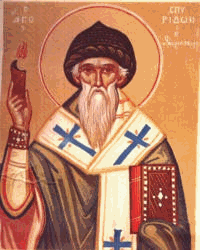
Arius
Enter Scumbag Arius

As dry leaves that before the wild hurricane fly,
When they meet with an obstacle, mount to the sky;
So up to the naysayer Bishop Nick flew,
With a fist full of fury (and righteous wrath, too).
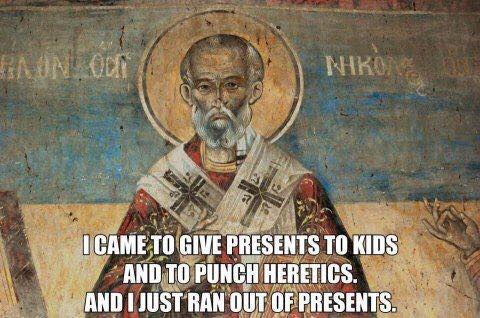
real santaAnd then, in a twinkling, I heard a great “Oomph!
We’re lucky that Nick didn’t kill the poor doof . . .

Constantine and the Bishops all gathered around,
And kicked Nick to the curb like an unwanted hound.

He was thrown into prison and stripped of his office,
His pallium confiscated – so were his Gospels.

Not quite the Santa you remember, is he?

He was left with only the clothes on his back –
Even a beggar had more in his pack.

But his eyes—how they twinkled! his dimples how merry!
His cheeks were like roses, his nose like a cherry!
His droll little mouth was drawn up like a bow
And the beard of his chin was as white as the snow.

Nicholas of Myra
artistic liberty taken

Arius was in favor of kicking his teeth,
But he was outvoted and started to seethe:

“Nick doesn’t deserve proper food for his belly,
Why don’t we just kill him? Someone, please tell me!”

Arius
Typical Arius . . .

It was then that they learned just how wrong they all were –
It all happened so fast, it seemed like a blur:

Christ and the Virgin visited his bed
– are we really quite certain this wasn’t all in his head? –

They restored his belongings and sent him to work
Helping poor children and building the Church.
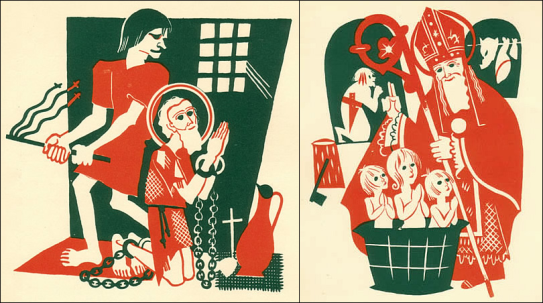
Saint Nicholas Before and After
Before and After

And laying his finger aside of his nose,
And giving a nod, he walked down the road.

He rallied his strength, to his team gave a whistle,
And strait away they read from the Missal,

But I heard him exclaim, ere he trod out of sight,
“I’ll mess you up, too, should we get in a fight.”

Nicholas-Awkward-Meme


Some Notes on Historical Accuracy

Obviously, I have taken some artistic license. In some cases I was just too lazy to come up with anything thought the original worked just fine. For your consideration:

The Constantine mentioned here is Constantine I, founder of New Rome (aka Byzantium, Constantinople, and Istanbul).

Despite my caption, Arius may or may not have been a scumbag. He did, however, believe that Jesus Christ was inferior to God the Father, while Nicholas believed that Jesus was equal to God the Father. Hence, their disagreement.

By all accounts Arius was speaking when Nicholas couldn’t take it any more and laid into him. That just didn’t work for me. Oh well, deal with it and move on.

I really don’t know how Arius reacted to getting punched in the face. His response is based on what my reaction would have been. Honestly, how would you have reacted?

Although I have Nicholas’ followers reading from the Missal, I don’t think it existed at that time. However, neither do flying reindeer, and you probably like that poem just fine, don’t you?

Anyway, now you have a semi-historical background for the real Nicholas. Combat ignorance and share it!

Krampuskarte
Eine Krampuskarte.
Just because.

Apologies for the Inconvenience

If you had problems viewing the Virtual Read Out, those issues have been addressed.

But what of the inconvenience of banned and challenged books? Do the school boards, parents, or “concerned individuals” ever apologize for limiting the First Amendment, for restricting education, or for judging the opinions of others?

As Banned Books Week draws to a close, remember that the war is far from over. The censors may lose a battle, but they haven’t surrendered the war.

Be Wary.

Be Vigilant.

Be Reading.

BBW Artwork

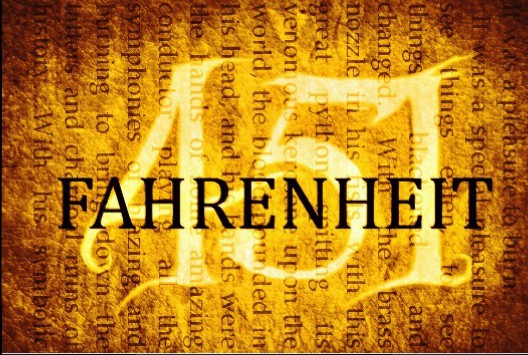
Some time ago I wanted a custom iPhone case. Although I never ordered it, I just couldn’t throw the artwork away; perhaps because it was the first time I semi-successfully created a fire effect in Photoshop. Enjoy!

Burning Fahrenheit 451

Challenged Sentences

LeatherBooksWant to read something for Banned Books Week but just don’t have the time? You’re in luck! Below, you’ll find ten of the most challenged books in the United States condensed (by me) into one sentence.

Irony isn’t lost on me; it wasn’t too long ago in writing about Fahrenheit 451 that I included the line:

Classics cut to fit fifteen-minute radio shows, then cut again to fill a two-minute book column, winding up at last as a ten- or twelve-line dictionary resume.

However, my goal is not to tell the story; rather, to whet your appetite for more.

Enjoy, fearless reader!

Ulysses (James Joyce; “explicit nature” and “promoting lust”): As an omniscient observer, spend 16 June 1904 with Leopold Bloom in Dublin.

To Kill a Mockingbird (Harper Lee; “racial slurs, profanity, and blunt dialogue about rape”): Scout, a young girl in Maycomb, Alamaba, learns from her father why racism is wrong.

The Sun Also Rises (Ernest Hemingway; profanity and sex): A group of young people attempt to forget the horrors of WWI with sex, parties, and alcohol.

Slaughterhouse-Five (Kurt Vonnegut; “depraved, immoral, psychotic, vulgar, and anti-Christian”): A soldier in WWII, Billy Pilgrim suffers from shell-shock.

1984 (George Orwell; sexual content and violence): A totalitarian government breaks Winston Smith.

The Jungle (Upton Sinclair; socialist philosophies): Discover the horror of meatpacking in the early 1900s (and socialism, too).

James and the Giant Peach (Roald Dahl; “inappropriate language, encourages disobedience to parents, references to drugs and alcohol, and ‘magical elements’): A young boy flees his abusive aunts in a magical fruit with talking insects.

The Great Gatsby (F. Scott Fitzgerald; “language and sexual references”): Jay Gatsby throws extravagant parties in an attempt to win the love of Daisy Buchanan.

Catch-22 (Joseph Heller; “offensive language”): John Yossarian deals imaginatively with Air Force bureaucracy in WWII.

The Adventures of Huckleberry Finn (Mark Twain; race and social issues): Huck Finn runs away from home and rafts down the Mississippi River with escaped slave Jim.

Child of Fear – Father of Ignorance

Censorship is the child of fear and the father of ignorance.

– Laurie Halse Anderson

LeatherBooksFor years I’ve told my students, “If you don’t like to read, it’s only because you haven’t found something you like to read.” No one really hates reading; they hate being told what to read and when to read it. Then, because this mandate usually comes from a “mean teacher,” they project that hatred onto the act itself. I recall one student who – on the first day of school – declared she hated reading and would rather solve long division (she hated math, too) than read a single page of another book. By the end of the year she loved reading; all it took was a little coaching to find what she actually wanted to read.

BBWPoster2013But what happens when a book you want to read has been censored or banned? I remember looking through my school’s library in Middle School and finding all the “bad words” marked out in black sharpie (which then bled through onto the next page, effectively ruining three pages of text). What good does that do? Did they really think we couldn’t figure out what was being said? If anything, it encouraged us to find non-vandalized copies and figure out what they were hiding from us.

Those that would censor books for religious, moral, or political reasons have entirely missed the point. Now, I agree that parents should have ultimate control over what their children read, but that’s where their power ends. No one should be able to dictate what someone else reads. Doing so kills creativity, stifles healthy debate, and creates citizens incapable of rational thought. It’s not enough to say “I don’t like it because my parents don’t;” that excuse stops working around the ninth grade.

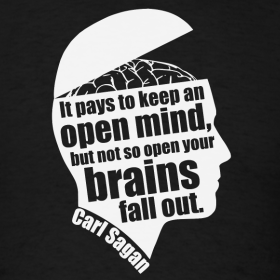
Carl Sagan Open MindI never tell my students to read with an open mind; I tell them to read with a discerning mind. An open mind blindly accepts information; a discerning mind filters information. The problem is that censors view books the way others view television: as a babysitter. Books entertain and teach, and require a guide. Just because you want to shirk that responsibility doesn’t give you the right to violate the First Amendment.

By happy coincidence, Banned Books Week coincides with my Bill of Rights section of American Government. I have no idea how my students will react – I suspect less than half of them read voluntarily. We’ll just have to see how it goes.

[SPOILER ALERT]*

bookstack1

Tracking my TBR on Goodreads presents me with a dilemma: the book review.

It has nothing to do with spoilers; frankly, I love knowing the ending in advance. I always read the last few pages just to see how things turn out. Doctor Who airs in Britain before it airs in the United States, and I’m the guy looking up Wikipedia articles or fan pages to find out what happened. I want to know how things happen even on shows I don’t watch. For example, my wife enjoys Pretty Little Liars, and she wasn’t able to watch the season finale until after it had aired. I looked up fan reactions to find out who died. I still don’t know what her reaction was since I fell asleep.

For the record, science backs me up: people usually enjoy a spoiled book or show rather than an unspoiled one.

Although I don’t mind knowing what happens, I worry about being influenced by others’ perspectives. For example, I recently finished The Kite Runner and found it lacking. However, I had also read several reviews that were rather critical of the novel. Although my criticisms were not the same, I wonder if I began reading with an eye to find fault. I’d like to think I keep an open mind; for every book I agree with someone about there are others with which we disagree.

Furthermore, I hesitate to write my own reviews. I’ll give it a star rating based on my opinion, but that’s just it: it’s my opinion. Why should my opinion color someone’s experience?

Perhaps I’ll start doing things differently. I think I’ll read the book first and then read the reviews to see if others felt the same way. Not for validation or vindication, but just to see how others see what I see.

After all, if a book doesn’t cause discussion, is it worth reading in the first place?


Website Powered by WordPress.com.

Up ↑