It can be traded and it can be banked, and more secretly than money.
London, 1385:
A book and a cloth prophesy regicide.
Two aspiring poets hide their own a dark secrets.
Two ambitious men plot revenge.
Two fallen women desire a better life.
This is the scene and these are the principal characters of Bruce Holsinger’s A Burnable Book. A book of heretical verse prophesying the death of Richard II circulates through London. When the only known copy goes missing, it’s up to John Gower – enlisted by his friend Geoffrey Chaucer – to track it down and stop the assassination.
[SPOILERS AHEAD]
Distraction, deception, subterfuge, mendacity, all those unspoken tools of the subtler crafts: government and trade, diplomacy and finance.
As far is intrigues go, I found A Burnable Book relatively easy. It is quite obvious that Chaucer is the author of De Mortibus, that Gower’s son Simon is in it up to his ears, and the identity of the so-called “mystery girl” is evident early on as well. History tells us that Richard II wasn’t assassinated in 1385, so we know the plot will fail. (I really shouldn’t have to give a spoiler alert for something over 600 years old, you know . . .) However, this did not stop me from enjoying the book and seeing how the characters would figure it out. For me, the only real plot twists were (a) just who was responsible for Simon’s involvement in the plot and (b) just how much Chaucer “knew” beforehand.
As a work of fiction, I found A Burnable Book to be about as satisfying as a bag of chips: It filled time but had little actual value. Adam Scarlett really turned me off. A relatively minor character, his rather violent end was not really necessary to the plot. Furthermore, coming as it did in the final ten pages of the book, it somewhat ruined the denouement of the overall storyline. I understand the motives behind his death; I simply think it should have come at a different point (preferably not at all).
I borrowed this book from my local library; otherwise, I would have felt robbed. I definitely wouldn’t pay $26 for the hardback edition, and even $8 for a paperback may be a bit much.
Perhaps you have never heard of a Lessons and Carols service.
From Wikipedia:
The first Festival of Nine Lessons and Carols at King’s College, Cambridge, was held on Christmas Eve in 1918. It was conceived by Eric Milner-White, the Dean of the College, whose experience as an army chaplain had led him to believe that more imaginative worship was needed by the Church of England. The order of service was adapted from the order created by Benson for Truro Cathedral 38 years earlier, based on an idea from the future Bishop of Edinburgh, George Walpole . . .
The format of the first Festival of Nine Lessons and Carols did not differ substantially from the one known today. The order of the lessons was revised in 1919, and since that time the service has always begun with the hymn “Once in Royal David’s City” . . .
The Nine Lessons, which are the same every year, are read by representatives of the college and of the City of Cambridge from the 1611 Authorized King James Version of the Bible . . . The singing is divided into “carols” which are sung by the Choir of King’s College, Cambridge, and “hymns” sung by the Choir and congregation . . . The service ends with the hymn “Hark! The Herald Angels Sing” . . .
If you have never attended a Lessons and Carols service – or, if you are unable to attend one or find a broadcast – I would like to provide one for you.
AB INITIO
FIRST LESSON
Genesis 3:8-19
8. And they heard the voice of the Lord God walking in the garden in the cool of the day: and Adam and his wife hid themselves from the presence of the Lord God amongst the trees of the garden.
9. And the Lord God called unto Adam, and said unto him, Where art thou?
10. And he said, I heard thy voice in the garden, and I was afraid, because I was naked; and I hid myself.
11. And he said, Who told thee that thou wast naked? Hast thou eaten of the tree, whereof I commanded thee that thou shouldest not eat?
12. And the man said, The woman whom thou gavest to be with me, she gave me of the tree, and I did eat.
13. And the Lord God said unto the woman, What is this that thou hast done? And the woman said, The serpent beguiled me, and I did eat.
14. And the Lord God said unto the serpent, Because thou hast done this, thou art cursed above all cattle, and above every beast of the field; upon thy belly shalt thou go, and dust shalt thou eat all the days of thy life:
15. And I will put enmity between thee and the woman, and between thy seed and her seed; it shall bruise thy head, and thou shalt bruise his heel.
16. Unto the woman he said, I will greatly multiply thy sorrow and thy conception; in sorrow thou shalt bring forth children; and thy desire shall be to thy husband, and he shall rule over thee.
17. And unto Adam he said, Because thou hast hearkened unto the voice of thy wife, and hast eaten of the tree, of which I commanded thee, saying, Thou shalt not eat of it: cursed is the ground for thy sake; in sorrow shalt thou eat of it all the days of thy life;
18. Thorns also and thistles shall it bring forth to thee; and thou shalt eat the herb of the field;
19. In the sweat of thy face shalt thou eat bread, till thou return unto the ground; for out of it wast thou taken: for dust thou art, and unto dust shalt thou return.
Clement Moore perpetrated a great crime against Church history when he penned and published the poem “A Visit from Saint Nicholas” in 1823. The mostly-benevolent Church Father known as Saint Nicholas of Myra was replaced with a magical man and equally magical reindeer who should – according to the laws of physics – immediately burst into flames and crash back to earth in a flaming ball of death and destruction the moment they attempt takeoff, simultaneously wiping out elven workshops and delivering barbecue to the North Pole. (I can only imagine Saint Nicholas’ reaction to this development . . .)
Therefore, in the spirit of historical accuracy (or – at the very least – greater historical accuracy than Mr. Clement’s epic failure), I present to you the real “Visit from Saint Nicholas.”
A Visit from Saint Nicholas
‘Twas the First Council of Nicaea, when all through the Church Every Christian was stirring, and starting research.
The search for Truth, that is.
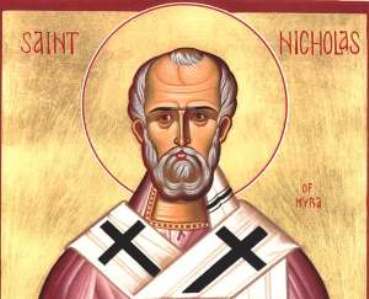
The Church Fathers had chosen their sides with great care, For Nicholas of Myra soon would be there;
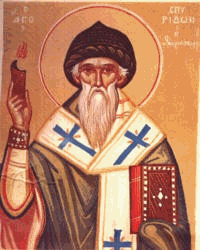
^ [this guy] ^
The Elders were settled all smug in their doctrine,
While allegations of heresy swarmed like a toxin;
Gnosticism Just say NO!
Constantine in his robes and Bishops in caps
Were just praying the Church wouldn’t collapse.
But it almost did . . . 1,000 years later.
When out of debate there arose such a clatter, All heads turned around to see what was the matter.
Away to the Council I flew like a flash, Threw open the doors and stopped in my tracks.
The lamps in their sockets were all aglow,
Giving lustre of mid-day to objects below,
Well, duh. That’s what lamps are for, right?
When, what to my wondering eyes should appear,
But a lively Church Council – no longer austere –
And a stately Church Father, so lively and quick,
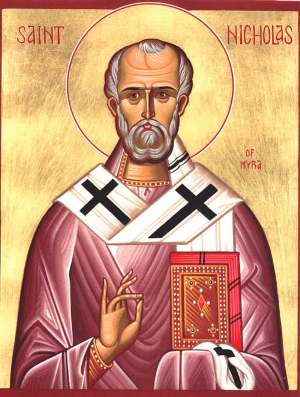
I knew in a moment it was Bishop Nick.
^ [this guy] ^ in case you needed reminding
More rapid than eagles his discourses came,
And he whistled, and shouted, and I heard him proclaim:
“The deity of Christ cannot be refuted;
Equality with the Father cannot be disputed!”
From the back of the pack there came a loud call:
“That’s not what I think; no, not at all!”
Enter Scumbag Arius
As dry leaves that before the wild hurricane fly,
When they meet with an obstacle, mount to the sky;
So up to the naysayer Bishop Nick flew,
With a fist full of fury (and righteous wrath, too).
And then, in a twinkling, I heard a great “Oomph!”
We’re lucky that Nick didn’t kill the poor doof . . .
Constantine and the Bishops all gathered around,
And kicked Nick to the curb like an unwanted hound.
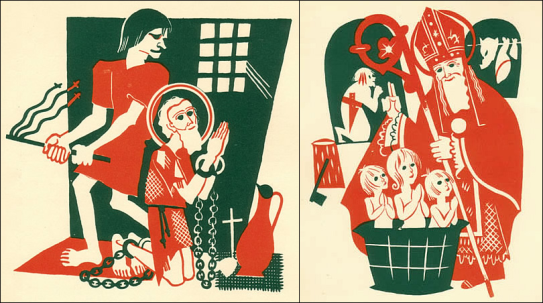
He was thrown into prison and stripped of his office,
His pallium confiscated – so were his Gospels.
Not quite the Santa you remember, is he?
He was left with only the clothes on his back –
Even a beggar had more in his pack.
But his eyes—how they twinkled! his dimples how merry!
His cheeks were like roses, his nose like a cherry!
His droll little mouth was drawn up like a bow
And the beard of his chin was as white as the snow.
artistic liberty taken
Arius was in favor of kicking his teeth,
But he was outvoted and started to seethe:
“Nick doesn’t deserve proper food for his belly,
Why don’t we just kill him? Someone, please tell me!”
Typical Arius . . .
It was then that they learned just how wrong they all were –
It all happened so fast, it seemed like a blur:
Christ and the Virgin visited his bed
– are we really quite certain this wasn’t all in his head? –
They restored his belongings and sent him to work
Helping poor children and building the Church.
Before and After
And laying his finger aside of his nose,
And giving a nod, he walked down the road.
He rallied his strength, to his team gave a whistle,
And strait away they read from the Missal,
But I heard him exclaim, ere he trod out of sight,
“I’ll mess you up, too, should we get in a fight.”
Some Notes on Historical Accuracy
Obviously, I have taken some artistic license. In some cases I was just too lazy to come up with anything thought the original worked just fine. For your consideration:
The Constantine mentioned here is Constantine I, founder of New Rome (aka Byzantium, Constantinople, and Istanbul).
Despite my caption, Arius may or may not have been a scumbag. He did, however, believe that Jesus Christ was inferior to God the Father, while Nicholas believed that Jesus was equal to God the Father. Hence, their disagreement.
By all accounts Arius was speaking when Nicholas couldn’t take it any more and laid into him. That just didn’t work for me. Oh well, deal with it and move on.
I really don’t know how Arius reacted to getting punched in the face. His response is based on what my reaction would have been. Honestly, how would you have reacted?
Although I have Nicholas’ followers reading from the Missal, I don’t think it existed at that time. However, neither do flying reindeer, and you probably like that poem just fine, don’t you?
Anyway, now you have a semi-historical background for the real Nicholas. Combat ignorance and share it!
















 Running In My Head