Given opportunity, we might try to find them again.
Calling cards
Autograph books
Yearbooks
Facebook
If especially bold, we might drive by their house.
This summer, I rediscovered my first love: the library.
Public Library Honesdale, PA
My hometown library contained all the charm, character, and mystery of a 100+ year old home. I adored the card catalog – every book condensed in neat little boxes. I learned Library of Congress designations before I could read most of the books. The high water mark of the big flood of ’42 was still visible on the walls. Each room was its own section; no getting lost in this library. In the hall, a wide staircase to the forbidding upstairs, off-limits to regular patrons. In the front hall, the television that stood for years until my friend C_____ bought it for $20. I wonder if he ever replaced the missing tubes?
The big library in Scranton – in my mind a fortress – with two separate buildings: one for kids and one for adults. The first time someone told me I was too young to be in the adult section. The joy and wonder of “getting lost” in the ironwork stacks. Knowing the library better than my teachers for the annual research trip. My first copy card. Learning microfilm and microfiche.
Public Library Scranton, PA
I loved to read. My first book report – given in the second grade – was Moby Dick (unabridged, of course). In the fourth grade I explained the symbolism of Snowball in Animal Farm. I read political theory and philosophy while my classmates struggled with Little House on the Prairie. My parents told me that during one PTA, a teacher said I shouldn’t act so smart. Apparently I made the rest of the class feel stupid by using the word “doubloon” in a sentence. We were discussing Treasure Island.
But along the way, I stopped loving making time for books. In pursuing education, I stopped reading for fun. Well, at least during the school year. The only books I remember reading for personal pleasure between 2003 and 2008 were Charlotte’s Web and The Silmarillion, both in German. I’m sure there were books I read – some I even wanted to read – I just don’t remember them.
For the last few years, I’ve saved up and bought the books I wanted to read. But I forgot about the library. And so, several weeks ago, short of cash but long in the To-Be-Read list, I went to my local library.
Public Library New Bern, NC
It’s not like the libraries of my childhood. It’s small(er), but maybe that’s because I’ve grown. It was obviously built – or at least renovated – to be a library. Two large open rooms and a smaller local history/microfilm room. No chance to get lost in the stacks, just look down the aisle. But still, it’s a library. And I’ve discovered the books call to me here just as well. It’s love, rekindled.
It’s hard to write about current events: everyone has an opinion and – after a time – there’s nothing new to be said. I’ve spent the last several days trying to write about something mainstream: Hobby Lobby, Kendall Jones, Immigration, the World Cup, Israel and Gaza. I’ve only completed one of those, but I did write about it twice.
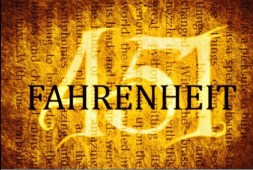
As I sat writing, editing, and deleting, I thought back to the first blog I ever wrote: a short-lived current events Blogger site whose only semi-redeeming feature was the title: 451 Revisited. I’d intended to use it as a place of information and discussion, but I only posted four articles in six months. Thinking on that failed abomination, I reflected on the title. Hadn’t I written a piece about Fahrenheit 451 for Banned Books Week? Maybe the time was right for another visit.
After days weeks of reading professional articles, personal blogs, Twitter feeds, and Facebook updates, I came to the opinion that many people would benefit from Captain Beatty’s speech to Montag about the history of the Firemen. I intended to update it for a modern audience, but found that Bradbury’s argument still held true – no rewriting necessary. Instead, I decided on a different tack entirely . . .
Captain Beatty’s Speech
Edited* and Illustrated for the Modern Reader
Original by Ray Bradbury – Fahrenheit 451 (1979 ed)
Declared Martial Law Suspended Habeas Corpus Ignored Supreme Court Jailed Dissenters Loved by Millions
When did it all start, you ask . . . ? Well, I’d say it really got started around about a thing called the Civil War . . . The fact is we didn’t get along well until photography came into its own. Then – motion pictures in the early twentieth century. Radio. Television. Things began to have mass . . .
And because they had mass, they became simpler . . . Once, books appealed to a few people, here, there, everywhere. They could afford to be different. The world was roomy. But then the world got full of eyes and elbows and mouths. Double, triple, quadruple population. Films and radios, magazines, books levelled down to a sort of paste pudding norm . . .
Ironic, isn’t it?
Picture it. Nineteenth-century man with his horses, dogs, carts, slow motion. Then, in the twentieth century, speed up your camera. Books cut shorter. Condensations, Digests. Tabloids. Everything boils down to the gag, the snap ending . . .
Classics cut to fit fifteen-minute radio shows, then cut again to fill a two-minute book column, winding up at last as a ten- or twelve-line dictionary resume. I exaggerate, of course. The dictionaries were for reference. But many were those whose sole knowledge of Hamlet . . . was a one-page digest in a book that claimed: ‘now at least you can read all the classics; keep up with your neighbours.’ Do you see? Out of the nursery into the college and back to the nursery; there’s your intellectual pattern for the past five centuries or more . . .
Sound Bites!
Politics? One column, two sentences, a headline! Then, in mid-air, all vanishes! Whirl man’s mind around about so fast under the pumping hands of publishers, exploiters, broadcasters, that the centrifuge flings off all unnecessary, time-wasting thought! . . .
School is shortened, discipline relaxed, philosophies, histories, languages dropped, English and spelling gradually neglected, finally almost completely ignored. Life is immediate, the job counts, pleasure lies all about after work. Why learn anything save pressing buttons, pulling switches, fitting nuts and bolts?
[sarcasm] Seriously, why waste time with extras? [/sarcasm]Sound Familiar?
The zipper displaces the button and a man lacks just that much time to think while dressing at dawn, a philosophical hour, and thus a melancholy hour . . .
Empty the theatres save for clowns and furnish the rooms with glass walls and pretty colours running up and down the walls like confetti or blood or sherry or sauterne . . .
More sports for everyone, group spirit, fun, and you don’t have to think, eh? Organize and organize and superorganize super-super sports. More cartoons in books. More pictures. The mind drinks less and less. Impatience. Highways full of crowds going somewhere, somewhere, somewhere, nowhere. The gasoline refugee. Towns turn into motels, people in nomadic surges from place to place, following the moon tides, living tonight in the room where you slept this noon and I the night before . . .
Now let’s take up the minorities in our civilization, shall we? Bigger the population, the more minorities. Don’t step on the toes of the dog-lovers, the cat-lovers, doctors, lawyers, merchants, chiefs, Mormons, Baptists, Unitarians, second-generation Chinese, Swedes, Italians, Germans, Texans, Brooklynites, Irishmen, people from Oregon or Mexico. The people in this book, this play, this TV serial are not meant to represent any actual painters, cartographers, mechanics anywhere.
The events depicted are fictitious. Any similarity to any person living or dead is purely coincidental.Why are you thinking? Don’t you have something better to do?
The bigger your market . . . the less you handle controversy, remember that! All the minor minor minorities with their navels to be kept clean. Authors, full of evil thoughts, lock up your typewriters. They did. Magazines became a nice blend of vanilla tapioca. Books, so the damned snobbish critics said, were dishwater. No wonder books stopped selling, the critics said. But the public, knowing what it wanted, spinning happily, let the comic-books survive. And the three-dimensional sex-magazines, of course . . .
It didn’t come from the Government down. There was no dictum, no declaration, no censorship, to start with, no! Technology, mass exploitation, and minority pressure carried the trick, thank God. Today, thanks to them, you can stay happy all the time, you are allowed to read comics, the good old confessions, or trade-journals . . .
Remember: You’re Unique! (just like everybody else)
With school turning out more runners, jumpers, racers, tinkerers, grabbers, snatchers, fliers, and swimmers instead of examiners, critics, knowers, and imaginative creators, the word `intellectual,’ of course, became the swear word it deserved to be. You always dread the unfamiliar. Surely you remember the boy in your own school class who was exceptionally ‘bright,’ did most of the reciting and answering while the others sat like so many leaden idols, hating him. And wasn’t it this bright boy you selected for beatings and tortures after hours? Of course it was. We must all be alike. Not everyone born free and equal, as the Constitution says, but everyone made equal. Each man the image of every other; then all are happy, for there are no mountains to make them cower, to judge themselves against.
So! A book is a loaded gun in the house next door. Burn it. Take the shot from the weapon. Breach man’s mind. Who knows who might be the target of the well-read man? Me? I won’t stomach them for a minute . . .
You must understand that our civilization is so vast that we can’t have our minorities upset and stirred. Ask yourself, What do we want in this country, above all? People want to be happy, isn’t that right? Haven’t you heard it all your life? I want to be happy, people say. Well, aren’t they? Don’t we keep them moving, don’t we give them fun? That’s all we live for, isn’t it? For pleasure,for titillation? And you must admit our culture provides plenty of these . . .
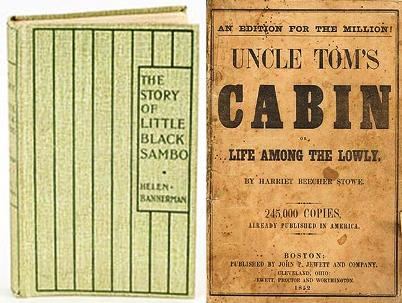
Coloured people don’t like Little Black Sambo. Burn it. White people don’t feel good about Uncle Tom’s Cabin. Burn it. Someone’s written a book on tobacco and cancer of the lungs? The cigarette people are weeping? Bum the book. Serenity, Montag. Peace, Montag. Take your fight outside. Better yet, into the incinerator. Funerals are unhappy and pagan? Eliminate them, too. Five minutes after a person is dead he’s on his way to the Big Flue, the Incinerators serviced by helicopters all over the country. Ten minutes after death a man’s a speck of black dust. Let’s not quibble over individuals with memoriams. Forget them. Burn them all, burn everything. Fire is bright and fire is clean . . .
Original Little Black Sambo: $14,850.00 Original Uncle Tom’s Cabin: $99.00 price source: biblio.com
Heredity and environment are funny things. You can’t rid yourselves of all the odd ducks in just a few years. The home environment can undo a lot you try to do at school. That’s why we’ve lowered the kindergarten age year after year until now we’re almost snatching them from the cradle.
We had some false alarms . . . [but] [n]ever found a book. Mixed record; anti-social . . . [people are] a time bomb. The family had been feeding [the] subconscious, I’m sure . . . [People don’t] want to know how a thing was done, but why. That can be embarrassing. You ask why to a lot of things and you wind up very unhappy indeed, if you keep at it. [People are] better off dead . . .
CONFORM CONSUME OBEY
Luckily, queer ones like her don’t happen, often. We know how to nip most of them in the bud, early. You can’t build a house without nails and wood. If you don’t want a house built, hide the nails and wood. If you don’t want a man unhappy politically, don’t give him two sides to a question to worry him; give him one. Better yet, give him none. Let him forget there is such a thing as war. If the Government is inefficient, top-heavy, and tax-mad, better it be all those than that people worry over it . . .
Give the people contests they win by remembering the words to more popular songs or the names of state capitals or how much corn Iowa grew last year. Cram them full of non-combustible data, chock them so damned full of ‘facts’ they feel stuffed, but absolutely `brilliant’ with information. Then they’ll feel they’re thinking, they’ll get a sense of motion without moving. And they’ll be happy, because facts of that sort don’t change.
Information age of hysteria. It’s going out to idiot America.
Don’t give them any slippery stuff like philosophy or sociology to tie things up with. That way lies melancholy. Any man who can take a TV wall apart and put it back together again, and most men can nowadays, is happier than any man who tries to slide-rule, measure, and equate the universe, which just won’t be measured or equated without making man feel bestial and lonely. I know, I’ve tried it; to hell with it. So bring on your clubs and parties, your acrobats and magicians, your dare-devils, jet cars, motor-cycle helicopters, your sex and heroin, more of everything to do with automatic reflex. If the drama is bad, if the film says nothing, if the play is hollow, sting me with the theremin, loudly. I’ll think I’m responding to the play, when it’s only a tactile reaction to vibration. But I don’t care. I just like solid entertainment.
* I have removed dialogue indicators, Montag’s remarks, and changed/added words when necessary.
I don’t know you personally, and for that I am extremely grateful. Obviously I’ve heard of you; after all, what historian worth their salt hasn’t devoted some time to studying the great plagues and epidemics of the past? I must confess, however, I had a dismal regard for your power to infiltrate, terrify, and decimate entire cities. I had considered you a distant cousin to y pesits; I now realize that you are brothers in arms.
What changed my mind, you ask? Author/historian Steven Johnson’s work The Ghost Map. Now, I must confess that Mr. Johnson’s writing leaves something to be desired. His redundancy reminds me of students padding a term paper. His asides and personal vendettas add little to the narrative. He berates historical ideas of science and medicine for not knowing better, only briefly pausing to consider they had no reason to know better. They were ignorant, not stupid. And yet, Mr. Johnson, while making the same claim, treats our forebears as stupid.
Nevertheless, once the chaff is removed the kernels of knowledge remain. In reading of the London plagues that led to understanding you, I have developed a new respect. No longer will I confuse you with dysentery. To call you dysentery would be akin to calling anaphylaxis “an allergy.” I had long known alcohol was safer than water for much of human civilization, now I know you were the reason why. You struck with apparent impunity and malignancy, infiltrating and poisoning seemingly healthy water. The master of disguise, many blamed bad air or meteorological catastrophes for your appearance. Despite our best efforts, you continued to plague our great cities well into the nineteenth century.
And still you remain. Africa and the East and South America – where sanitation and hygiene are poor or nonexistent – know you all too well. We see our politicians and entertainers “bring awareness” to AIDS and cancer and illiteracy and women’s rights. Where are the spokesmen for cholera? It baffles me that something so basic as “don’t drink where you crap” needs to be taught; and yet it must. Where is the outrage? Where are the PSAs? Where are the contribution campaigns?
I hope that one day the only way anyone will hear of you is in a history book.
Yes, even this one.
This post is being published as part of Writing 101. Challenge 14: Pick up the nearest book and flip to page 29. What jumps out at you? Start there, and write in the form of a letter.
The Germans have a wonderfully exact word (is there any other kind in German?) called kummerspeck. Idiomatically, it refers to weight gained from emotional overeating. Literally, it means “grief bacon.” In the part of Pennsylvania where I grew up, we had a similar term. We called it “sympathy ham.”
I have no idea where the term came from, but I don’t think it’s related to the Germans (unfortunately). We’re a bit too far removed from the Pennsylvania Dutch/Deutsch for a cultural impact. Nevertheless, I suppose it’s possible.
Sympathy ham only came around when there’d been a death in the family. Where others might bring casseroles or stews or things like that, the people of Wayne County brought ham. Lots and lots and lots of ham. Baked ham, smoked ham, ham sandwiches, ham soup, and yes, ham casseroles. Glorious, salty ham.
Wait a minute! This is supposed to be about foods for celebration, and here I am talking about death. To you, a funeral is not a cause for celebration (unless you’re one of those kinds of people), but for me, a funeral is a celebration of life. We sit and talk about our loved ones: the things we remember fondly, their quirks and idiosyncrasies, family stories they had shared, and sometimes wondering about things we’d found out just a bit too late. All the time we munch on ham: ham with mustard, ham with mayonnaise, cold ham, hot ham, ham in all its varieties. Think of it like a modern wake, but without the alcohol. Great. Now I’m stereotyping. Sorry.
When my grandmother died, the ham seemed infinite. Our car seemed packed with it after church; our doorbell would ring, and there was more ham; I think someone even brought ham to the viewing. Perhaps I’m remembering that wrong. Whatever. Our refrigerators and freezers were soon maxed out with majestic ham. I think we ate ham for a month or more.
I know that science and medicine claim that salt may help stave off depression and that depression is likely to kick in after the death of a loved one, but I don’t sit down and eat ham thinking “man, I’m depressed. I need more salt.” I eat it because of the memories. Because when I eat ham I’m back in Pennsylvania sitting with family talking about days done by and things I never knew, things I half remember, and things I know all too well. Ham is the catalyst for my family’s history. Without it, I would be lost.
A Note from the Author
Writing 101 has challenged me. Today, we’re supposed to write in our own voice, as if we were talking to a friend over coffee. So that’s what I did. I made myself some coffee and had a friend ask me “So, what’s sympathy ham?” and typed my response as if I were verbally answering them. It might be disjointed, but that’s how most of my conversations go: I start out technical, then realize I’m being too technical, and start to dial it back. Thanks for your continued patience.
This post is being published as part of Writing 101. Challenge 10: Tell about your favorite meal — the one that was always a treat, that meant “celebration,” or that comforted you and has deep roots in your memory. Tell the story in your own distinct voice.
Why is it always like this? I leave the house early and end up being late. All I want is my coffee – two cream two sugar – and blueberry donut. The guy ahead of me must be an utter moron. Seriously, how long does it take to place an order? Who goes to a donut shop not knowing what they want. Seriously, it’s coffee and donuts. That’s it. Nothing complicated. Just hurry it up already, not all of us have all day.
I’m running on empty here. Night shift at the hospital ER takes its toll. I just need something to make it home. Black coffee should do it. Don’t forget something for the wife; she’ll be leaving for work soon. I wish we could spend more time together. At least we have some time together. I know some families won’t have that any more. Not after last night. Now which one does she like again? The regular with chocolate glaze or the chocolate with regular glaze? I know she’ll eat whatever, but I’d like it to be right. She sacrifices so much. Where is my wallet? Don’t tell me I left it in my locker again.
It’s 7:15. I’ve been at work since 4:00. Three hours, fifteen minutes. Fifteen minutes to break. Then four and a half hours to end of shift. Don’t forget to pay the electric on the way home. Sleep til 4 and then evening shift at the diner. Home by 10:00. Is this my weekend for Jared or not? One more day to the weekend. I actually have all of Sunday off. I haven’t been to church in ages. I should go. If I’m not sleeping. Oh look: another customer. Whatever pays the bills.
This post is being published as part of Writing 101. Challenge 9: Write a scene from three different points of view.
This is my first work of fiction of any length. It was inspired by the following prompt from Writing 101:
You stumble upon a random letter on the path. You read it. It affects you deeply, and you wish it could be returned to the person to which it’s addressed. Write a story about this encounter.
Today’s twist: Approach this post in as few words as possible.
Thoughts, comments, and especially constructive criticism are greatly appreciated.

 First best friend
 Calling cards


 I loved to read. My first book report – given in the second grade – was Moby Dick (unabridged, of course). In the fourth grade I explained the symbolism of Snowball in Animal Farm. I read political theory and philosophy while my classmates struggled with Little House on the Prairie. My parents told me that during one PTA, a teacher said I shouldn’t act so smart. Apparently I made the rest of the class feel stupid by using the word “doubloon” in a sentence. We were discussing Treasure Island.



 As I sat writing, editing, and deleting, I thought back to the first blog I ever wrote: a short-lived current events Blogger site whose only semi-redeeming feature was the title: 451 Revisited. I’d intended to use it as a place of information and discussion, but I only posted four articles in six months. Thinking on that failed abomination, I reflected on the title. Hadn’t I written a piece about





 Heredity and environment are funny things. You can’t rid yourselves of all the odd ducks in just a few years. The home environment can undo a lot you try to do at school. That’s why we’ve lowered the kindergarten age year after year until now we’re almost snatching them from the cradle.

 making man feel bestial and lonely. I know, I’ve tried it; to hell with it. So bring on your clubs and parties, your acrobats and magicians, your dare-devils, jet cars, motor-cycle helicopters, your sex and heroin, more of everything to do with automatic reflex. If the drama is bad, if the film says nothing, if the play is hollow, sting me with the theremin, loudly. I’ll think I’m responding to the play, when it’s only a tactile reaction to vibration. But I don’t care. I just like solid entertainment.







 Running In My Head