The Ballad of Magellan

In working on an article about how cartoons teach history, I came across one of the first historically-themed songs I remember learning. For your enjoyment, I present “The Ballad of Magellan” as performed by the Warner Brothers (and the Warner Sister!).

The Ballad of Magellan

Lyrics by John P. McCann and Paul Rugg; harmonies arranged by Julie Bernstein.

For best results, sing to the tune of “Git Along, Little Doggies.”

There once was a man, his name was Magellan.
A Portuguese skipper, the girls found him cute.
He sailed with five ships to find the East Indies
Then come back to Spain with a bounty of loot.
Whoopi-ti-yi-yo, oh, happy Magellan!
Starting your journey with hardly a care!
Whoopi-ti-yi-yo, strong, brave Magellan,
You’ll find the East Indies, you just don’t know where!
They crossed the Atlantic and spotted a country.
Magellan said…
It’s the East Indies at last!
But then someone shouted…
Hey, that’s Argentina!
Magellan got cranky and chopped down the mast.
Whoopi-ti-yi-yo, settle down, Magellan.
Put down that ax! There’s no time to despair.
Whoopi-ti-yi-yo, keep trying, Magellan,
You’ll find the East Indies, you just don’t know where!
A great storm arose in the mighty Pacific.
The five little ships were diminished to three.
At last, land was sighted. Magellan was happy.
But then someone shouted…
Hey, that’s Chile!
Whoopi-ti-yi-yo, cheer up, Magellan.
Check out your map and don’t tear out your hair!
Whoopi-ti-yi-yo, keep trying, Magellan,
You’ll find the East Indies, you just don’t know where!
It took them five months, but they crossed the Pacific.
They spotted a land that was dotted with palms.
Magellan proclaimed…
Yes! That’s the East Indies!
But then someone shouted…
Hey, I think that’s Guam!
Ai yi yi yi, oops, Magellan!
Your fun little journey’s become a nightmare!
Whoopi-ti-yi-yo, keep trying, Magellan,
You’ll find the East Indies, you just don’t know where!
They sailed due west to the Philippine Islands.
Magellan was pleased as the natives drew near.
But then someone shouted…
I think they’re attacking!
Magellan said…
What?
And got hit by a spear.
Whoopi-ti-yi-yo, farewell, Magellan!
You almost made it! It’s really not fair!
Whoopi-ti-yi-yo, oh, ghost of Magellan,
The East Indies Islands were right over there!
Boats Against the Current: The Great Gatsby

Banned_Great_Gatsby

Can’t repeat the past?…Why of course you can!

Warning: This post may contain politically incorrect language and expletives. They exist for the purpose of example and edification; they are not intended to disparage or defame any particular person, race, creed, color, or religion. If you feel you may be offended by such language, stop reading now. You have been warned.

SPOILERS AHEAD

From the Back Cover

Here is a novel, glamorous, ironical, compassionate – a marvelous fusion into unity of the curious incongruities of the life of the period – which reveals a hero like no other – one who could live at no other time and in no other place. But he will live as a character, we surmise, as long as the memory of any reader lasts.

It is the story of this Jay Gatsby who came so mysteriously to West Egg, of his sumptuous entertainments, and of his love for Daisy Buchanan – a story that ranges from pure lyrical beauty to sheer brutal realism, and is infused with a sense of the strangeness of human circumstance in a heedless universe.

It is a magical, living book, blended of irony, romance, and mysticism.

~ 1953 Scribner Edition

Why the Book was Banned

1. Language

2. Sexual references

3. Hedonism

4. Racism

Synopsis

Meet our main cast: Nick (the narrator), Daisy and Tom Buchanan (Nick’s cousins), Jordan Baker (Nick’s love interest), and Jay Gatsby (a mysterious, eccentric individual)

Tom introduces Nick to Myrtle, his mistress; Nick is unimpressed.

Gatsby throws open-invitation parties; Nick meets both Gatsby and Jordan at one of these affairs. Gatsby recounts some history: he had been in love with Daisy before the war (WWI) and lost her to Tom. Now, he wants her back and desires Nick’s help.

The plan works, an affair ensues. Everything is fine until Tom meets Gatsby, becomes suspicious, and starts researching his background. (Hint: Tom knows everything).

Eventually, the truth comes out and everyone parts ways in foul moods. Daisy accidentally kills Myrtle, Tom tells her husband, George, that Gatsby is to blame. George commits first-degree murder and then suicide. Daisy and Tom leave; Nick ends it with Jordan and arranges Gatsby’s funeral.

The book ends with an invective against nostalgia.

Here, have an infographic:

the-great-gatsby-character-map_514d045268c55
Photo Source: http://visual.ly/great-gatsby-character-map
I’d really like this as a poster…

My Thoughts

Fitzgerald packed a variety of themes into such a short book, i find it difficult to choose just a few to write about. Therefore, I picked three; two were at random, one was not. No prizes for guessing which one I purposefully chose.

First, in the Jazz Age, wealth and class went hand-in-hand. Gatsby tries to change his class by changing his wealth; people of a different era might call him nouveau riche. However, Gatsby never fully assimilates into the class he desires. Despite his wealth and lavish expenditures, Gatsby never becomes “one of them.” This begs the question: can America be a classless society? Even today, media pundits talk of “class division.” If we are to believe Fitzgerald, not only is a classless America a myth, but so is the American Dream. Gatsby’s life evidences that no matter what wealth one obtains, others will still judge him by his past. Taken to the extreme, any attempt to change class results in tragedy. Lotto winners, anyone?

Second, “only fools fall in love,” and Gatsby is the greatest fool of all. Other characters possess tolerance, infatuation, perhaps even affection, but only Gatsby is actually in love – and look how it ended for him. In this, Gatsby resembles Romeo and Juliet much more than The Sun Also Rises.

Third, history defines every character in Gatsby. Some, like Gatsby, try to hide or rewrite it. Others, like the Buchanans, base their way of life on it. Despite living in such a progressive era, everyone actually lives in the past (some despite their best intentions). It’s one thing to remember the past; it’s another to live in the past. No good comes from living in the past. Remembering the past helps us learn, grow, progress. Living in the past stunts growth and slows progress. (Trust me: I teach history for a living). Ultimately, living in the past results in insurmountable frustration. As Nick says in the last line of Gatsby:

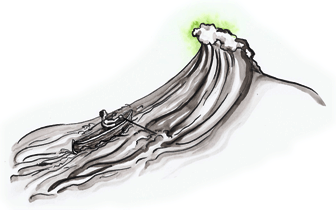
And so we beat on, boats against the current, borne back ceaselessly into the past.

boats_against_the_current

Sisyphus Gatsby by m.e.g
Photo Credit: http://www.themediares.com

Memorial Day 2013

National Cemetery New Bern, North Carolina
National Cemetery
New Bern, North Carolina

Today is Memorial Day, and, although they are similar, Memorial Day is not Veterans Day.

On Memorial Day, we remember those who have died in the service of their country, either in battle or as a result of battle.

On Veterans Day, we honor former military personnel, wether they served in war or in peace. In general, Veterans Day is supposed to recognize living veterans for their courage and sacrifice; it is on this day we assure our veterans that they are not forgotten.

Memorial Day: A Brief History

Memorial Day was first observed on May 28, 1868. At that time it was called Decoration Day, and was set aside to specifically honor those who served on both sides of the American Civil War. This tradition continued until World War I, when it expanded to include all those killed in American wars.

Veterans Day: A Brief History

Veterans Day, originally called Armistice Day, was first observed in 1919. World War I had ended at 11:00 AM on November 11,1918. One year later, President Woodrow Wilson declared November 11 the first Armistice Day:

To us in America, the reflections of Armistice Day will be filled with solemn pride in the heroism of those who died in the country’s service and with gratitude for the victory, both because of the thing from which it has freed us and because of the opportunity it has given America to show her sympathy with peace and justice in the councils of the nations…

Twenty years later, an act of Congress made November 11 a federal holiday called Armistice Day. Just as Decoration Day was to honor Civil War veterans, Armistice Day was to honor World War I veterans. This tradition continued until 1954, when the word Armistice was changed to Veterans in order to include all American veterans.

So remember: Memorial Day honors the dead; Veterans Day honors the living. And never forget to thank a vet.

Brevity in Communication: Twitter vs the telegram

The more things change the more they stay the same.

Katherine's avatarThe Victorianachronists

While Twitter has become a wildly popular new means of communication, it has not been without its critics.  Questions like, “What can we say that is meaningful in 140 characters?” and “What are we losing by keeping our social interactions so brief?” have abounded since Twitter’s inception.  The value of brevity, however, is not a new concept.  In the late 19th and early 20th century, one of the most efficient ways to transmit important information rapidly over great distances was the telegram.

Telegram authors had an incentive to be brief – most telegram companies charged per word.  As a result, authors took some common shortcuts used in the Twitterverse such as dropping pronouns and articles and using abbreviations and code words to maximize information and minimize characters.  So forced brevity in communications isn’t really a new concept at all. In fact, telegrams were often used to convey life-changing news-births, deaths…

View original post 172 more words

The Nine Cs of Historical Thinking

Excellent ideas; some of which I will be incorporating into my lesson plans next year.

Tim Lacy's avatarThinking Through History

[Note: As of June 10, 2016, this post has been updated—once and for all—to 12 Cs. You can find the update at this link. – TL]


With apologies to Thomas Andrews and Flannery Burke, who first Many-Csintroduced me to their “Five Cs of Historical Thinking” through a January 2007 column in AHA’s Perspectives magazine, I have developed a modification of their mnemonic that may be useful to my colleagues in history. I think this may be particularly helpful for introducing the field to new students—to those first-year undergraduates who think about “social studies” rather than history. In addition to Andrews and Burke, I also want to acknowledge Sam Wineburg for his classic work on this subject, Historical Thinking and Other Unnatural Acts (2001).

Rather than just “Five Cs,” I think we should add four more and emphasize the ‘s’ such that the mnemonic becomes “The Nine Cs.” It’s…

View original post 737 more words

Website Powered by WordPress.com.

Up ↑