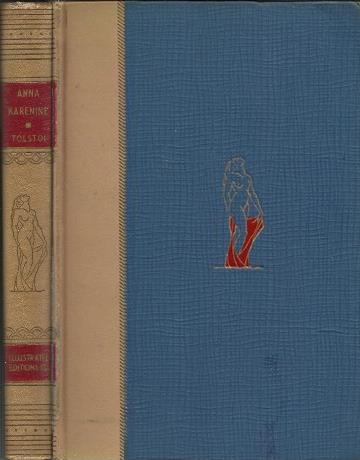
Like a child riding a carousel reaching for the coveted brass ring, the Wheel of Time has spun ’round to Teaser Tuesday. Continue reading “Teaser Tuesday: Anna Karenina”
Teaser Tuesday: Anna Karenina
rantings & ramblings
Like a child riding a carousel reaching for the coveted brass ring, the Wheel of Time has spun ’round to Teaser Tuesday. Continue reading “Teaser Tuesday: Anna Karenina”


We built our castles in the air;
high above all else, they towered in the sky.

Saïd and Chérif Kouachi force their way into the offices of satiricalweekly newspaper Charlie Hebdo, murdering in cold blood Stephane Charbonnier, Jean Cabut, Bernard Verlhac, Georges Wolinski, Bernard Maris, Philippe Honore, Michel Renaud, Elsa Cayat, Ahmed Merabet, Frédéric Boisseau, Franck Brinsolaro, & Mustapha Ourrad for no other reason than Charlie Hebdo’s publication of images of Muhammad.

photo courtesy ITVNews & itv.com
Yes, it is true these images were considered irreverent.
Irrelevant, as Islam prohibits all visual representation of the prophet.
As the world learned of the attacks, the world rallied around Paris.
Americans exclaimed “Je suis Charlie!,”
proclaimed their devotion to the freedom of speech,
and changed their Facebook profile photos . . .
. . . until something else came along.
The date and time are no accident, because I have not forgotten. For the past 365 days I and others like me have made a conscientious effort to protect and promote not just freedom of speech, but all First Amendment rights.
One need only look at the State of the First Amendment to realize we have failed – a full 19% of those surveyed say the First Amendment goes too far.
Let’s get more specific, shall we?
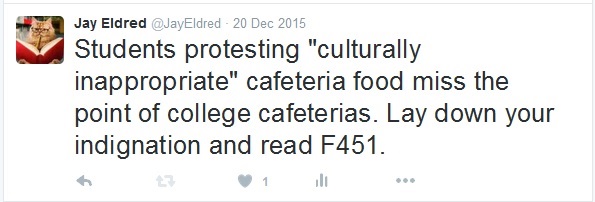
Unsurprisingly, colleges and university made headlines
Some students demanded “safe spaces” from ideas and opinions they find uncomfortable, while others needed “trigger warnings” so they could shut their ears from the possibility of bad memories.
Professors were criticized for thinking critically about those “needs”, as well as gender, Halloween costumes, and cafeteria food.
Speakers were invited – or uninvited – based on the approval of the mob.
I’m going to call Mizzou out by name, where demonstrators against racism and bigotry attempted to restrict freedom of the press by only allowing access to those reporters 100% sympathetic to their cause.
Breaking News
Students are in school to learn how to deal with the real world.
The time for tantrums ended long ago.
From brick-and-mortar to server-and-cloud, we turn to the internet.
While proposals to proposals to the Internet to groups like ISIS might find widespread support, such discussions inevitably turn to banning all forms of “hate speech”, ambiguous a term if ever there was one.
Restricting access to beheading videos is one thing, but Google’s Eric Schmidt has more ambitious ideas.
[Schmidt voiced] the idea of an algorithm that would relentlessly prowl the corridors of the Web searching and eliminating hateful speech — an Orwellian concept of censorship-by-technology that went even further than “1984” author George Orwell imagined. *
And, lest we forget the Presidential candidates:
Donald Trump. Need I say more?
However, other Republican and Democratic candidates have voiced support for a so-called “Silicon Valley Solution”.
And then there’s Bernie Sanders, the Vermont socialist-cum-democrat who’s been most vociferous calling for an increased American democracy. Senator, America is a Democratic Republic, and democracy ends in mob rule. Based on your own logic, should you be elected President Facebook will be the new House, Twitter the new Senate, and BuzzFeed the Supreme Court. In which case, God help us all.
Nevertheless, better the devil you know than the devil you don’t.
American society in general fared no better.
Supporters of the Confederate Flag found themselves more ostracized than usual after Dylan Roof murdered nine people in Charleston, SC.
Colleges, cities, and even the state of South Carolina removed the flag (or versions thereof) from certain premises, and several online retailers took the perfectly acceptable action of discontinuing products featuring the flag.
However others would have the Federal Government restrict the right of American citizens to display the flag in any context.
If surveys are to be believed, 35% of Americans support a Federal statute banning the Confederate flag on license plates. No word on how many support a similar ban on Planned Parenthood tags.
At least President Obama didn’t issue an executive order declaring the flag illegal.
Other cities – like New Orleans – have begun to sanitize history by removing Confederate statues and memorials.
Since we’re on the topic of unpleasant history, here’s Rod Serling:
All the Dachaus must remain standing. The Dachaus, the Belsens, the Buchenwalds, the Auschwitzes – all of them. They must remain standing because they are a monument to a moment in time when some men decided to turn the Earth into a graveyard. Into it they shoveled all of their reason, their logic, their knowledge, but worst of all, their conscience. And the moment we forget this, the moment we cease to be haunted by its remembrance, then we become the gravediggers. Something to dwell on and to remember, not only in the Twilight Zone but wherever men walk God’s Earth.
Deaths-Head Revisited [emphasis mine]
Oh, and since I’ve mentioned God, let’s talk religion . . .
Opponents of same-sex marriage are *officially* on the naughty list for daring to take a stand against society-determined morality. I mean, if it’s the choice between religion and government, you should always go with the government, right? right?
Remember: it’s possible to dislike an action while still loving the person performing the action. Stop conflating tolerance with acceptance.
Anti-Abortion advocates found themselves censored when a temporary restraining order was issued against the Center for Medical Progress, the group responsible for leaking videotapes alleged to show PP profiting from the sale of aborted fetuses.
Note: While the linked article calls the videotapes “heavily edited to cast Planned Parenthood in an unflattering light”, the full videos were also available, and they didn’t improve PP’s image at all.
And, since many suffer from the delusion that religion and science are incompatible, let’s not forget there are still advocates for the arrest of climate-change deniers based on the awful decision of the Italian courts to convict six seismologists of manslaughter for failing to predict an earthquake.
Oh wait, it was really about the defendants giving “‘inexact, incomplete and contradictory information’ about whether small tremors prior to the April 6 quake should have constituted grounds for a warning”?
How is that different from predicting an earthquake?
All right, I know these articles are from 2014, but the trend is toward charging climate-change deniers with crimes against humanity.
Speaking of intellectual freedom, here’s a friendly reminder that governments in America still try to ban, restrict, and censor books.
Remember:
I disapprove of what you say, but I will defend to the death your right to say it. – Evelyn Beatrice Hall [attr. to Voltaire]
The real danger to the First Amendment are those willing to suppress First Amendment freedoms in the name of public safety, namely Millennials.
There’s just one problem with that – the first amendment proffers no right to feel safe, no right to not be offended, and certainly no provision to punish people who make unpopular speech . . . In plain language, the first amendment does not give you the right not to be offended or not to be mocked, and the fact that these people are using the first amendment to, in essence, advocate censorship, is one of those perfect ironies that seldom comes along in this life.
– Daniel P. Malito
It’s obvious there’s more work to be done.
The right to express one’s political, religious, and even literary ideas are under constant attack, and we must remain ever vigilant in our defense of those rights.
Others may have forgotten, but I will not.
Je suis CharlieJe reste Charlie
[I remain Charlie]

Have a suggestion for a poem, photograph, or future post?
Drop a note in the prompt box!
Don’t forget to follow me on:
Facebook – where I share news stories, articles from other blogs, and various and sundry miscellany that happens to catch my eye. It’s stuff you won’t see here! Well, mostly.
Instagram – where I show you my Life in Motion and share quotes and such. The widget only shows my last three photographs – don’t you want to see them all?
Twitter – where you can see my thoughts in 140 characters or less. Also, funny retweets.

A Conversation between Stanley & Gabriel
S: War? Who are we at war with?
G: Anyone who impinges on America’s freedom. Terrorist states, Stanley. Someone must bring their war to them. They bomb a church, we bomb ten. They hijack a plane, we take out an airport. They execute American tourists, we tactically nuke an entire city. Our job is to make terrorism so horrific that it becomes unthinkable to attack Americans.
S: How can you justify all this?
G: You’re not looking at the big picture, Stan. Here’s a scenario: You have the power to cure all the world’s diseases, but the price for this is that you must kill a single innocent child; could you kill that child, Stanley?
S: No.
G: You disappoint me; it’s the greatest good.
S: Well how about ten innocents?
G: Now you’re getting it, how about a hundred – how about a thousand, not to save the world, but to preserve our way of life?
S: No man has the right to make that decision; you’re no different from any other terrorist.
G: No, you’re wrong, Stanley. Thousands die every day for no reason at all, where’s your bleeding heart for them? You give your twenty dollars to Greenpeace every year thinking you’re changing the world? What countries will harbor terrorists when they realize the consequences of what I’ll do?
We know what happened.
We saw the reactions.
We live with the results.
Still, we ask:
How far are we willing to go?

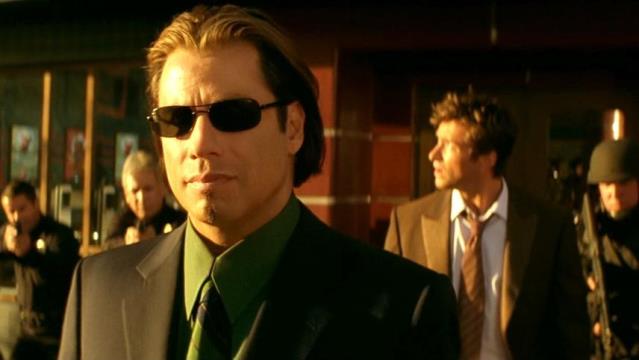
I don’t remember when I first saw Swordfish; I think it was my senior year of high school, which would put it sometime around 2004. I think the movie was taboo in the conservative circles I moved it, not just for the rating but also for its kinds-sorta anti-government message.
Recently, I found it again on Netflix; remembering it as mainly a tecno-drama in which John Travolta shoots massive weaponry and gets away with his scheme to divert $6 billion in government slush money to wage War on Terror [before such a thing existed], I sat down and watched it again.
The conversation stopped me cold. Swordfish came out mere weeks before 9/11. In the aftermath, did we go too far or not far enough? It depends. I wonder what the world would be like if Gore had won Indecision 2000 and not Bush; I honestly think Bush was the right President in 2001, but have second-guessed his re-election in 2004. That may have been a mistake. Dangerous things happen when historians start playing “What-If?”.
Perhaps it’s because Ender’s Game is still fresh in mind, but when I have a free moment, I find myself asking:
How far would I go?
How far should I go?
Thing is, I’m not convinced there’s a right answer.
What do you think?

Have a suggestion for a poem, photograph, or future post?
Drop a note in the prompt box!
Don’t forget to follow me on:
Facebook – where I share news stories, articles from other blogs, and various and sundry miscellany that happens to catch my eye. It’s stuff you won’t see here! Well, mostly.
Instagram – where I show you my Life in Motion and share quotes and such. The widget only shows my last three photographs – don’t you want to see them all?
Twitter – where you can see my thoughts in 140 characters or less. Also, funny retweets.

Last Monday I complained about the awful songs that play on seemingly infinite repeat during the Christmas season.
Then, on Christmas Day, I woke up to discover two bands had attempted to rectify that situation.
Radiohead released their intended Spectre theme. Having listened to both Sam Smith’s official theme and Radiohead’s offering, I am of the opinion Radiohead nailed it.
The one person to vote in my Twitter poll agreed with me.
If you haven’t listened to Spectre yet, here it is:
Move over, Mariah Carey; Green Day gave us a present that makes “All I Want for Christmas is You” sound like scales played on a toy piano. Feast your ears on this:
At they very least I think we can all agree it’s much better than anything Michael Bublé has done. Seriously, this should have dominated the airwaves this Christmas season. Oh well, there’s always next year.
Happy Christmas, Music Lovers!
Have a suggestion for a poem, photograph, or future post?
Drop a note in the prompt box!
Don’t forget to follow me on:
Facebook – where I share news stories, articles from other blogs, and various and sundry miscellany that happens to catch my eye. It’s stuff you won’t see here! Well, mostly.
Instagram – where I show you my Life in Motion and share quotes and such. The widget only shows my last three photographs – don’t you want to see them all?
Twitter – where you can see my thoughts in 140 characters or less. Also, funny retweets.
Saturdays here on Running in My Head are what I call “Uncensored Saturdays” in that I write what I really feel about a particular subject with no regard for tact or certain types of political correctness.
You may not like my point of view.
You may find what I have to say offensive.
And that’s fine.
However, I hope they won’t make you feel less of me or cause you to stop reading my blog on the “creative” days.
See something you don’t like, disagree with, or think I’ve got totally wrong?
Great! Leave a comment; let’s start a discussion.
I consider myself both educated and open-minded. I know why I believe what I do, yet I’m not so stuck-in-the-mud to consider other opinions or the fact I might be wrong.
Ten years ago, I was an authoritarian-leaning Republican; now I’m a centrist independent leaning mainly conservative or libertarian depending on the issue.
That change didn’t come about on its own, it came about because I was willing to listen to others with opposing views.
I’d like to think I still have that open mind.
I only ask you keep the conversation civil.
With that in mind, here we go:
I enjoy watching House of Cards on Netflix.
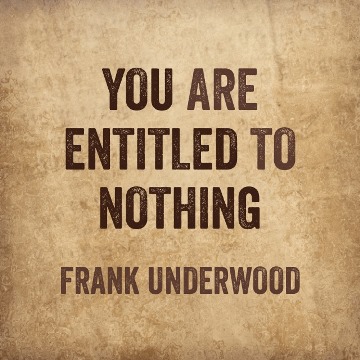
Now, I could never vote for Frank Underwood; however, in Season Three he gave a speech which resonated with me:
In the full clip, Underwood uses this as a springboard to launch a program even more ambitious than the New Deal – the very system of programs that created the problems he’s trying to fix.
Nevertheless, I agree with him on this point:
 Like Henry David Thoreau (and possibly Thomas Jefferson), I am of the opinion that
the government is best which governs least
Now, I understand that government must tax in order to function. However, not all governmental functions are necessary, neither are they all the government’s responsibility.
According to the Preamble of the Constitution of the United States, the purpose of American government is to
1. form a more perfect Union

2. establish Justice

3. insure domestic Tranquility

4. provide for the common defence [sic]

5. promote the general Welfare

6. secure the Blessings of Liberty
   to ourselves and our Posterity
I want to focus on No. 5, but feel I should briefly address the other 6; perhaps they’ll appear in future Uncensored Saturdays.
For better or worse, the form of the “more perfect Union” was decided on the battlefields of the Civil War. Personally, I feel our current system invested the central government with far too much power.
As a people, we’re still working on what, exactly, Justice means and how to adequately implement it. This means we’re also working on insuring Tranquility.
I think we’ve done a fair job on providing for the common defense; so long as the Second Amendment remains intact and SCOTUS decision in District of Columbia v Heller is strengthened and applied nationally.
With every attack on personal liberty in the name of diversity, safety, security, or some other intangible notion, we chip away at those Blessings of Liberty. Soon, we will have no Blessings to pass down.
Yes. I can see these will become fodder for future Uncensored Saturdays.
So many ideas!
Now, welfare is a tricky word whose meaning has changed over the years.
I cringe whenever I hear it.
 Webster’s 1828 Dictionary of the English Language (the closest online dictionary to 1789 I could find) defines welfare as
Exemption from any unusual evil or calamity; the enjoyment of peace and prosperity, or the ordinary blessings of society and civil government; applied to states.
Now, I understand that even this definition can be interpreted many ways.
Nevertheless, I see in this definition no basis for such government programs as
Medicare / Medicaid
Food Stamps / SNAP
WIC / CHIP
Social Security
AHA / Planned Parenthood
Before you jump all over me as a woman-hating Republican racist bigot, let’s clear a few things up:
1. Disagreeing with government programs does not equate with hating the people those programs benefit. It means I disagree with the nature of government. Go read some political theory then come back when you can carry on an intelligent conversation.
2. Disagreeing with certain government programs does not mean I think people shouldn’t have access to certain services. It means I think the government has no right or responsibility to either fund or run said programs. Most likely, I feel those services should be in the hands of the private sector.
3. Whoever said I was a Republican? I haven’t identified as a Republican since at least 2004. I’m a registered Independent who leans conservative/libertarian depending on the issue. Like any well-informed citizen of the United States, I refuse to believe that any political party hold all the answers to all the problems. I have never voted a straight party ticket, and I’ve voted for candidates from a wide variety of political parties.
Now let’s look at the programs I listed and I’ll tell you why, exactly, I am against them.
First, I am against the Affordable Healthcare Act for two reasons:
1. It only passed SCOTUS review in that it was interpreted as a kind of tax. As such, it is a tax on life. Too many people likened it to a driver’s license or car insurance, but this is a false equivocation. Only those who drive need a driver’s license or car insurance; the AHA applies to anyone living – it is essentially a tax on life.
2. As such, the AHA violates Article 1, Section 9 of the Constitution, which prohibits such taxes.
Along the same lines, I view the Sixteenth Amendment (Income Tax) as directly opposed to the original intent of the Constitution and blame the increasing liberal SCOTUS of the early 1900s for allowing its continuation.
The Seventeenth Amendment is the worst offender; the Senate was never supposed to represent the People, but the States. With direct election of senators, we may as well abolish the Senate since we already have a body representing the people: the House of Representatives.
3. The government should have no say in how I spend my money or what I spend my money on.
4. The AHA is not affordable; I find myself making too much for any real form of government assistance yet making to little to afford any insurance that would actually benefit my needs. Essentially, I’m paying for insurance which I’ll never use or meet the deductible – beyond a major catastrophe – just to avoid paying a tax penalty. The AHA has placed me in a worse financial situation that I was in before its passing.
Second, I find it well within government’s regulatory power to regulate the insurance and healthcare industries.
Simply forcing the American people onto insurance rolls has not lowered insurance prices, neither has it decreased hospital costs. If it were to regulate the healthcare industry, particularly the monstrosity known as the charge sheet, healthcare costs would come down. Since insurance companies traditionally pay a percentage of hospital costs based on the plan one has purchased, their overall costs would decrease and they could charge less for premiums. I’m not sure that they would without government intervention, but it would be easier for them to turn a profit.
TL;DR: Let the government regulate the business, not the people.
Third, were the government to take such steps, programs such as Medicare, Medicaid Food Stamps, SNAP, WIC, and CHIP could be reduced or outright eliminated.
Again, I’m not against access to affordable healthcare.
I am against government sticking its ever-growing nose and fingers in places where they don’t belong.
Fourth, I am against Social Security in that – again – the government has no business in taking taxes out of my paycheck to support someone else. The program is not a bank; politicians have made it clear they’ve used the money invested in the program, lost it, and it now relies on younger payers paying into the system to keep it going. How is this any different than a Ponzi Scheme? We’d have more economic security investing that money in a bank guaranteed by the FDIC. If Social Security were a bank, it’d have collapsed long ago.
Finally, I’ve already made it clear I’m against Planned Parenthood because I am against abortion. However, even those who support abortion ought to be outraged over its sale of human parts. Isn’t it a bit hypocritical to consider a fetus a “thing” before abortion yet classify a fetus as “human” after abortion? Isn’t killing a human being murder? The hoops they jump through for moral justification puts contortionists to shame.
Just because it’s legal doesn’t make it right.
Liberals use this arguments to clam certain moral superiorities and to justify attacks on certain conservative values.
When conservatives use the same argument, they are routinely labelled regressive moralistic bigots.
Furthermore, it’s been proven the so-called “services” (apart from abortion) they claim to provide are either (a) nonexistent at most Planned Parenthood facilities or (b) performed better and more often at other healthcare facilities. Again, why support a failing business?
As my speech teacher once said:
Stand Up. Speak Up. Shut Up.
Since I’ve run out of steam and have nothing more to say, I’ll turn it over to you in the comments.
Have a suggestion for a poem, photograph, or future post?
Drop a note in the prompt box!
Don’t forget to follow me on:
Facebook – where I share news stories, articles from other blogs, and various and sundry miscellany that happens to catch my eye. It’s stuff you won’t see here! Well, mostly.
Instagram – where I show you my Life in Motion and share quotes and such. The widget only shows my last three photographs – don’t you want to see them all?
Twitter – where you can see my thoughts in 140 characters or less. Also, funny retweets.


