Special thanks goes to Liesel of Skill Up Skillet for suggesting today’s topic!
          The Gentle Subjugation of Humanity


Waiting for centuries, biding time.

Staging a bloodless, velvet revolution.

Infiltrating the very fabric of society, all fell victim:

    Princes and Potentates

    Priests and Popes

    Politicians and People


Like cannibals of old, we gained power by consumption.

  Power, but not victory.


Now, we are enslaved:

  Economies of nations rise and fall.

  Temples call for universal worship.

  Factions arise.

  Blood spills.

  We cannot function.


                Coffee Reigns Supreme
Have a suggestion for a poem, photograph, or future post?
Facebook – where I share news stories, articles from other blogs, and various and sundry miscellany that happens to catch my eye. It’s stuff you won’t see here! Well, mostly.
Instagram – where I show you my Life in Motion and share quotes and such. The widget only shows my last three photographs – don’t you want to see them all?
Twitter – where you can see my thoughts in 140 characters or less. Also, funny retweets.
I’ve really enjoyed the last two weeks in Writing 201: Poetry. I learned quite a few new techniques, but above all I gained the confidence to write more poetry. I also learned that I write better when given a topic and some restraints – maybe it’s time to start paying attention to the daily prompts? – and others liked it too; that is, as long as the statistics don’t lie. To those of you who boosted to stats, never fear – I hope to visit your blogs and repay the favor (it just might take me a few days . . . better make that weeks).
If you’ve missed my previous poems, I encourage you to go back and read them – some are better than others (obviously) but I’ve gotten such positive feedback that I’m sure you’ll find something to tickle your fancy.
At this point all I’m doing is attempting to delay the inevitable: the final post of my first poetry class.
So, here you go:
         Sonnet to the Future

The future stretches out before us like
the open road or wide, rolling sea –
beckoning with siren’s call to come
and hazard all in one great game of chance.
It rolls over us, breaking the dike
we have built to hold it back. L’esprit
de l’escalier is not for us, succumbing
not to sticks or stones or lances.

We beat on as boats against the current
born back ceaselessly into the past*
and forced to confront our innermost fears.
Things that were and things that were not
challenge our resolve in standing fast.
Here’s to the future: the future is here.
* In case you didn’t know, this is nearly the final line from F. Scott Fitzgerald’s The Great Gastby (I changed a word or two). Arguably one of the greatest lines in one of the greatest works in American literature, it also happens to be one of my favorite quotes from literature.
I can’t be the only one who has trouble getting into drawers.
No, not those drawers; get your mind out of the gutter!
I mean the junk drawers, the catch-all drawers, the drawers that are oh-so-handy for storing the miscellany and bric-a-brac that accumulates on our desks and nightstands and coffee tables.
Eventually these drawers have more in common with a goblin hoard than anything else and are almost impossible to open without violence or high-energy explosives. Perhaps both.
This is their story:
                 An Ode to Drawers
                        or
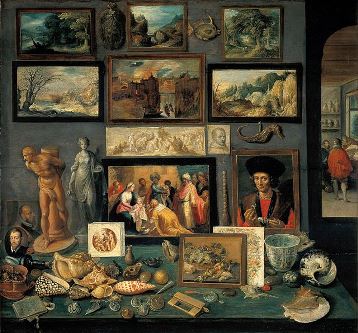
              The Cabinet of Curiosity
They say that in days long gone by
  kings bent on increasing their wealth and fame
    would collect wonders of both land and sea
      in rooms designed to awe the viewer’s eye -
        to never again see the world the same:
          the Cabinet of Curiosity.

These were the magical places -
  a microcosmic theat’r of the world,
    the original memory palace
      in which to worship the world’s Three Graces.
It was in this landscape the mind unfurled
  and dared to scale the heights of Daedalus.

These cabinets live on today,
  found in the homes of all those who cannot
    bear to part with one single, solit’ry
      thing.
They are attuned to life’s great ballet,
  thus will not bear a thing to be forgot -
    exalting both unique and ordinary.

Declare, O Drawer, the wonders
  you contain and the detritus of life -
    the forgotten bits and misplaced baubles –
Proclaim, O Drawer, the mysteries and plunders
  pigeonholed inside.
With valiant strife
  I pry at you; your case strains and wobbles.

Finally gaining entry to the hold
  of life’s forgotten treasures, I find there
    long-lost remnants of a life lived fully.
While ‘tis a shame I find no hoarded gold,
  I find loose change, pencils and pens to spare,
    old batteries and papers stacked unruly,

Old Christmas cards and past-due bills,
  strange locks and keys that do not fit each other,
    notebooks and fliers and take-out menus,
      postcards and letters – e’en one from Brazil –
        family photos sent by my brother;
This drawer has no bottom, it always continues.

And though I might try to clean it
  someday, I know it is useless to try.
No matter how much is removed from the
  drawer - no matter how hard I commit
    to decluttering life -  I’ll be that guy
      who saves everything, even debris.
I’ll be the first to admit that it gets hokey and off-rhythm, but don’t our drawers do the same? See what I did there? I’d claim it was intentional, but it wasn’t. And you know what? I don’t care. I had fun writing this piece; I hope you had as much fun reading it.
We’re supposed to be writing a prose poem for Writing 201. After reading several examples, this is my first attempt; however, I don’t even know if I’m on the right track. Comments, suggestions, and helpful criticism are greatly appreciated!
Update: Having left my original post up for several hours, I received several positive reviews and no real suggestions other than to remove the fingers – from the piece, not from me. I’m not that bad . . . at least, I don’t think I am . . . but you’d tell me, right?
Anyway, I’m going to go ahead and remove the password protection and share this with the world. Or, at the very least, the forty or so people who regularly visit.
Morning
With cold fingers I hold onto my coffee, wordlessly hoping for another school closing. Nope. Pull on the hat, coat and gloves. Head out the door to see the car frozen over. No ice remover, no scraper, just the vents put on overload. Listen to How Stuff Works; I wonder how long it will take. Twenty-one minutes – at least the motor turned over! Drive on to work.
Warm(er) fingers turn the key in the lock; kids are already waiting like a flock of . . . sheep? geese? Oh great. The clocks are all off. Again. I really need more coffee – strike that – I need the whole pot. Okay, who forgot to throw out the grounds? Come on, people! I’m not the only one around here! How much longer? Ten minutes? I guess that’ll work.
When I first heard I had to write a ballad, I thought What? I don’t know any ballads!
Then I stopped and thought for just a few minutes and realized that I love ballads:
Bohemian Rhapsody by Queen
American Pie by Don McLean
Homecoming by Green Day
Hallelujah by Rufus Wainwright
What’s Left of the Flag by Flogging Molly
However, the very first ballad I ever learned was The Ballad of Magellan:
The older I get, the more I remember learning from cartoons. Anyway, I used the same general rhyme scheme / syllable count so you can sing my ballad to the same tune – just note that in some cases you’ll have to stretch the syllable out or condense it. In addition, my ballad is slightly longer that the Animaniacs’ song, so you’ll run out of music before you run out of words.
But enough of that: Less Talk, More Rock Ballading! (And if that’s not a word, it is now!)
The Ballad of Frederick Barbarossa
1. There once lived a man,
 named Fred'rick Barbarossa:
  a Holy Roman Emperor
   named for his red beard.
He was a weak king
 who wanted more power;
  He made a deal with the Pope
   which wasn't that weird.

Chorus:
O what will you do,
 Fred'rick Barbarossa?
Your people don't like you,
 you're a figurehead.
O what will you do,
 Fredrick' Barbarossa?
Some might prefer you
 better off dead.

2. He invaded the states
 of Italy & Sicily;
  four times he attempted
   to strengthen his hand.
He captured some relics,
 made peace in the Rhineland,
  and extended his power
   all over the land.

Chorus:
O what are you doing,
 Fred'rick Barbarossa?
Ignoring your people
 is no way to help.
O what are you doing,
 Fred'rick Barbarossa?
Try being a leader
 not focused on self.

3. He tried to unite
 the Germanic princes
  who held onto their power
   and great influence.
So he went back to fighting
 the battles he could win -
  I guess in some way
   it does make some sense.

Chorus:
Well at least you tried,
 Fred'rick Barbarossa -
  It isn't your fault
   if the princes won't heel.
Oh wait! It is!
 Fred'rick Barbarossa,
  You're seen as a fool,
   tell me: how does it feel?

4. The Church then offered
 a chance a redemption:
  protect holy pilgrims
   and offer them aid.
He went off to war
 with two other kings named
  Richard and Louis
   in the Third Crusade.

Chorus:
To war! To war!
 Fred'rick Barbarossa -
  starting your journey
   towards Jerusalem.
Crusade! Crusade!
 Fred'rick Barbarossa -
  soon you'll be fighting
   the feared Saracen.

5. They came to a river -
 they needed to cross it;
  Barbarossa said
   "I think I'll cross over here."
He fell off his horse
 and into the river;
  he sank to the bottom
   in all of his gear.

Chorus:
Oh no! Oh no!
 Fred'rick Barbarossa,
  did you forget
   you could not be touched?
Oh no! Oh no!
 Fred'rick Barbarossa,
  were you distracted
   by the prospect of lunch?

6. Now you might have thought
 "That's the end of Barbarossa!"
  Well, you would be right,
   but there's more to my song.
His men tried to preserve him
 in a barrel of vinegar,
  continuing their journey
   they marched right along.

Chorus:
What ho! What ho!
 Fred'rick Barbarossa,
  Crusading on
   though your spirit is gone.
This is really quite morbid,
 Fred'rick Barbarossa -
  you're starting to stink
   in this hot summer sun.

7. His army deserted,
 except for five thousand
  who continued to Acre
   with his son Frederick.
He was buried in Tyre,
 Antioch, and Tarsus
  instead of Jerusalem
   as originally wished.

Chorus:
You will live on,
 Fred'rick Barbarossa,
  in stories and legends
   of your Christian ways.
And although you were used
 by those dastardly Nazis,
  we'll remember you fondly
   until end of days.