Enjoy a sampling of the photographs I took this week:
This slideshow requires JavaScript.
rantings & ramblings

Enjoy a sampling of the photographs I took this week:

Every once in a while history and real life collide.
This year marks the 103rd anniversary of the sinking of the Titanic.
 Given the number of film and articles written and dispersed over that time, I don’t think I need to retell the story.
What does this have to do with me? My great-grandfather was supposed to be on Titanic as a ship’s printer; that’s right, my great-grandfather was employed by White Star Line. I never knew my great-grandfather, so I’ll never know exactly why he quit instead of jumping at the chance to serve on what was already the most famous ship of its day. But quit he did; he obtained new employment on the banana boats. I know this because of the matchsafe he left behind:

I do know great-granddad lost friends and colleagues and acquaintances that cold April night; it is only by Divine Providence he did not perish as well.
And while I couldn’t find his immigration records (I forget his first name), here’s the immigration record for my grandpa:

Oh, and today marks the two-year anniversary of this blog. Happy Anniversary to Me!

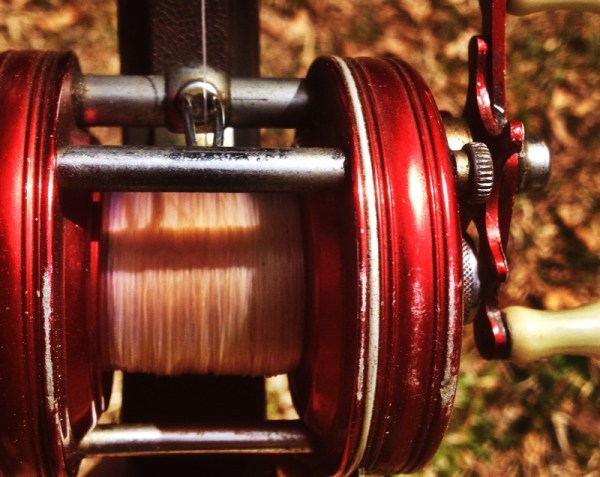
 I went fishing today.
When I was younger I hated fishing: the monotony of nothing for hours on end punctuated only by the droning of dragonflies and the gently swaying cattails as black bass taunt me from the shallow water a few feet from shore.
This afternoon fishing was just what I needed: the monotony of nothing for hours on end punctuated only by the droning of dragonflies and the gently swaying pampas grass as I cast my line out from the kayak over bluish-grey waters of a North Carolina estuary.
I found that sweet spot where the wind and waves moved me back and forth along a fifty-foot stretch of water – no paddling necessary, except to correct course every now and then.
 A heron bobbed twenty feet ahead of me. I wonder now if he knew something I didn’t; otherwise, he’d be diving down into the murky depths for a tasty morsel.
The tide was low, much lower than normal, exposing four feet of muddy riverbank and constantly threatening to beach my craft. I wish I had a camera I could take out on the water.
Eventually I hear a call from upriver – time to head in.
As we stow the gear and put up the canoe and kayak, Father in Law sees a large mouth bass laying up against the bank. “I’m going to catch him,” he says and promptly
casts his line into a tree,
rolls it out onto a stump and
from there down into the water
where the bass strikes immediately.
 Some people have all the luck.*
I still had a good afternoon.
For the record, the bass was back in the water and swallowing real insects in a matter of moments.

After several weeks of frivolity with photography, it’s time to post a more serious piece.
Over the past days weeks months years public speech in America has come under intense scrutiny, particularly on college campuses. From my perspective, it appears that certain people operate under the assumption that they have a right not to be offended; if they are offended, then something must be wrong.
The following opinion piece crossed my news feed; I felt compelled to write a rebuttal.
I am greatly disappointed that Walker Mills ’15’s opinion piece “Playing it Safe — Too Safe” falls into the same semantic trap that New York Times contributing opinion writer Judith Shulevitz and many other generational pundits have been making in recent editorial comments across news outlets. The current rally that generational pundits make against me and my peers in college today is that we have forsaken freedom of speech and multiple view points for “comfort.” What does this word “comfort” even mean? I’m afraid that it is a product of jargon that is too easily mistranslated by these opinion columnists hoping to pass a deadline.
Logical Fallacy: Strawman
What does “comfort” mean, you ask? Well, according to the American Heritage College Dictionary:
com·fort (kŭm•fərt)
tr.v. com·fort·ed, com·fort·ing, com·forts
n.
1.
2.
3.
Therefore, when you say you want to be comfortable, I take it you want to be at ease, strengthened in your own beliefs, and soothed in spirit.
Fair warning: none of these should be demanded – let alone accepted or expected – in debate. It is the nature of debate to challenge our innermost beliefs and heartfelt desires. Otherwise, what is the purpose? This argument reminds me of this utterly absurd cartoon, claiming that using dictionary definitions in debate is akin to arguing from a position of privilege and power.
If they delved with any honest intent into the vast discourse of social justice, they would see how far from the mark they really are.
Logical Fallacy: Fallacy Fallacy; smacks of Ad Hominem
What is this “vast discourse” other than a reiteration of the 1970s “Stick it to the man”? There is no understanding of the past; the past is invalid because anyone older than your own generation “doesn’t understand society today.”
To begin, when students claim a lecture or event is “uncomfortable,” it’s not because the chair cushion is sagging. Nor is it because we simply don’t like the ideas being touted before us. It is because the speakers promoting these ideas do not display an effort to be inclusive in their thoughts.
Logical Fallacy: Genetic
Remember: Don’t kill the messenger!
A speaker’s language may not recognize the differences in gender identity or expression, and thus speak in ways that exclude and marginalize certain groups. Their arguments may not acknowledge the position of power they inherently have when making certain claims. The solutions they offer to whatever discussion at hand many not consider the long history of injustice performed against people of color.
Logical Fallacy: Burden of Proof, Personal Incredulity
One cannot claim the moral high ground while also advocating moral equivalency.
Or, to put it another way, you can’t have your cake and eat it, too.
Take note: not every word, thought, and action is an attempt to keep and save power.
These examples may seem vague, but I am trying to generalize a range of possible situations that have caused dismay across college campuses. To outside observers, make no mistake, these problems are not analogous to me sitting on an uncomfortable lumpy mattress.
Logical Fallacy: Anecdotal
Based on your own argument, you imply that everyone who doesn’t think like you think they should think is an ignorant, bigoted megalomaniac. How is that inclusive?
When I say your argument makes me uncomfortable, it is because I am greatly concerned that you have not done the requisite thought and research into generating an inclusive thesis that considers as many nuances as necessary to deliver a sound debate.
Logical Fallacy: Fallacy Fallacy; hints of Burden of Proof
Perhaps one considers those nuances and rejects them. What then?
Why should a thesis be inclusive? It is the very nature of hypotheses and theses to be divisive!
If you do not believe that skin color, age, religious identity, sexuality, class or (dis)ability have an effect in cultural, political or economic problems that we debate at universities, then it is you who is trying to remain comfortable despite such frightening realities. In this sense, being uncomfortable is the strongest form of rhetoric that our millennial generation wields in the struggle against all forms of oppression.
Joseph DiZoglio ’15
Logical Fallacy: Appeal to Emotion, Ad Hominem
I can “believe that skin color, age, religious identity, sexuality, class or (dis)ability have an effect in cultural, political or economic problems that we debate at universities” and still disagree with you or make you feel uncomfortable!
Again, that is the very nature of debate.
Ultimately, this piece is built on the logical fallacies of Ad Hominem, Tu Quoque, and Personal Incredulity.
I would direct the author to read Beatty’s Speech from Fahrenheit 451.
What do you think? Am I off the mark? Is there something I’m missing?
Let me know in the comments!

I don’t know how many of you are religious or not, or – since one does not necessitate the other – how many of you observe Easter.
Easter is my favorite holiday; it is a time of reflection and introspection and meditation.
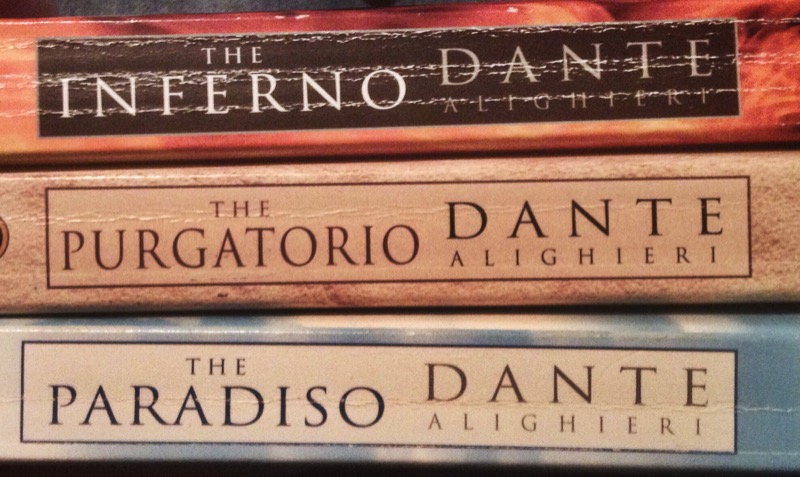
Now a nine-year tradition, I am again reading Dante’s Divine Comedy (Ciardi translation).
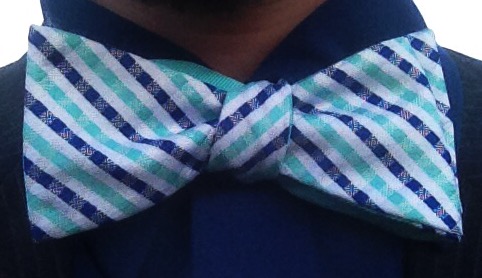
I never thought my “Triumph” post would be as popular as it was; apparently many people had an opinion about which bow tie I wore Easter Sunday. For the record, it was this one:

I’ve also been meditating on two songs sung as part of our Easter program:
Finally, you’re never to old to get an Easter Basket!

Happy Easter, Everyone!

Nothing says “Triumph” better than a bow tie – even if one of them is pre-tied.
 Sunday
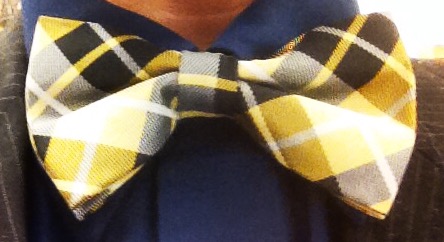 Monday
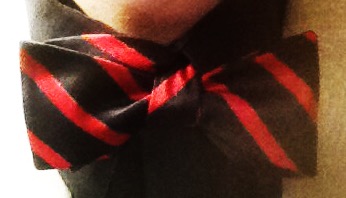 Tuesday
 Wednesday
 Thursday
Feature Image courtesy Steeevie @ deviantart . com


