Warning: This post may contain politically incorrect language and expletives. They exist for the purpose of example and edification; they are not intended to disparage or defame any particular person, race, creed, color, or religion. If you feel you may be offended by such language, stop reading now. You have been warned.
SPOILERS AHEAD
From the Back Cover
Here is a novel, glamorous, ironical, compassionate – a marvelous fusion into unity of the curious incongruities of the life of the period – which reveals a hero like no other – one who could live at no other time and in no other place. But he will live as a character, we surmise, as long as the memory of any reader lasts.
It is the story of this Jay Gatsby who came so mysteriously to West Egg, of his sumptuous entertainments, and of his love for Daisy Buchanan – a story that ranges from pure lyrical beauty to sheer brutal realism, and is infused with a sense of the strangeness of human circumstance in a heedless universe.
It is a magical, living book, blended of irony, romance, and mysticism.
~ 1953 Scribner Edition
Why the Book was Banned
1. Language
2. Sexual references
3. Hedonism
4. Racism
Synopsis
Meet our main cast: Nick (the narrator), Daisy and Tom Buchanan (Nick’s cousins), Jordan Baker (Nick’s love interest), and Jay Gatsby (a mysterious, eccentric individual)
Tom introduces Nick to Myrtle, his mistress; Nick is unimpressed.
Gatsby throws open-invitation parties; Nick meets both Gatsby and Jordan at one of these affairs. Gatsby recounts some history: he had been in love with Daisy before the war (WWI) and lost her to Tom. Now, he wants her back and desires Nick’s help.
The plan works, an affair ensues. Everything is fine until Tom meets Gatsby, becomes suspicious, and starts researching his background. (Hint: Tom knows everything).
Eventually, the truth comes out and everyone parts ways in foul moods. Daisy accidentally kills Myrtle, Tom tells her husband, George, that Gatsby is to blame. George commits first-degree murder and then suicide. Daisy and Tom leave; Nick ends it with Jordan and arranges Gatsby’s funeral.
The book ends with an invective against nostalgia.
Fitzgerald packed a variety of themes into such a short book, i find it difficult to choose just a few to write about. Therefore, I picked three; two were at random, one was not. No prizes for guessing which one I purposefully chose.
First, in the Jazz Age, wealth and class went hand-in-hand. Gatsby tries to change his class by changing his wealth; people of a different era might call him nouveau riche. However, Gatsby never fully assimilates into the class he desires. Despite his wealth and lavish expenditures, Gatsby never becomes “one of them.” This begs the question: can America be a classless society? Even today, media pundits talk of “class division.” If we are to believe Fitzgerald, not only is a classless America a myth, but so is the American Dream. Gatsby’s life evidences that no matter what wealth one obtains, others will still judge him by his past. Taken to the extreme, any attempt to change class results in tragedy. Lotto winners, anyone?
Second, “only fools fall in love,” and Gatsby is the greatest fool of all. Other characters possess tolerance, infatuation, perhaps even affection, but only Gatsby is actually in love – and look how it ended for him. In this, Gatsby resembles Romeo and Juliet much more than The Sun Also Rises.
Third, history defines every character in Gatsby. Some, like Gatsby, try to hide or rewrite it. Others, like the Buchanans, base their way of life on it. Despite living in such a progressive era, everyone actually lives in the past (some despite their best intentions). It’s one thing to remember the past; it’s another to live in the past. No good comes from living in the past. Remembering the past helps us learn, grow, progress. Living in the past stunts growth and slows progress. (Trust me: I teach history for a living). Ultimately, living in the past results in insurmountable frustration. As Nick says in the last line of Gatsby:
And so we beat on, boats against the current, borne back ceaselessly into the past.
Everyone behaves badly . . . Give them the proper chance.
Warning: This post may contain politically incorrect language and expletives. They exist for the purpose of example and edification; they are not intended to disparage or defame any particular person, race, creed, color, or religion. If you feel you may be offended by such language, stop reading now. You have been warned.
From the Back Cover
An absorbing, beautifully and tenderly absurd, heartbreaking narrative….It is a truly gripping story, told in lean, hard athletic prose . . . magnificent writing, filled with that organic action which gives a compelling picture of character. ~ The New York Times
~ 1970 Scribner Edition
Sounds like a Mad-Lib, doesn’t it?
Why the Book was Banned
1. Language and profanity
2. Focus on sex and adultery
3. Overall hedonism
Synopsis
Jake Barnes (the narrator), Robert Cohn (a writer), and Brett Ashley (a nymphomaniac divorcée) live a hedonistic lifestyle in post-WWI Paris. Jake and Brett love each other, but aren’t together because Jake’s war wound rendered him impotent. Cohn falls for Brett and the two secretly travel to San Sebastian, Spain. When they return, the group – which now includes Jake’s friend Bill and Brett’s fiancé Mike – plan a trip to Spain, where they will fish and watch the running of the bulls in Pamplona.
The group separates due to illness, so only Bill and Jake fish. The group reunites in Pamplona for a week of alcohol-imbued celebrations. Of the group, only Jake cares about the bullfights, everyone else is there to party. Nevertheless, Brett falls for a bullfighter (shocker); and Cohn’s jealousy leads him to pummel the man to the point of death. Rather than rejuvenation, the excursion causes tension within the group.
Jake stops over in San Sebastian before returning to Paris. While there, Brett telegrams him; she is in trouble in Madrid and needs help. Jake agrees, but there is no hope. He and Brett agree that although they love each other, there is no future for them.
My Thoughts
As I was reading, I felt I was reading someone’s diary. Therefore, I found a several repeated themes, such as
Dissatisfaction. Every character seems focused on immediate satisfaction. The constantly find “fun” things to do, but never find happiness. Jake wants Brett; it’s obvious that this will never happen. Cohn wants someone to love him rather than use him; good luck with that Mr. Semi-Famous Author. Brett wants security, but is generally unwilling to show her insecurities. Bill wants money; he’s always in debt to someone. Mike just wants another drink, but one more is never enough. In the world they inhabit, it is not just difficult, it is impossible for them to find true satisfaction.
Exile. Although the novel is set in France and Spain, none of the central characters are French or Spanish. Instead, they are American and British nationals living in self-imposed exile from their home countries. Defined by their upbringing, they attempt to make their way in a culture completely foreign to them. Never truly fitting in anywhere, we can add “fish out of water syndrome” to the reasons for their dissatisfaction.
Identity. Every character has a facade. As the novel progresses, we see the effort exerted in keeping the facade from crumbling.
Love. Every character desires love, but few realize what love actually is. Although set in Paris, the “City of Love,” there is little – if any – romance in the novel. Instead, the so-called “love” exhibited by the characters centers mainly around coercion.
Manliness. The men of the novel are constantly posturing to prove themselves men, especially when it comes to impressing Brett. However, each male character experiences insecurities causing each to doubt their own masculinity.
Substance Abuse. Everyone in the novel is an alcoholic. For Mike, it’s practically his job. Alcohol provides a short respite from fears and frustrations, but it is only temporary. Therefore, most characters spend their time talking about which bar to visit next.
It was a good story, but nothing really made sense for me until the last line. On their way back to Paris from Madrid, Brett remarks, “Jake, we could have had such a . . . good time together.” Jake replies, “Yes, isn’t it pretty to think so?” I wanted to scream “NO! It isn’t pretty, it’s stupid! You’re all a bunch of despondent alcoholics with manic-depressive tendencies. Continue this way and you’ll all end up dead.” But since that would have annoyed my wife at 2:30 in the morning, I thought the words in my head instead.
There is no real satisfying conclusion to the story. The characters have not changed since the beginning of the novel. We have seen their thoughts, their actions, their motives, their mistakes. At times, these flaws are visible to the other characters, but nobody actually learns anything. One reviewer called The Sun Also Rises a modern-day Romeo and Juliet. If that is, indeed, the case, the remake is far worse than the original. As least in the original play there was the chance for happiness; in Hemingway’s novel happiness isn’t even on the table.
Overall, The Sun Also Rises can be summed up with one line:
Oh, darling, I’ve been so miserable.
I imagine this played a major role in their misery.
I tell ya, I tell ya a guy gets too lonely an’ he gets sick.
Warning: This post may contain politically incorrect language and expletives. They exist for the purpose of example and edification; they are not intended to disparage or defame any particular person, race, creed, color, or religion. If you feel you may be offended by such language, stop reading now. You have been warned.
From the Back Cover
They are an unlikely pair: George is “small and quick and dark of face”; Lennie, a man of tremendous size, has the mind of a young child. Yet they have formed a “family,” clinging together in the face of loneliness and alienation.
Laborers in California’s dusty vegetable fields, they hustle work when they can, living a hand-to-mouth existence. For George and Lennie have a plan: to own an acre of land and a shack they can call their own. When they land jobs on a ranch in the Salinas Valley, the fulfillment of these dreams seems to be within their grasp. But even George cannot guard Lennie from the provocations of a flirtatious woman, nor predict the consequences of Lennie’s unswerving obedience to the things George taught him.
~ 1993 Penguin Book Edition
Why the Book was Banned
1. Offensive language
2. Racial slurs
3. Promoting euthanasia
4. Anti- business ideas
Synopsis
A short book begets a short synopsis. Lennie and George eke out a living in Depression-era California. Forced to leave town when Lennie causes a “misunderstanding,” the two find work on a ranch in Salinas County. Hoping to own their own land, this will be the last time they work for someone else. Then Lennie causes another “misunderstanding.” You know what Shakespeare said about “the best laid plans of mice and men…”
The polar opposite of Ockham’s Razor
My Thoughts
Steinbeck covers a variety of themes in Of Mice and Men, including dreams, prejudice, weakness, and violence. Here’s several that stood out to me:
First, he addresses the idea of equality.
Ranch workers represent the plight of migrant workers. Set during the Depression, Lennie, George, and others are forced to find work where they can, often traveling long distances on the mere rumor of work. Employers negotiate pay upon their arrival and renegotiate at will. Workers receive substandard room and board while their masters (for lack of a better word) live in luxury. In his sympathy for the overworked and underpaid, Steinbeck calls attention to the abuses of impersonal corporations.
Crooks, the stable hand, highlights racialinequality. Although born and raised in California, Crooks is treated as an outsider. The men force him to live apart and constantly refer to him as “nigger.” Even the name Crooks is insulting; it refers not to his given name, but to his crooked back. Nevertheless, Steinbeck shows Crooks to be a normal human being. Neat and bookish, Crooks dispels the “ignorant savage” stereotype common in the 1930s (and still existing today). Crooks even opens up to Lennie and begins to dream of partnering with George and Lennie in their dream to own some land. Sadly, Crooks’ dream dies when Curely’s wife threatens his life in front of Lennie and some other men.
Curley’s wife highlights gender inequality. She possess no name in the novel; she is the property of her husband. The only woman on the ranch, she must make do with “men talk” and tolerate Curley’s narcissism. Desiring her own form of freedom, she dreams of Hollywood. Admittedly, she is self-obsessed and cruel, but I also feel sympathy for her. When she dies, we see what she might have been under different circumstances:
[T]he meanness and the plannings and the discontent and the ache for attention were all gone from her face. She was very pretty and simple, and her face was sweet and young. Now her rouged cheeks and her reddened lips made her seem alive and sleeping very lightly.
Second, Steinbeck addresses the ruthlessness of big business. Curley, the boss’ son and main antagonist of the novel, embodies this idea. Relatively small and weak, Curley is obsessed with appearance and power. Some might say he possesses a Napoleon Complex, but that would be insulting to Napoleon. Curley habitually picks fights with larger men (often ambushing them) to “prove” his prowess (not unlike a corporate businessman in an unfriendly merger). To Curley, power is everything: sexual power, physical strength, and business acumen are his goals.
Third, Steinbeck’s overarching theme is friendship. The relationship between George and Lennie resembles that of a bromance, after all, their friendship is the only real constant in either of their lives. However, I’m not sure what Steinbeck meant to achieve with this theme. For Lennie and George to be so close, why do they choose a job seemingly more well-suited to loners? Was Steinbeck trying to show that their friendship was solid, or that it was merely superficial? Was it even friendship, or was George just using Lennie? After all, he constantly had to protect Lennie from getting into trouble (something he wasn’t always successful at doing) and spends some time telling us how much better off he’d be if he didn’t have Lennie to look after. If that’s the case, why not just leave him? Furthermore, if that’s how he really felt, is George’s final act done to protect Lennie or to free George from further obligation?
To the chase: Overall, I’m not sure what to think about Of Mice and Men. Throughout most of the book, Steinbeck keeps the reader hopeful of a happy ending. George and Lennie’s friendship seems to last insurmountable odds. The men find work (and good work at that) and a partner to help make their dream a reality. Hope disappears in the last 17 pages. Lennie accidentally kills Curley’s wife and runs away. George tries to help him, but this time there is nothing to be done. George must either turn Lennie in, or . . .
This is too depressing. Here’s what another reader thought of the ending:
Even though the dream never becomes reality, Steinbeck does leave us with an optimistic message. George and Lennie do not achieve their dream, but their friendship stands out as a shining example of how people can live and love even in a word of alienation and disconnectedness.
I wonder what book this reviewer read; it certainly wasn’t Mice and Men. What optimism is there? Facing the loss of his dream and the necessity of turning Lennie over to the authorities, George opts to shoot Lennie and claim “self-defense.” How then does their friendship “stand out?” That the people you trust the most will be the one to stab you in the back? That the mentally challenged should be treated like animals, to the point of being “put down” if they pose a danger to society? I might be confused about the book as a whole, but I’m not confused about George and Lennie: George used Lennie, and, when Lennie was no longer useful, threw him to the wolves.
I wish I could end this review on a happy note, but I can’t. Instead, here’s a picture of my cat:
How do you know what you’re going to do until you do it?
Warning: This post may contain politically incorrect language and expletives. They exist for the purpose of example and edification; they are not intended to disparage or defame any particular person, race, creed, color, or religion. If you feel you may be offended by such language, stop reading now. You have been warned.
From the Back Cover
This is one of the most remarkable books published in years. It is the story of sixteen-year-old Holden Caulfield, who wants desperately to find himself, but who goes underground in New York for forty-eight hours when he is overwhelmed by the perplexing circumstances of his life. Read the first page – and you will not be able to stop until you have completed this wild and magic adventure with him.
~ New American Library Edition
Why the Book was Banned
1. Profanity
2. Advocating Rebellion
Synopsis
Set in the 1950s, Catcher in the Rye is the story told by the central character, sixteen-year-old Holden Caulfield, of how he came to be at a sanatorium in California.
Saturday: Expelled from a prep school in Pennsylvania and annoyed by his professors, neighbors and roommates, Holden makes an early return his Manhattan home. Rather than face his parents, he checks into a hotel; there he spies on his neighbors, smokes cigarettes, attempts to find a stripper, and connives to get drunk. Holden ends up flirting with women twice his age and paying their tab. Undefeated, Holden makes his way to a jazz club in Greenwich Village, where he watches the other patrons and ignores a family acquaintance. When he returns to the hotel, Holden is swindled out of $10 by the elevator operator and a prostitute.
Sunday: Holden arranges a date with his old friend, Sally. He eats breakfast with 2 nuns while discussing Romeo and Juliet. He starts to look for his sister, Phoebe, but instead heads to the Biltmore Hotel for his date. The date fails: Sally spends her time talking to someone else and she and Holden fail at ice skating. When Sally refuses to run away with him, Holden calls her a “pain in the ass” and she leaves. After driving off another acquaintance with talk of homosexuals and foreigners, Holden drunk-calls Sally, visits the frozen lagoon in Central park, and breaks into his own apartment. Here he reveals to Phoebe his fantasy of being “the catcher in the rye.” His parents return, Holden creeps out and calls up an old English teacher, who in turn offers him a pace to sleep. When he perceives the man making homosexual advances, Holden instead spends the night in Grand Central Station. Later, Holden decides to run away for good, but he tells Phoebe, who tries to go with him. To make up for refusing her, Holden takes Phoebe to the carousel, where he is overcome with emotion and moved to tears. The story abruptly ends here with Holden declaring that he’s not going to tell anything else.
My Thoughts
Without a doubt two of Catcher‘s themes are alienation and adolescence. However, phoninessoutshines all other contenders. On nearly every page Holden finds something hypocritical to complain about: a headmaster’s favoritism, a teacher’s mannerisms, jocks, nerds, football, his Dorm Mother, tabloids, taxis, magazines, and night trains. All this and more in the first 52 pages.
It is ironic, therefore, that Holden is the biggest phony in the book.
He considers magazine discussions phony, yet continues to buy them.
He can’t stand emotional girls; yet will do anything to keep his sister from crying.
He hates jocks who get it on in the back of cars, yet tries at least twice to hire a stripper.
He hates people who use other people, but he uses his brother to meet girls and old friends to get drunk.
He despises people who arbitrarily judge others, yet he constantly does the same.
He lies multiple times about who he is and why he is leaving Pencey.
He thinks people should work for their money when he hasn’t had to work a day in his life.
He wants people to act the same all the time, yet he act different every time he meets someone new.
He wishes people would be better than they are, yet he refuses to better himself.
In short, he is the exact definition of a hypocrite.
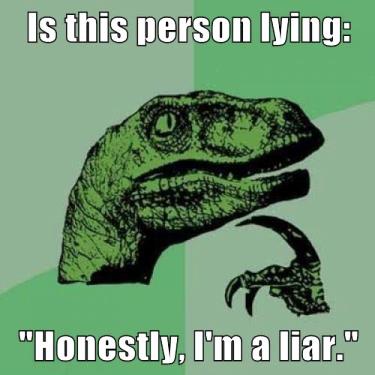
I’m the most terrific liar you ever saw in your life. It’s awful. If I’m on the way to the store to buy a magazine, even, and somebody asks me where I’m going, I’m liable to say I’m going to the opera. It’s terrible.
Holden Caulfield thinks Philosoraptor is a phony.
In my opinion, this quote throws the entire story into question. If Caulfield is such a terrific liar, what’s to keep him from inventing a story about how he came to the sanatorium? We’ve seen from his story that, above all else, he craves sympathetic attention. Perhaps we’ve spent several hours with Holden for nothing; the whole thing was an elaborate ruse to gain some sympathetic human contact. Challenge: read it for yourself and come to your own conclusion. Otherwise, Holden Caulfiend might think you’re a phony.
When one reads these strange pages of one long gone one feels that one is at one with one who once [was].
~ James Joyce, Ulysses
Warning: This post may contain politically incorrect language and expletives. They exist for the purpose of example and edification; they are not intended to disparage or defame any particular person, race, creed, color, or religion. If you feel you may be offended by such language, stop reading now. You have been warned.
From the Back Cover
The revised edition follows the complete and unabridged text of ULYSSES as corrected and reset in 1961. Like the first American edition of 1934, it also contains the original forward by the author and the historic court ruling by Judge John M. Woolsey to remove the federal ban on ULYSSES. It also contains page references to the 1934 edition, which are indicated in the margins.
A Truncated Summary, with Themes and Motifs in Bold
Part I: The Telemachiad
Telemachus
Stephen Dedalus and his roommate, Buck Mulligan, breakfast. Stephen experiences guilt over the passing of his mother. Mulligan demands a loan; Stephen determines to move out.
Nestor
Stephen teaches history and wonders how parents love unattractive children. Stephen collects his pay from his anti-Semitic employer.
Line I love to hate: “History is a nightmare from which I am trying to awake.”
Proteus
Stephen broods about Sandymount Strand contemplating life.
Joyce’s wildly-shifting stream of consciousness becomes the norm.
Part II: The Odyssey
Calypso
Like an episode in Dr. Who, the reader shifts time and place. Now we meet Leopold Bloom, an ad-man of Jewish descent. Bloom cooks and eats a pork kidney, reads correspondence from his wife’s lover and his daughter, and completes his morning constitutional in the outhouse.
Lotus Eaters
Bloom ambulates to the post office, where he receives a letter from his love interest. He then ogles a woman in stockings and destroys his letter. Wandering into church, Bloom ruminates on theology before visiting a chemist, where he purchases soap. Leaving the chemist, Bloom meets an acquaintance. When the two part ways, Bloom heads towards the baths.
Hades
Bloom attends Paddy Dignam’s funeral, where he converses with Stephen’s father about death and burial traditions. From his taxi, Bloom also observes both Stephen and Blazes Boylan (Molly’s lover). Evidencing his own guilt and need for paternalism,Bloom reflects on the death of his son, Rudy. After the service, Bloom leaves with the funeral cart.
Aeolus
Here, the layout mimics a tabloid newspaper.
Bloom attempts (unsuccessfully) to place an advertisement in the Freeman’s Journal. Although Stephen is also in the office, he and Bloom do not meet. Stephen and a group of office workers then head to a pub.
Line I love: “We were always loyal to lost causes.”
Lestrygonians
Bloom searches for lunch. Repulsed by animal-like manners of diners at Burton Hotel, Bloom instead patronizes Davy Byrne’s pub, where his repast consists of a gorgonzola cheese sandwich and a glass of burgundy. Lunchtime musings light upon the rise and fall of Bloom’s marriage and the anatomical correctness of Greek sculpture. On his way to the museum, Bloom glimpses Boylan and seeks refuge in a gallery adjacent the museum.
Scylla and Charybdis
At the National Library, Stephen Dedalus debates the origins, merits, and authorship of Shakespeare and his works. Looking for an old ad copy, Bloom also enters the library. He and Stephen briefly cross paths at the end of the episode.
Wandering Rocks
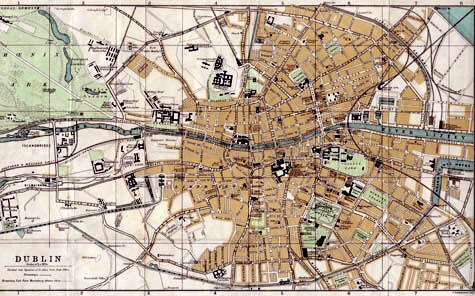
Taking a short break from Stephen and Leopold, the plot follows various characters through the streets of Dublin. The procession of the Lord Lieutenant, William Ward, Earl of Dudley, unifies the narrative.
Sirens
Music dominates this episode.
Bloom dines with Stephen’s uncle while his father sings. Molly rendezvous with her lover, Blazes Boylan.
Cyclops
The narrative now follows an unnamed Dubliner who witnesses an argument between Bloom and an anti-Semitic diner in Barney Kiernan’s pub.
The episode is notable for its tangential thoughts, including legalese, the Bible, and Irish mythology.
Nausicaa
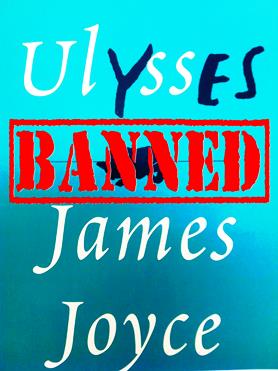
This episode caused Ulysses to be banned and burned by the United States Postal Service.
Copying the style of a romance novel, the episode shadows Gerty MacDowell. Bloom watches her, fantasizing to meet his carnal desires. His mood dies as Gerty reveals her lame leg. Several asides later, Bloom decides to visit a friend in hospital.
Oxen of the Sun
Bloom visits his friend and heads to a bar where he meets Stephen Dedalus.
In this episode, Joyce uses wordplay to tell the history of the English language. Joyce moves from Latinate through several eras and various authors, ending the episode with unintelligible gibberish.
Circe
This episode mirrors a play script.
Highly intoxicated, Bloom and Dedalus enter Dublin’s red-light district. The pair begins to hallucinate; their fears and passions are brought to life. Stephen vandalizes a brothel and attacks an English soldier. Bloom “sees” his son brought back to life.
Part III: The Nostos
Eumaeus
Bloom and Dedalus find refuge in a cabman’s shelter, where they encounter a drunken sailor. Confusion and mistaken identity ensue as their identities are repeatedly questioned. Rambling and strenuous, the narrative reflects the psychological state of the men.
Ithaca
The pair returns to Bloom’s home; Stephen refuses Bloom’s offer of a place to stay. After relieving themselves, the two part ways.
Written as a catechism, this episode is one of the easiest to understand, since the questions preceding each section alert the reader to the topic at hand.
Penelope
Bloom and Molly lie in bed, where Molly’s thoughts flit about before settling on a remembrance of her and Bloom’s engagement.
We can only assume that the next day was unremarkably similar.
My Thoughts
Disclaimer: I read this book on an e-reader, and hated the experience. I tried not to let that fact influence my judgement; however, the fact that I could not easily mark pages or flip back to reread segments annoyed me to no end.
Just Say No
I read Ulysses as a bet to myself. I’d attempted the work several years ago, but failed to read past the first five pages or so. This time, though, Banned Books Week provided the motive I needed. Although a myriad of guides exist to help readers tackle Joyce’s epic, I chose to go alone.
As most of you probably know, critics consider Ulysses one of the greatest – if not the greatest – modern work of English literature; it is without a doubt the greatest work to ever come out of Ireland (well, there is the Book of Kells…) Written over the course of seven years, Joyce follows Leopold Bloom and Stephen Dedalus through Dublin on June 16, 1904. Ulysses is well known for its plethora of allusions, references, and outright gibberish. Joyce once said, “I’ve put in so many enigmas and puzzles that it will keep the professors busy for centuries arguing over what I mean.” He wasn’t exaggerating.
What can I say about Ulysses that hasn’t already been said by people much more intelligent than I? The sprawling work threatens to consume the unwary. Joyce modeled Ulysses after Homer’s Greek epic The Odyssey (something I figured out halfway through), and – like Odysseus – Ulysses is a long journey home.
In my opinion, Joyce’s key theme is the heroicism of the common man. One common complaint levied against Ulysses is its outright commonality: there is no obvious story arc, no clear motive, no cheer-worthy hero. These complainers miss the point: the very commonality of Ulysses is what makes it great. Consider: Joyce takes us into Bloom’s innermost thoughts. When you think, are the thoughts full-formed? Probably not. Do you relate present circumstance with past experience? So does Bloom. In reading Ulysses we see the thought process. We see the relations and allusions as they form; it is stream of consciousness at its best. Therefore, by far my favorite passages are the ones that deal with food, like this one:
Mr Leopold Bloom ate with relish the inner organs of beasts and fowls. He liked thick giblet soup, nutty gizzards, a stuffed roast heart, liverslices fried with crustcrumbs, fried hencods’ roes. Most of all he liked grilled mutton kidneys which gave to his palate a fine tang of faintly scented urine.
I might not enjoy giblets as much as Bloom, but I appreciate the imagery. Joyce’s mastery allows me to see, taste, and smell the food Bloom consumes. This is just one of many instances; Bloom was a foodie before it was hipster.
However, I cannot help but think that every character in Ulysses is a lost cause. Stephen’s mother is dead; he can never gain the forgiveness and absolution he seeks. Bloom’s son is dead and his wife an adulteress; it is highly unlikely he will ever have the progeny he desperately desires. The food, the alcohol, the prostitutes, the music, and the workplace all provide distraction, but they do not provide answers. When they awake on June 17, their plights will be exactly the same.
Nevertheless, don’t let me dissuade you from embarking on your own journey. Ulysses cannot be described; it must be experienced.
Who knows who might be the target of the well-read man?
Ray Bradbury – Fahrenheit 451
Warning: This post may contain politically incorrect language and expletives. They exist for the purpose of example and edification; they are not intended to disparage or defame any particular person, race, creed, color, or religion. If you feel you may be offended by such language, stop reading now. You have been warned.
SPOILERS AHEAD
From the Back Cover
Guy Montag was a fireman whose job it was to start fires.
The system was simple. Everyone understood it. Books were for burning…along with the houses in which they were hidden.
Guy Montag enjoyed his job. He had been a fireman for ten years, and he had never questioned the pleasure of the midnight runs nor the joy of watching pages consumed by flames…Never questioned anything until he met a seventeen-year old girl who told him of a past when people were not afraid.
Then he met a professor who told him of a future in which people could think…and Guy Montag suddenly realized what he had to do!
~ 1991 Del Ray Edition
Why the Book was Banned
1. Profanity, especially for the use of the words “hell” and “damn”
2. Burning of the Christian Bible
3. Perceived opposition to Government (c.f. 1940s and 50s McCarthyism)
Photo Source: quarterlyconversation.com
Synopsis
In the future, any home containing books must be immediately destroyed by firemen. Guy Montag is one such fireman.
Several events alter his worldview. First, he meets Clarisse McClellan, a teenage girl who opens his eyes to the world around him. Second, his wife Mildred ODs on sleeping pills, further reinforcing Clarisse’s declarations.
Montag reevaluates his life, going so far as to save a book from destruction. Clarisse vanishes, most likely killed by a motorist. Suspicious of Montag’s behavior, Beatty (his boss) lectures him on the origins of firefighting. The lecture bolsters Montag’s “rebellious” nature, and he goes beyond saving books and starts reading them.
One day, Montag meets an old English professor, Faber. Reluctantly, Faber agrees to help Montag fight the firemen. Headstrong, Montag reads poetry aloud to his wife and her friends. That night, Beatty forces Montag to torch his own house.
Running from the law, Montag hides with Faber, who helps him flee the city. On the outskirts of town, Montag meets the Book People: intellectual hobos led by a man named Granger. As the Book People memorize literature to keep it from extinction, Montag volunteers to memorize parts of the Bible.
As they are talking, war strikes home and the city destroyed. The novel ends with the Book People discussing how best to rebuild society.
My Thoughts
I knew going into this project that Fahrenheit 451 would top my list. No other book in all of literature has affected me in quite the same way. The book challenged me to think critically, to memorize passages I found important, to know my past, and to not accept blindly every “fact” that I was given. (Can you tell I like the book?) Therefore, I find it quite distressing that people like this consider it trash. That said, let’s begin.
Fahrenheit 451 isn’t about censorship. Bradbury intended Fahrenheit to highlight television’s negative impact on literature. According to Captain Beatty, literature dies a slow, agonizing death:
Step One: Make things simpler. Photography, radio, and television reduce the need to reading comprehension. A picture is worth a thousand words; a 4-hour speech becomes a 30-second sound bite. What books remain are further reduced in condensations, tabloids, and digests. Cut out the boring bits and get to the ending already! Classics are adapted to radio, book columns, and dictionary/encyclopedia entries.
Step Two: Reduce the need for critical thinking. Shorten school; relax discipline; drop subjects like philosophy, history, and languages; ignore English and spelling.
Step Three: Change society’s focus. Everyone needs a job, so ignore everything you “don’t need.” After work, find pleasure in sports, cartoons, and travel.
Step Four: Tolerance. Efforts to avoid offending anyone result in bland books (and entropy of critical thinking).
Note the absence of censorship from this litany. The anti-censorship “theme” appears once:
Colored people don’t like Little Black Sambo. Burn it. White people don’t feel good about Uncle Tom’s Cabin. Burn it. Someone’s written a book on tobacco and cancer of the lungs? The cigarette people are weeping? Burn the book. Serenity, Montag. Peace, Montag. Take your fight outside. Better yet, into the incinerator. Funerals are unhappy and pagan? Eliminate them, too. Five minutes after a person is dead he’s on his way to the Big Flue, the Incinerators serviced by helicopters all over the country. Ten minutes after death a man’s a speck of black dust. Let’s not quibble over individuals with memoriums. Forget them. Burn them all, burn everything. Fire is bright and fire is clean.
p. 59-60, 1991 Del Ray edition
The misconception persists thanks to the adage “If you tell a lie often enough, it becomes truth.” Over the past 50 years hundreds of critics, essayists, and reviewers promulgated the anti-censorship theory. Even Bradbury’s biographer got it wrong. In reality, Bradbury warns us of a technology-dependent society. Taken to extremes, technology negatively influences everything it touches.
Technology kills diversity. Now, I don’t mean that technology somehow magically transforms everyone into the same race. In its attempt at diversity, technology cannot afford to offend anyone; in so doing, it kills a diversity of ideas. Society benefits from healthy dialogue and debate. These avenues allow us to progress, to move beyond the mistakes of the past, and to leave our world a better place than we found it. Ignoring “unpopular” issues or ideas solves nothing; outright suppression of opposing viewpoints breeds radicalism.
In education, technology limits the free exchange of ideas. “Impossible!” you say. “The internet provides access to more information than at any other time in human history.” Correct. But what happens when (not if) a government decides to limit access to that information? The internet transforms into an echo chamber for government-approved philosophies, resulting in citizens unable to think critically about their world.
Technology also has the power to help or harm the environment. Bradbury envisioned a future where people ignore the landscape; drivers on the superhighways can’t see it and couch potatoes can’t be bothered. It is notable that Montag’s moment of awakening occurs in the rain.
Consider, too, the implications on mental health. Cyber-bullying plagues countless teenagers. Unfiltered access to the internet warps ones perspective on self and society.In a society incapable of building real, lasting relationships, interpersonal skills break down. In Bradbury’s dystopia, teenagers succumb to violence and suicide on a regular basis and no-one bothers to ask why. Thankfully, our society is not that far gone (yet).
Speaking of violence, technology changes our morality. Consider how many studies link technology – especially video games – to violence. There’s a reason why the government uses simulation to prepare soldiers: desensitization. In Bradbury’s world, people ignore the reality of war and treat it like a game or a piece of celebrity gossip.
Bradbury’s overarching theme is inaction. The dystopia he foresees is not the result of cataclysm or military coup; it results from people not caring. They do not care to know, to learn, to grow. They care only for the immediate, for instant gratification, for the next reality show or technological “wonder.” The people voluntarily gave up their rights and chose to blindly follow their authority. Therefore, Bradbury does not warn us of a world where books are censored; he warns us of a world where they are not important. And that, dear reader, is a future most horrifying indeed.













 Running In My Head