April: First Guest Post!

It is with great pleasure I present to you a wonderful stream-of-consciousness guest post.

Enjoy!


I have never begun a novel with more misgiving. Granted: I am an inmate of a mental hospital; my keeper is watching me, he never lets me out of his sight; there’s a peephole in the door, and my keeper’s eye is the shade of brown that can never see through a blue-eyed type like me. If I am out of my mind, it’s all right with me. I write this sitting in the kitchen sink.

Lolita, light of my life, fire of my loins, call me Ishmael. I am a sick man . . . I am a spiteful man . . . I am an invisible man. You don’t know about me without you have read a book by the name of The Adventures of Tom Sawyer; but that ain’t no matter.

If you really want to hear about it, the first thing you’ll probably want to know is where I was born, and what my lousy childhood was like, and how my parents were occupied and all before they had me, and all that David Copperfield kind of crap, but I don’t feel like going into it, if you want to know the truth. Whether I shall turn out to be the hero of my own life, or whether that station will be held by anybody else, these pages must show.

In a sense, I am Jacob Horner. I was born twice: first, as a baby girl, on a remarkably smogless Detroit day in January of 1960; and then again, as a teenage boy, in an emergency room near Petoskey, Michigan, in August of 1974. I am an American, Chicago born—Chicago, that somber city—and go at things as I have taught myself, free-style, and will make the record in my own way: first to knock, first admitted; sometimes an innocent knock, sometimes a not so innocent

You are about to begin reading Italo Calvino’s new novel, If on a winter’s night a traveler. A story has no beginning or end; arbitrarily one chooses that moment of experience from which to look back or from which to look ahead. This is the saddest story I have ever heard. It was like so, but wasn’t. I had the story, bit by bit, from various people, and, as generally happens in such cases, each time it was a different story. All this happened, more or less.

Once upon a time and a very good time it was there was a moocow coming down along the road and this moocow that was coming down along the road met a nicens little boy named baby tuckoo.

It was the best of times, it was the worst of times, it was the age of wisdom, it was the age of foolishness, it was the epoch of belief, it was the epoch of incredulity, it was the season of Light, it was the season of Darkness, it was the spring of hope, it was the winter of despair. It was a bright cold day in April, and the clocks were striking thirteen. The sun shone, having no alternative, on the nothing new.

It was a dark and stormy night; the rain fell in torrents, except at occasional intervals, when it was checked by a violent gust of wind which swept up the streets (for it is in London that our scene lies), rattling along the house-tops, and fiercely agitating the scanty flame of the lamps that struggled against the darkness. The sky above the port was the color of television, tuned to a dead channel.

Happy families are all alike; every unhappy family is unhappy in its own way. In my younger and more vulnerable years my father gave me some advice that I’ve been turning over in my mind ever since: “You better not never tell nobody but God.

Many years later, as he faced the firing squad, Colonel Aureliano Buendía was to remember that distant afternoon when his father took him to discover ice. Once an angry man dragged his father along the ground through his own orchard. He was an old man who fished alone in a skiff in the Gulf Stream and he had gone eighty-four days now without taking a fish.

They say when trouble comes close ranks, and so the white people did. They shoot the white girl first.

124 was spiteful. It was a wrong number that started it, the telephone ringing three times in the dead of night, and the voice on the other end asking for someone he was not.

Mother died today.

Time is not a line but a dimension, like the dimensions of space.

It was a queer, sultry summer, the summer they electrocuted the Rosenbergs, and I didn’t know what I was doing in New York. It was the day my grandmother exploded. Having placed in my mouth sufficient bread for three minutes’ chewing, I withdrew my powers of sensual perception and retired into the privacy of my mind, my eyes and face assuming a vacant and preoccupied expression.

In the late summer of that year we lived in a house in a village that looked across the river and the plain to the mountains. For a long time, I went to bed early. We started dying before the snow, and like the snow, we continued to fall. It was a pleasure to burn.

There was a boy called Eustace Clarence Scrubb, and he almost deserved it. He was born with a gift of laughter and a sense that the world was mad. He was an inch, perhaps two, under six feet, powerfully built, and he advanced straight at you with a slight stoop of the shoulders, head forward, and a fixed from-under stare which made you think of a charging bull. He—for there could be no doubt of his sex, though the fashion of the time did something to disguise it—was in the act of slicing at the head of a Moor which swung from the rafters.

“Take my camel, dear,” said my Aunt Dot, as she climbed down from this animal on her return from High Mass.

Where now? Who now? When now?

It is a truth universally acknowledged, that a single man in possession of a good fortune, must be in want of a wife. Of all the things that drive men to sea, the most common disaster, I’ve come to learn, is women. It was love at first sight. What if this young woman, who writes such bad poems, in competition with her husband, whose poems are equally bad, should stretch her remarkably long and well-made legs out before you, so that her skirt slips up to the tops of her stockings?

The human race, to which so many of my readers belong, has been playing at children’s games from the beginning, and will probably do it till the end, which is a nuisance for the few people who grow up.  Justice?—You get justice in the next world, in this world you have the law.


A special thanks to the American Book Review for making this post possible.

Teaser Tuesday: The Long Mars

Once again the wheel of time has turned to

Teaser TuesdayJust in case you don’t know, Teaser Tuesday is a weekly bookish meme, hosted by A Daily Rhythm. Anyone can play along! All you have to do is grab the book you’re currently reading, open to a random page and share two sentences from that page. But make sure you don’t share any spoilers!*

*I wish I could take credit for this introduction, but I shamelessly stole it from Heather over at bitsnbooks. To help me make amends, you should go check out her blog.

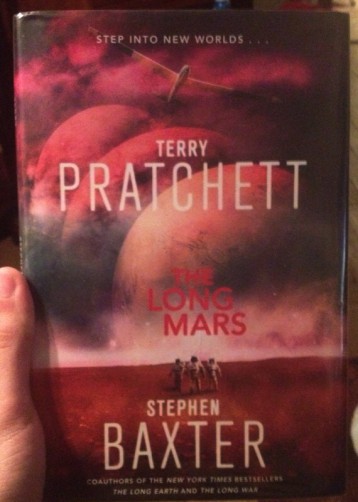
This week I’m reading The Long Mars by Terry Pratchett and Stephen Baxter, the third (and most likely final) installment of the Long Earth series. I’ve only read the first few pages, but it already appears to be a significant improvement over the other two.

Enough chatter; you want the teaser! Happy to oblige:

Well, there are plenty of contingencies we couldn't 
survive at all. A massive enough meteor strike.

IMG_2366


In Retrospect

I gave last week’s read The Art of Asking by Amanda Palmer 5 out of 5 stars; I’d give more if I could. I’m actually working on writing a review to post here and on Goodreads – unlike the review for Republic of Pirates, which I still haven’t gotten around to . . .

The Seven Deadly Sins . . .

The Seven Deadly sins may bring to mind one of two things.

For Catholics (and several other religious denominations), the phrase refers those faults that may or may not send one directly to Hell without passing Purgatory or collecting $200. Although thirty pieces of silver may be an option, I hear the gift shop is terrible.

For the more musically-minded, the phrase might plant an earworm:

Sail away where no ball or chain
Can keep us from the roarin' waves
Together undivided but forever we'll be free
So sail away aboard our rig
The moon is full and so are we
We're seven drunken pirates
We're the seven deadly sins

Of course, the two are not mutually exclusive. Anyway, Heather over at bitsnbooks recently posted her Seven Deadly Sins of Reading; being tagged by proxy, here is my own list:


LUST: a strong sexual desire

What attributes do you find most attractive in male (or female) characters?

Intelligence and strength of will. This means I often find myself sympathizing with the antagonists of a story rather than the intended protagonist.

Dore_Gustave_Francesca_and_Paolo_da_Rimini_Canto_5_73-75
Gustave Doré Francesca and Paolo

GLUTTONY: intense over indulgence

What book have you devoured over and over with no shame?

The Divine Comedy by Dante Alighieri

The Discworld novels by Sir Terry Pratchett

Lord of the Rings by J.R.R. Tolkien

The Space Trilogy by C.S. Lewis

640px-Stradano_Inferno_Canto_06
Third Circle illustrated by Stradanus

GREED: an intense and selfish desire for something

What is your most expensive book?

I’m not sure; there are several contenders:

A large coffee table book on Raphael

A leather and gold edition of 100 Decisive Battles from Ancient Times to Present

Several turn-of-the-last-century encyclopedias and almanacs (valuable for their prints)

Gustave_Doré_-_Dante_Alighieri_-_Inferno_-_Plate_22_(Canto_VII_-_Hoarders_and_Wasters)
Gustave Doré The Hoarders and Wasters

SLOTH: a reluctance to work or make an effort

What book have you neglected to read due to laziness? 

Until recently that distinction would go to To Kill A Mockingbird by Harper Lee. It was the only book I’d ever lied about reading, too.

Now, I’m probably neglecting Atonement by Ian McEwan; it’s been on my Currently Reading list since January and I haven’t even cracked the cover.

Gustave Dore The Slothful
Gustave Doré The Slothful

WRATH: extreme anger

What author do you have a love/hate relationship with?

Nicholas Sparks in that I love to hate him. Lacking originality, his books are highly predictable; never mind the fact that he’s literally sold the exact same story many times over.

466px-Stradano_Inferno_Canto_08
Fifth Circle illustrated by Stradanus

ENVY: a feeling of discontented or resentful longing aroused by someone else’s possessions, qualities or luck

What book would you most like to receive as a gift?

Anything signed by Tolkien, Lewis, Pratchett, or Dante (good luck with that last one!)

Gustave Dore The Envious
Gustave Doré The Envious

PRIDE: satisfaction derived from one’s own achievements or from qualities or possessions that are most widely admired

What books do you talk about most in order to sound like an intellectual reader?

Everything I’ve ever read.

Gustave Dore Titans and Giants
Gustave Doré Titans and Giants

What about you?

What, if any, are your reading sins?

Do you have any bad reading habits?

Teaser Tuesday: Art of Asking

Once again the wheel of time has turned to

Teaser TuesdayEven though it will be Wednesday when this finally posts. You know how things keep piling up . . .

Just in case you don’t know, Teaser Tuesday is a weekly bookish meme, hosted by A Daily Rhythm. Anyone can play along! All you have to do is grab the book you’re currently reading, open to a random page and share two sentences from that page. But make sure you don’t share any spoilers!*

*I wish I could take credit for this introduction, but I shamelessly stole it from Heather over at bitsnbooks. To help me make amends, you should go check out her blog.

Last night I started Amanda Palmer’s Art of Asking. I was just going to grab two sentences and ended up reading the first 64 pages; I only stopped because I had to sleep sometime and I really did need to make it to work on time this morning. That’s how good it is. Now I’m going to break my own rules and share not two but three sentences:

Here's the thing: all of us come from some place 
of wanting to be seen, understood, accepted, 
connected.
 
Every single one of us wants to be believed.

Artists are often just . . . louder about it.

If that doesn’t spark your interest, bear in mind that Amanda Palmer herself retweeted my library run to get her book:

Amanda Palmer Retweeted MeHow many authors would do that?

In Retrospect

I awarded last week’s book Republic of Pirates 3 out of 5 stars. I’m still working on writing a review; stay tuned to Goodreads!

The Ripples They Cause

Word of the Week certainly fits the mold of a regular feature.

Last week’s word was discovery. This week’s word is . . .

LOSS


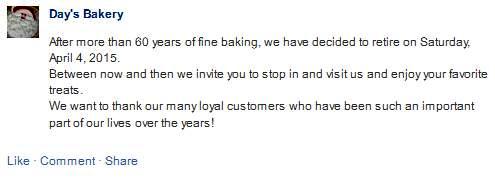
Late last week, my sister posted to my Facebook:

Days Bakery ClosingTruly the end of an era, people are wondering who will supply their dinner rolls and cookies with frosted faces and donuts and cakes and – most importantly – lebkuchen.

However, all is not lost. There are rumors the bakery will be bought – property, machines, expertise – and the tradition continue. In addition, I received a parcel:

Parcel PostThree Lebkuchen! Thanks, Mom!

I’m not as desperate financially able as the woman who cleared out her freezer and ordered fifty dozen lebkuchen.

FIFTY DOZEN

At ten dollars per dozen, that’s quite a bit of dough.

Pun intended.


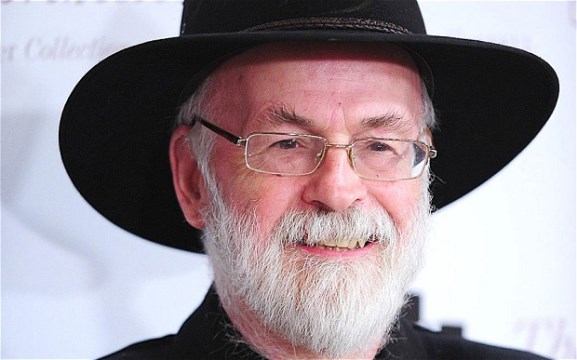
Then there’s the loss the world is talking about:

Sir Terry Pratchett

Sir Terry Pratchett

I doubt there’s anything I can say here that hasn’t been said elsewhere.

I have no story of how I met him or saw him or received an autographed book as a gift. Nevertheless, he influenced my life in ways few authors have. In those terms, he’s part of my Triad:

Dante

Tolkien

Pratchett

His books have been out since the early eighties, but I only discovered the Disc in 2008 or so with the Hogfather DVD American release. Having loved the film, I tracked down the book; looking back, it may not be the best introduction to Discworld, but I was hooked. Soon most extra money went to purchasing more of Pratchett’s works, and I found myself emotionally invested in Rincewind and Granny Weatherwax and Gythia Ogg and Havelock Vetinari and Sam Vines and Moist von Lipwig and DEATH.

As Iain Sutherland wrote on the change.org petition that DEATH return Sir Terry:

Terry Pratchett turned Death from a figure of hate into a much loved and sometimes welcomed character. No-one else cared about you Death.

You owe him!

I’ve never cried about the death of a celebrity or other public figure . . . until now.

And the more I thought about it, the more I realized I was crying not as much for Sir Terry, but for the end of the Disc.

Does that make me selfish?

I’ll never understand why I’m such a selfish man.

Sir Terry’s death also makes me angry.

Angry for the loss of literary wonder.

Angry at the Alzheimer’s that took him far too early.

Angry at the unfairness of it all.

Another petitioner on change.org wrote

It is like when you lose that relative who you didn’t know very well, but they helped you get through some really tough time and you always meant to call or write, and now it’s too late.

It’s times like these that make us wonder what makes it all worthwhile. Sir Terry had the answer:

“I meant," said Ipslore bitterly, "what is there 
in this world that truly makes living worthwhile?"

Death thought about it.

CATS, he said eventually. CATS ARE NICE.”

When it comes down to it, I just don’t know what to say. So I’ll read instead, savoring every line and turn of phrase and share the ones that speak to me. Because although Sir Terry is gone,

No one is actually dead until the ripples 
they cause in the world die away.

May Sir Terry’s ripples go on forever.

Teaser Tuesday: Republic of Pirates

We interrupt Photography 101 to bring you a feature new to Running In My Head:

Teaser Tuesday

What is Teaser Tuesday? I’m glad you asked!

Teaser Tuesday is a weekly bookish meme, hosted by Should Be Reading A Daily Rhythm. Anyone can play along! All you have to do is grab the book you’re currently reading, open to a random page and share two sentences from that page. But make sure you don’t share any spoilers!*

*I wish I could take credit for this introduction, but I shamelessly stole it from Heather over at bitsnbooks. To help me make amends, you should go check out her blog.

Anyway, of the books I’m currently reading, Republic of Pirates by Colin Woodard is closest at hand, so here are two random sentences:

By some accounts, she lost her mind during her 
incarceration, and (with the possible assistance of 
the Devil) escaped to live a hermit's life on the 
stark tablelands above the Atlantic beach. 

There she roamed, scaring children, searching for 
Bellamy, and bringing nasty storms down on
passing mariners, hobbies that earned her the 
epithet Sea Witch of Billingsgate . . .

If you want to know more, follow my Goodreads account and get notified when I give it a rating or review!


Teaser Tuesday

Website Powered by WordPress.com.

Up ↑