Like a car stuck on a roundabout, the Wheel of Time has turned to Teaser Tuesday. Continue reading “Teaser Tuesday: Beautiful Creatures”
Teaser Tuesday: Beautiful Creatures

rantings & ramblings
Like a car stuck on a roundabout, the Wheel of Time has turned to Teaser Tuesday. Continue reading “Teaser Tuesday: Beautiful Creatures”
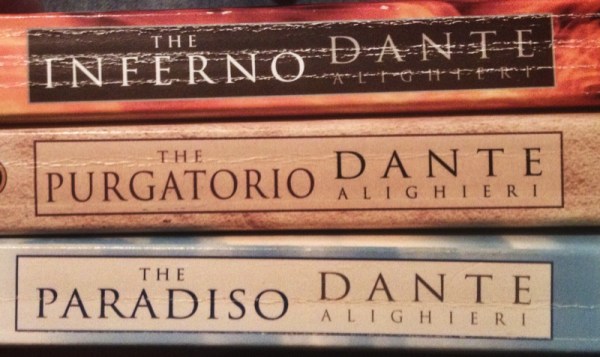
Like an ever-winding stair, the Wheel of Time has turned once more to Teaser Tuesday. Continue reading “Teaser Tuesday: Dante’s Divine Comedy”

I don’t know how many of you are religious or not, or – since one does not necessitate the other – how many of you observe Easter.
Easter is my favorite holiday; it is a time of reflection and introspection and meditation.
Now a nine-year tradition, I am again reading Dante’s Divine Comedy (Ciardi translation).
I never thought my “Triumph” post would be as popular as it was; apparently many people had an opinion about which bow tie I wore Easter Sunday. For the record, it was this one:

I’ve also been meditating on two songs sung as part of our Easter program:
Finally, you’re never to old to get an Easter Basket!

Happy Easter, Everyone!

As part of Writing 201: Poetry, we were asked to post our favorite poem.
Being as mine is The Divine Comedy, that would be a bit ambitious, though you can indeed find the full text online.
Now, you could be asking
Why on earth would a guy in his late twenties pick a Late Medieval / Early Renaissance Italian epic known for reflecting medieval Catholic theology as his favorite poem?
Well, I’m glad you asked!
I’ve always liked poetry. I loved learning poems in English class; I was the guy who asked to recite the great Shakespearean soliloquies (and made everyone else hate him for it). Before Dante, my favorite poem was Percy Bysshe Shelley’s Ozymandias:
I met a traveller from an antique land
Who said: Two vast and trunkless legs of stone
Stand in the desert. Near them on the sand,
Half sunk, a shatter'd visage lies, whose frown
And wrinkled lip and sneer of cold command
Tell that its sculptor well those passions read
Which yet survive, stamp'd on these lifeless things,
The hand that mock'd them and the heart that fed.
And on the pedestal these words appear:
"My name is Ozymandias, king of kings:
Look on my works, ye Mighty, and despair!"
Nothing beside remains: round the decay
Of that colossal wreck, boundless and bare,
The lone and level sands stretch far away.
In college I took a course in Classical and Medieval Lit; what can I say – I wanted to make the most of my liberal arts education. By that time an interest in philosophy and theology and history had taken root. In Dante I found a poet that combined everything I found intriguing. I liked poetry well enough, but Dante made be love it.


I am somewhat unique among my historian acquaintances in that I don’t totally despise Dan Brown. Now don’t get me wrong, there’s plenty to dislike: shoddy research, weak plot lines, vast historical inaccuracies, and – in my opinion the most egregious fault – the claim that his books are based on historical “fact”. His locations and historical figures may have existed, but the stories he has woven around them are pure fiction. Nevertheless, I am willing to suspend belief and accuracy in order to enjoy a well-written thriller, and let’s face it, Dan Brown knows how to tell a story.
Therefore, I regarded Mr Brown’s recent work with some trepidation. For those that don’t yet know, his most recent book is entitled Inferno and – if I am to believe the dust jacket – is set in Italy with the central conflict involving a mastermind criminal who happens to be an aficionado of Dante Alighieri’s Divine Comedy. Though the book was released several days ago, I didn’t have the time to check it out personally until today. Upon examining the first few pages, two things immediately turned me off.
First, Mr Brown has inverted Dante’s Hell. The frontispiece reads thus:
“The darkest places in hell are reserved for those who maintain their neutrality in times of moral crisis.”
Now, I own three translations of Dante: Longfellow, Sinclair, and Ciardi. Nowhere in these academically accepted translations does this quote appear, nor does any similar quote appear; the quote is not from Dante. I did some research on the matter, and it appears the “misquote” (as it may be called) can be attributed to President John F. Kennedy. I don’t blame President Kennedy for misquoting Dante; after all, countless Americans have been misquoting Alexis de Tocqueville for years thanks to our Presidents. I do, however, blame Dan Brown for sloppy research.
A quick perusal of either Sanclair or Ciardi would have yielded Mr Brown either a handy diagram or a map of Hell, both of which indicate that the neutral are not even in Hell proper. For their sin of moral ambivalence, these sinners have been cast out by Heaven and coughed up by Hell. Far from being consigned to the darkest part of Hell, these lost souls are doomed to forever follow a fleeting flag, born on by a tempestuous wind. It is worth noting that other mistranslations cite Dante as saying “hottest part of hell.” This view is also incorrect, as the hottest part of Dante’s Hell is reserved for the Violent against Others, who are continually boiled in a river of blood.
Had this error appeared elsewhere in his work of fiction, Brown might be forgiven. Perhaps he could have worked it into a piece of dialogue or used it as a sort of symbolism (as he has previously done with Renaissance and Late Renaissance artwork, Catholic custom and liturgy, and the writings of the Founding Fathers). Thus innocuously “hidden” in the midst of the story, the line would do little harm. However, since Brown chose this so-called quote to represent the conflict of his entire work, I must question whether he even consulted Dante at all.
Second, Mr Brown has apparently missed the point with Dante’s Inferno. From Brown’s “Facts” page:
Inferno is the underworld as described in Dante Alighieri’s epic poem The Divine Comedy, which portrays hell as an elaborately structured realm populated by entities known as “shades” – bodiless souls trapped between life and death.
Has Mr Brown ever heard of Hell before in any way, shape or form? Hell is not for the nearly dead, it is for the dead. They have no hope of resurrection to the world of the living nor have they hope of attaining the perfection of Heaven. The shades are not souls “trapped between life and death”, they are souls trapped in the eternal damnation of Hell in all its gory detail.
It is furthermore apparent that Mr Brown apparently never bothered to consult a map of Dante’s Hell. Far from being “elaborately structured”, the Hell of Dante’s imagination is made up of 9 concentric circles with each circle growing progressively smaller until Hell reaches the center of the Earth where Satan feasts on Brutus, Cassius, and Judas Iscariot. Neither are Dante’s conceived punishments particularly imaginative in that the punishment is made to fit the sin. The idea of making the punishment fit the crime is as old as law itself; it is only in the modern era that “rehabilitation” has become a more popular mode of “punishment”. Dante’s Hell is as elaborate in structure as that of a spiral staircase.
My last issue with Mr Brown has nothing to do with Dante. Again, I quote from his “Facts” page:
“The Consortium” is a private organization with offices in seven countries. It’s name has been changed for considerations of security and privacy.
I imagine that “The Consortium” is about as real as the Illuminati from Angels and Demons, SPECTRE in the James Bond novels and films (namely Thunderball and Dr. No), or KAOS in the Get Smart TV series.
The real question is this: would I read Dan Brown’s Inferno? If I’m to answer honestly, I would have to say that yes, I would read the novel. As I said earlier, I appreciate a good story. However, I would not read it within earshot of my wife. She really hates in when I start screaming at inanimate objects for being wrong and inaccurate.

And when he had opened the third seal, I heard the third beast say, Come and see. And I beheld, and lo a black horse; and he that sat on him had a pair of balances in his hand.And I heard a voice in the midst of the four beasts say, A measure of wheat for a penny, and three measures of barley for a penny; and see thou hurt not the oil and the wine.
– Saint John the Evangelist Book of the Revelation Chapter 6 Verses 5-6
Author’s Note: This is the third installment of a four-part series. The first installment is Death, and the second installment is War.
In my second installment of this series, I complained about how difficult it was to find an anthropomorphic personification of War. I had similar difficulties with this third installment, so once again I must consult with my old friends the Greeks and Romans (Hesiod, Ovid, and Virgil, respectively). I’ll also take a look at the character of Want in Charles Dickens’ A Christmas Carol and re-examine the inspiration for this series, Terry Pratchett’s Discworld series. And so, without further ado, I present the third installment of Death and All His Friends: Famine.
The only Greek source for a personification of Famine that I could find is a small section of Hesiod’s Works and Days. In it, Hesiod says to “Work on, so that Limos (Famine) will avoid you and august and garlanded Demeter will be you friend, and fill your barn with substance of living; Limos (Famine) is the unworking man’s most constant companion.” In other words, work hard now so that you will be blessed by bountiful crops and full barns and not starve to death come winter. Not much personification there from the Greeks, so on to the Romans.
Once again I can find solace in Ovid’s Metamorphoses. In Book 8, Ovid recounts the tale of Erysichthon and his daughter Mestra. For those of you unwilling to read through Ovid (and shame on you if you don’t), I offer a brief summary: Erysichthon desecrated a tree sacred to Ceres (goddess of the harvest). In revenge, Ceres made a deal with Famine to make Erysichthon eternally insatiable. He ate everything in his storehouses, and even sold all his possessions to get more food. He eventually had nothing left to sell, and resorted to selling Mestra in exchange for food. Mestra prayed to Neptune, who turned her into a shapeshifter. Erysichthon used this ability to swindle men out of money to buy even more food. However, Erysichthon was still unsatisfied, and he ultimately ate himself.
Here is Ovid’s description of Famine:
She…clutch[ed] at scant herbs with nails and teeth. Beneath her shaggy hair her hollow eyes glared in her ghastly face, her lips were filthy and her throat was rough and blotched, and all her entrails could be seen, enclosed in nothing but her shriveled skin; her crooked loins were dry uncovered bones, and where her belly should be was a void; her flabby breast was flat against her spine; her lean, emaciated body made her joints appear so large, her knobbled knees seemed large knots, and her swollen ankle-bones protruded.
Ovid here describes the classic symptoms of starvation: a willingness to eat anything available, even weeds; a hollowing of the face so that the eyes appear to have sunk into the skull; the blotchy, stretched skin drawn tightly around the chest, and, perversely, a swelling of the joints – perhaps reminiscent of the protruding bellies endured by the victims of starvation. Obviously, Ovid’s Famine looks like one would expect: little more than skin and bones held together by nothing but a strong will. This Famine does not just cause famine, she is famine in all its gory detail.
However, Ovid is not the only Roman writer to describe Famine, Virgil also gives us a glimpse of this ghoul in his epic work, The Aeneid. In Book 6, Aeneas makes a journey through Dis (the Underworld) in order to hear a prophecy from his deceased father. On the way, Aeneas views a variety of Roman deities, among them Fames [Famine], called a “temptress to sin.” Virgil’s Famine serves as a reminder of the lengths a man will go to in order to survive (remember our friend Erysichthon?). Dear Reader, you may wonder why I mention Virgil at all, given his scant description of our subject. I must admit a personal bias: I greatly admire the works of Dante Alighieri, and since Virgil was a prime influence on Dante, I couldn’t leave Virgil out of this discussion.
And now, on to more modern literature, in this case Charles Dickens’ classic tale A Christmas Carol. When Ebenezer draws to the close of his visit with the Second Spirit (Ghost of Christmas Present), the Spirit warns him to beware of Ignorance and Want. I believe that Want is, in this case a form of Famine. Just look at Dickens’ description of the girl:
Yellow, meagre, ragged, scowling, wolfish; but prostrate, too, in [her] humility. Where graceful youth should have filled [her] features out, and touched them with its freshest tints, a stale and shrivelled hand, like that of age, had pinched, and twisted them, and pulled them into shreds. Where angels might have sat enthroned, devils lurked, and glared out menacing. No change, no degradation, no perversion of humanity, in any grade, through all the mysteries of wonderful creation, has monsters half so horrible and dread.
Does this description sound familiar? It should; it is remarkably similar to Ovid’s description of the sallow, sunken hag of the underworld. Unlike the Greeks and Romans, however, Dickens’ does not see Famine as a goddess to be placated. According to the Second Spirit, Want [Famine] belongs to man; she is a creation of man and man’s problem to solve.
Finally, we return to my source of inspiration: Terry Pratchett and the Discworld. Famine makes a minor appearance in The Colour of Magic, but is also briefly featured in Sourcery. In Sourcery, Famine and two other Horsemen of the Apocralypse have their horses stolen while stopping for a bite at a tavern. However, since Famine was there, the quartet end up eating the innkeeper out of everything he has (except, perhaps, for a small jar of gherkins). Unlike the other authors on this list, Pratchett makes the unique choice of featuring Famine as a male figure rather than a female figure.
And there we have it: a brief survey of the anthropomorphic personification of Famine in five works of literature readily accessible to English readers. I hope you have enjoyed this journey as much as I have, and I look forward to presenting the fourth and final installment: Death and All His Friends – Part 4: Pestilence and Conquest. Two posts for the price of one!


 Running In My Head