
Every subject has its challenges, but history may be the most challenging of all.
There’s always more history. I can think of no other subject where this is true.
High school math – at least what I’ve seen of it – hasn’t changed much since I learned it 10+ years ago. Maybe the method has changed, but the ideas haven’t.
Science has made breakthroughs, clarifications, and corrections. This means that theories and hypotheses – and therefore formulas – have changed, but science generally doesn’t ask you to learn how things were done “in the old days.” At least, it doesn’t require you to have a practical, working knowledge of the old ways. Which is a shame, because once the technological apocalypse hits there will be no-one with the knowledge to rebuild society as we know it. Who needs time travel? It’s back the the Middle Ages (or Early Renaissance)! But that’s a different topic for a different time.
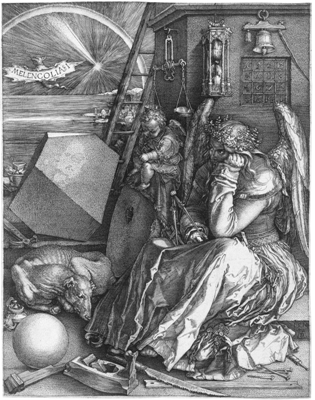
Melencolia I (Albrecht Dürer, 1514)
English hasn’t changed much, either. New authors may replace old ones, new words come into the vernacular and others fall out, and the way in which we communicate may vary, but English – as it is taught – remains largely unchanged from year to year.
History is not so – more is added to it every day and it all builds on what has happened before. For example, I cannot expect my students to understand the Arab-Israeli conflict without also understanding the origins of those particular people groups, the establishment of ancient Israel, the formation of Judaism and Islam, the Israeli diaspora under Roman rule, the re-creation of a modern Israeli state in 1948, and the various attempts (and failures) at co-existence since that time. How do you condense and revise to give an accurate overview without becoming swamped? Many teachers I know teach on themes or hit what they call “the highlights”. Some school districts have begun to expand the history requirements for graduation, making history a multi-year class (or multi-semester for those on block schedules). However, that doesn’t really solve that problem that . . .
And here is another point at which I disagree with the way in which you book presents . . .

Some history is going to be cut. How do we decide what to leave out? What to expand? What to assign for individual research? Granted, this may vary from state to state, from district to district, and from class to class, but Common Core (like it or not) will change that. Who’s to decide what is important and what’s not. Isn’t it all important? Once we’ve decided what to cut and what to leave in we’re left wondering . . .
How do we teach the “truth” of history? Like science, history cannot necessarily deal with “truth” (for a given value of “truth”). We can use primary sources and make assumptions, but even if we were to possess a time machine with which to view history our perceptions would be colored by our cultural prejudices and biases. Textbooks often present information in such a way to make it appear that history had to happen a certain way, that there is a linear cause-and-effect of events, and that there is a clear black and white morality of people and events. Seldom is that the case. Many times I end up providing my students with supplemental materials – primary sources when possible – so they can compare the claims of their book with other viewpoints and learn to base an opinion on logical application of all available facts. At least, that’s my goal. Success depends on the student. As the old saying goes, you only get out of an education what you are willing to put into it.

Don’t get me wrong. I hope you haven’t thought I’ve been complaining all this time. I’m merely pointing out what history teachers go through all the time. We watch the news and read magazines because what happens today can quite literally change what we teach tomorrow. And you know what?
I LOVE IT
[a special shout-out to Phil, Philosopher Mouse of the Hedge for inspiring this post]



 Running In My Head