Sunday Snapshots

I cleaned this week; picture opportunities seldom presented themselves.

That said, here’s a glimpse of my non-cleaning activities:

Books:


signed last will bryn greenwoodI rediscovered my signed copy of Last Will by Bryn Greenwood.


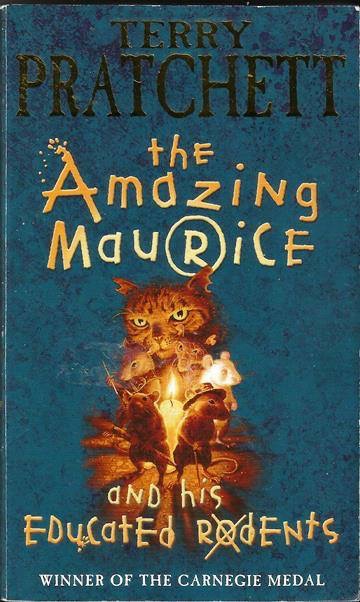
amazing maurice educated rodents coverAnother package arrived, this one bearing The Amazing Maurice and His Educated Rodents by Terry Pratchett.


Food:


german coffee
This German coffee powered most activities this week.


last piece of pie july 2015
This was the last piece of pie [with more of that German coffee].


Miscellany


haircut july 2015
I got a haircut for the first time in three months.
This is the “after” picture; I think I accidentally deleted the “before” picture.


steering wheel

In addition to cleaning, our church’s Vacation Bible School took up most evenings.
This was my view for a good hour – or more – each night.


vbs script 2015
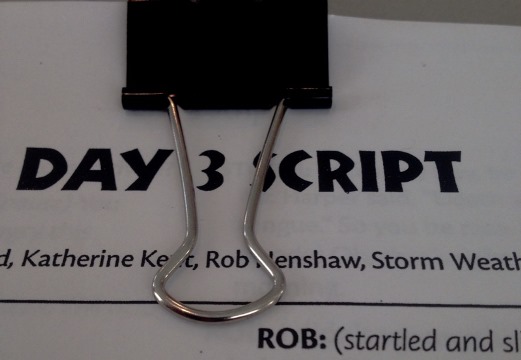
I took part in the skit each night; here’s a glimpse of one of the scripts.


lion head or holy grail
This decoration supposed to portray a lion.
I can’t help but see the Holy Grail surrounded by rays of light.


Coffee and the Holy Grail
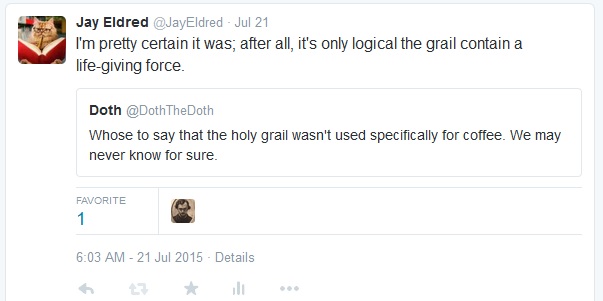
Obviously, the Grail contains coffee.


What did you do this week?


Have a suggestion for a poem, photograph, or future post?

Drop a note in the prompt box!


Don’t forget to follow me on:

Facebook – where I share news stories, articles from other blogs, and various and sundry miscellany that happens to catch my eye. It’s stuff you won’t see here! Well, mostly.

Instagram – where I show you my Life in Motion and share quotes and such. The widget only shows my last three photographs – don’t you want to see them all?

Twitter – where you can see my thoughts in 140 characters or less. Also, funny retweets.

Life at the Edges

IMG_2415Life is lived at the edges:

Between life and death,

Between light and dark,

Between good and evil,

Between today and tomorrow,

Between this world and the next,

Between many others.

Watch over and guard these edges.

Think fast, because edges can shift quickly.


Adapted from the works of Sir Terry Pratchett and this article


Photo101

Teaser Tuesday: The Long Mars

Once again the wheel of time has turned to

Teaser TuesdayJust in case you don’t know, Teaser Tuesday is a weekly bookish meme, hosted by A Daily Rhythm. Anyone can play along! All you have to do is grab the book you’re currently reading, open to a random page and share two sentences from that page. But make sure you don’t share any spoilers!*

*I wish I could take credit for this introduction, but I shamelessly stole it from Heather over at bitsnbooks. To help me make amends, you should go check out her blog.

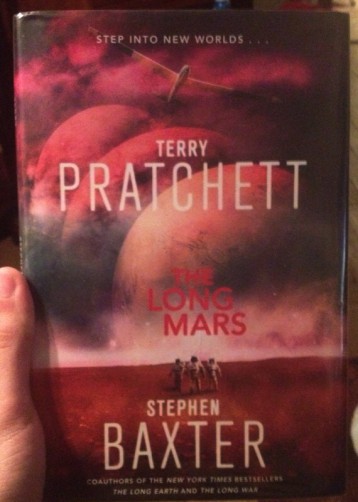
This week I’m reading The Long Mars by Terry Pratchett and Stephen Baxter, the third (and most likely final) installment of the Long Earth series. I’ve only read the first few pages, but it already appears to be a significant improvement over the other two.

Enough chatter; you want the teaser! Happy to oblige:

Well, there are plenty of contingencies we couldn't 
survive at all. A massive enough meteor strike.

IMG_2366


In Retrospect

I gave last week’s read The Art of Asking by Amanda Palmer 5 out of 5 stars; I’d give more if I could. I’m actually working on writing a review to post here and on Goodreads – unlike the review for Republic of Pirates, which I still haven’t gotten around to . . .

No Real Horizon: Discovering Discworld

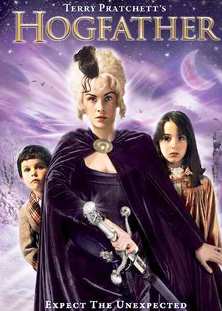
Some years ago I perused Blockbuster – back when that was a place – looking for something to watch on a lazy weekend. In that predicament, I based my selections mainly on what the covers. My wife and I settled on a unique flick entitled Hogfather. We were drawn to it for three reasons: (1) the cover looked somewhat dark,  (2) the title intrigued us, and (3) it was British. The third quality alone would have put it in our queue, for anything done by the British is almost infinitely superior to American films.

HogfatherMoviePoster

That film, starring the fabulous Michelle Dockery (Downton Abbey‘s Lady Mary Crowley) as Susan and the versatile Ian Richardson as Death, changed my literary world as no film has ever done. Normally, I read the book before the movie and then spend the length of the feature critiquing it. But, to this point, I was unaware of the beauty and glory that is the Disc. That changed the following weekend. While browsing our local bookstore (a chain, the last local closed a year before), I decided to track down the book upon which the film was based.

HogfatherBookCover

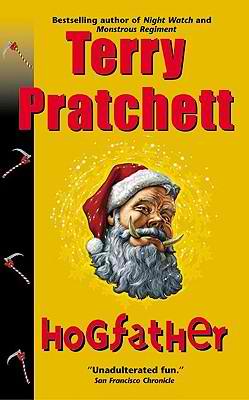
The book is superb and remains one of my favorite Discworld novels. However, I couldn’t get enough. I began to buy a book a week, soon accumulating the entire series (except for Last Hero and Raising Steam, which was released today), including the so-called “children’s books” (which aren’t just for kids, in case you didn’t know). Today, they occupy a prominent space in my personal library, with Good Omens being my most recent purchase.

If you haven’t yet experienced the wonders of Terry Pratchett’s fantasy world, get started today. It doesn’t really matter what order you read them in, just jump in with both feet and have fun!

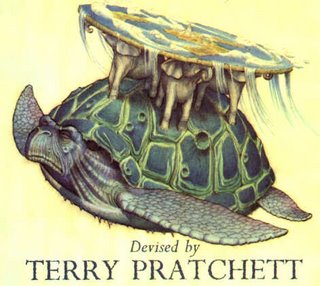
Discworld
From The Discworld Mapp

Note: Today is also the release of the newest Discworld novel: Raising Steam. But since I don’t live in England and will (probably) have to wait until Christmas, please don’t spoil it for me.

Posted for NaBloPoMo 2013NaBloPoMo_November_small

A Post for October 31

October 31 means different things to different people.

To some, October 31 is part of the Christian liturgical calender: All Hallows Eve. All Hallows Eve is the day before All Saint Day, the day dedicated to all saints (both known and unknown), as well as the martyrs and other faithful departed believers. As the nightly vigil before All Saint’s Day, All Hallows Eve constitutes the first day of Hallowmas. Perhaps early celebrations introduced such traditions as Soul Cake (and therefore Terry Pratchett’s Soul Cake Duck) and the celebration of the French danse macabre, reminding churchgoers of the end of all worldly things. These traditions changed with the Protestant Reformation, with some denominations condemning all associations with All Hallows Eve due to its “popish” customs and other denominations incorporating aspects of the day into a time of solemn reflection. Today, many American denominations consider October 31 to be a day of evil, associated with pagan harvest festivals and celebrations.

Picture1

Others consider October 31 a day of joviality. It is a day to dress up (or down), act out of character, and collect candy. They decorate their homes and costume their families and carry on traditions like trick-or-treating, carving jack-o-lanterns, or watching scary movies. Growing up, I always watched Tim Burton’s Nightmare Before Christmas. Today, that selection has been expanded to include episodes from Doctor Who, especially the “scary” or “thriller” episodes like “Don’t Blink,” “Time of Angels,” and “The Impossible Planet/Satan Pit” story line. Perhaps this year we will include “Hide” in the lineup.

Satan_Pit

These are the words of the Beast. And he has woken. He is the heart that beats in the darkness. He is the blood that will never cease. And now he will rise. We are the Legion of the Beast. The Legion shall be many, and the Legion shall be few. He has woven himself in the fabric of your life since the dawn of time. Some may call him Abaddon. Some may call him Kroptor. Some may call him Satan, or Lucifer, or the Bringer of Despair, the Deathless Prince, the Bringer of Night. These are the words that shall set him free: I shall become manifest. I shall walk in might. My Legions shall swarm across the worlds. I am the sin and the temptation and the desire. I am the pain and the loss and I have been imprisoned for eternity. But, no more. The Pit is open. And I am free.

These are some of the most terrifying words in the entire Doctor Who series . . .

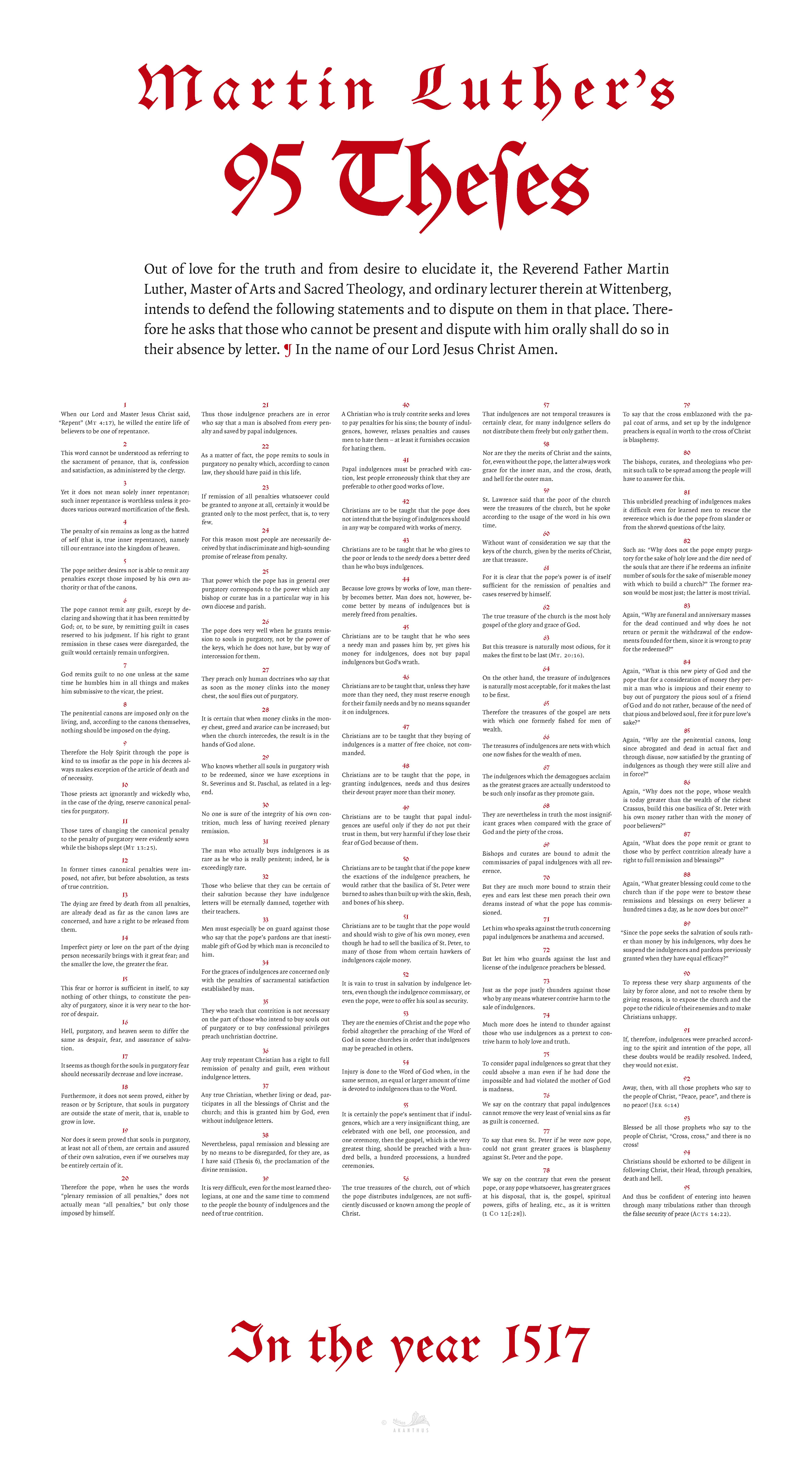
But to me, October 31 will always be first and foremost Reformation Day: the day that Martin Luther posted the 95 Theses in Wittenberg Germany protesting the Catholic practice of selling indulgences and – unintentionally – providing the impetus for the Protestant Reformation. Although the Reformation resulted in the German Wars of Religion, the Catholic Counter-Reformation, and an expansion of the Inquisition, the Reformation also brought with it a spiritual freedom not seen on a large scale since the time of Constantine. In addition, the Reformation compelled the Northern Renaissance to focus on spiritual matters rather than the humanism of the late Italian Renaissance, giving us artists like Albrecht Dürer and Jan van Eyck. The Reformation is so pivotal to human history that we use it to divide the world between the Medieval and the Modern ages.

The_95_Theses
Click to embiggen!

Whatever your penchant, I pray this October 31 finds you safe, happy, and healthy. After all, this day has something for everyone.

Death and All His Friends – Part One: Death

Grimm The Grimm Adventures  of Billy and Mandy
Grimm
The Grimm Adventures
of Billy and Mandy

“And I looked, and behold a pale horse: and his name that sat on him was Death.”

– St. John the Evangelist, Book of the Revelation Chapter 6, Verse 8

For whatever reason, I’ve been contemplating Death recently. Not the action, but the character. So, I decided to examine Death in the following pieces of literature: John Donne’s “Death Be Not Proud”, Samuel Coleridge’s “Rime of the Ancient Mariner”, Edgar Allen Poe’s Masque of the Red Death, and Terry Pratchett’s Discworld series. I chose these works for the simple reason that I could remember enough about them while running to work through some semblance of order.  The thoughts here are my own, and as such, mistakes in translation, interpretation, or application are also my own and should not reflect poorly on the authors of these magnificent works of English literature.

John Donne: “Death Be Not Proud”

Donne sees Death as a foe to be defeated; this is indicated by the very title of his poem. To me, Donne’s initial view of Death is similar to that of a hired thug. In the opening lines, Donne says that Death is considered by some to be “mighty and dreadful”. I imagine this Death to be a hulking bulk of a man lurking in dark shadows waiting for his naïve victim to stroll by. Nevertheless, Death himself has no power. Like an assassin or mercenary, Donne’s Death is a slave. “Fate, Chance, kings, and desperate men” determine Death’s contracts and there are always others willing to do the job: poison, war, sickness, poppies (narcotics), and charms (witchcraft) are always available. In addition, Donne’s belief in both a spiritual and bodily Resurrection means that Death has no real power; Death is simply a sleep from which one will soon wake. In the end, Donne’s Death is the schoolyard bully who will soon receive his comeuppance.

Samuel Taylor Coleridge: “Rime of the Ancient Mariner”

Death does not make an appearance here until Part 3 of “Rime,” and his appearance his quite brief. Having killed an albatross, a symbol of good luck, the mariner has doomed his crewmates to misfortune. Eventually, their ship is caught on a windless ocean and the men become delirious with thirst. It is in these throes of despair and despondency that Death makes his appearance. He comes for his prey on a ship befitting Death: it is able to sail and steer without wind, its masts appear to bar the sun, and the rigging has the appearance of cobwebs. Death himself is naked, perhaps intended as a reminder of the verse from the Book of Job; “Naked I came from my mother’s womb, and naked I will depart” (Job 1:21). Death is seen gambling for the souls of the sailors with a woman Coleridge names “Life-in-Death”. Life-in-Death, portrayed as a naked woman, is – to the mariner – both macabre and beautiful, possessing golden hair, red lips, and skin “white as leprosy.” Of all the crew, only the mariner is won by Life-in Death; however, the mariner considers those who died to be the fortunate ones. Coleridge then gives us the idea that there are some things worse than death. For the mariner, his fate is immortality; driven on by a supernatural desire to tell others his tale, he becomes a prisoner in his own body – a body that yearns for the release of death, a release that may never come.

Edgar Allen Poe: Masque of the Red Death 

Poe’s Death seems to take the worst aspects of Donne and Coleridge and combine them. Poe’s Death is accompanied by the Red Death, a form of pestilence (which will be examined in Death and All His Friends – Part 4: Pestilence) that kills within half an hour of initial infection. Against the threat of Death and contagion, Prince Prospero stocks his abbey with food and then locks himself and a thousand friends inside. As Poe says, “Security [was] within. Without was the “Red Death.” Six months later, Prospero hosts a wildly grotesque masquerade ball. Now in addition to his attempt at locking Death out, Prospero also chooses to mock fate in his décor: every room of the ball is decorated in bright colors except for the last, heavily adorned with black accoutrements, blood-red windows and containing a clock whose timing is designed to purposefully unnerve all who enter. To me, Prospero is mocking death by designing a room whose décor mirrors the color of death in the outside world. Almost theatrically, Death manifests himself at midnight. He comes dressed as the Red Death, wearing funeral robes stained with blood and the mask of a corpse. Ignoring the other revelers, Death moves inexorably towards Prospero, who calls for this uninvited guest to be seized and hanged. Lacking courage, none of Prospero’s friends move to help him; seizing a dagger, Prospero forces Death into the ghastly final room. However, upon reaching the disconcerting chamber, Death disappears and Prospero falls dead. It is then that the partygoers realize that figure of the Red Death was not a guest, but Death himself, and one by one they drop dead. When the last nobleman dies, “Darkness and Decay and the Red Death [hold] illimitable dominion over all.” Unlike Donne, there is no defeat of Death; he is the unavoidable equalizer, bringing both small and great to the same end with no hope or assurance of salvation.

A brief overview of Death from the Discworld novels and the world he inhabits.

Pratchett’s Death is difficult to explain to those who haven’t read his novels, but I’ll do my best to explain: imagine Death as you would want him to be. The Death of the Discworld is personable; it is only in the first book of the series, The Colour of Magic, that he is downright malicious. However, as the series has progressed, so has Death. His job is not to kill, as Death does in Donne, Coleridge, and Poe, but to collect souls after physical death has occurred. It is Death’s job to show the departed the way to their respective afterlives, whether it be some version of Valhalla, Paradise, or Reincarnation. He is sympathetic to the plight of humanity, at times endeavoring to understand emotions such as love, forgetfulness, and boredom. Death is seen as the protector of humanity and the provider of a necessary service. He is not someone to be feared, but rather a guide in unknown territory. I find now that I cannot do justice to Pratchett’s Death, you’ll just have to read the books for yourself. Suffice it to say that I find the character of Death in the Discworld series to be one of the most comforting characters in modern English literature.

Author’s Note: Death plays a minor role in many of Terry Pratchett’s Discworld novels. For those desiring to read more about Death, he plays a major role in the following books: Mort , Reaper Man , Soul Music , Hogfather , and Thief of Time.

Death and All His Friends – Part Two: War

Website Powered by WordPress.com.

Up ↑