If you had problems viewing the Virtual Read Out, those issues have been addressed.
But what of the inconvenience of banned and challenged books? Do the school boards, parents, or “concerned individuals” ever apologize for limiting the First Amendment, for restricting education, or for judging the opinions of others?
As Banned Books Week draws to a close, remember that the war is far from over. The censors may lose a battle, but they haven’t surrendered the war.
Want to read something for Banned Books Week but just don’t have the time? You’re in luck! Below, you’ll find ten of the most challenged books in the United States condensed (by me) into one sentence.
Irony isn’t lost on me; it wasn’t too long ago in writing about Fahrenheit 451 that I included the line:
Classics cut to fit fifteen-minute radio shows, then cut again to fill a two-minute book column, winding up at last as a ten- or twelve-line dictionary resume.
However, my goal is not to tell the story; rather, to whet your appetite for more.
Enjoy, fearless reader!
Ulysses (James Joyce; “explicit nature” and “promoting lust”): As an omniscient observer, spend 16 June 1904 with Leopold Bloom in Dublin.
To Kill a Mockingbird (Harper Lee; “racial slurs, profanity, and blunt dialogue about rape”): Scout, a young girl in Maycomb, Alamaba, learns from her father why racism is wrong.
The Sun Also Rises (Ernest Hemingway; profanity and sex): A group of young people attempt to forget the horrors of WWI with sex, parties, and alcohol.
Slaughterhouse-Five (Kurt Vonnegut; “depraved, immoral, psychotic, vulgar, and anti-Christian”): A soldier in WWII, Billy Pilgrim suffers from shell-shock.
1984 (George Orwell; sexual content and violence): A totalitarian government breaks Winston Smith.
The Jungle (Upton Sinclair; socialist philosophies): Discover the horror of meatpacking in the early 1900s (and socialism, too).
James and the Giant Peach (Roald Dahl; “inappropriate language, encourages disobedience to parents, references to drugs and alcohol, and ‘magical elements’): A young boy flees his abusive aunts in a magical fruit with talking insects.
The Great Gatsby (F. Scott Fitzgerald; “language and sexual references”): Jay Gatsby throws extravagant parties in an attempt to win the love of Daisy Buchanan.
Catch-22 (Joseph Heller; “offensive language”): John Yossarian deals imaginatively with Air Force bureaucracy in WWII.
The Adventures of Huckleberry Finn (Mark Twain; race and social issues): Huck Finn runs away from home and rafts down the Mississippi River with escaped slave Jim.
At this place, on May 10, 1933, Nazi students burned the books of writers, scholars, journalists, and philosophers.
A word to the unwise.
Torch every book.
Char every page.
Burn every word to ash.
Ideas are incombustible.
And therein lies your real fear.
– Ellen Hopkins
Remember, remember
The fifth of November
The gunpowder treason and plot.
I know of no reason
Why the gunpowder treason
Should ever be forgot.
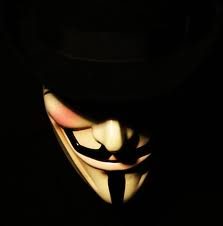
But what of the man? I know his name was Guy Fawkes, and I know that, in 1605, he attempted to blow up the houses of Parliament. But who was he really? What was he like? We are told to remember the idea, not the man, because a man can fail. He can be caught. He can be killed and forgotten. But four hundred years later an idea can still change the world. I’ve witnessed firsthand the power of ideas. I’ve seen people kill in the name of them; and die defending them. But you cannot kiss an idea, cannot touch it or hold it. Ideas do not bleed. They do not feel pain. They do not love.*
Today was a good day – one of the times I really felt I was making some headway with my classes.
Weapon of Math Instruction
It began with the first physics lab of the year – determining the density of a brass cylinder using linear measurement and water displacement methods. Good old Archimedes! Everything went extremely well with two groups completing the lab and all the supplemental material withing the class period. They even came to within .5 percent error on their math tables! Now, some students did get carried away the water-filled graduated cylinders, and one learned an early lesson on weak vacuum seals and centrifugal force. Good thing 50 mL of water is easy to clean, right?
Khufu. Khafre. Menkaure.
It continued in my World History section, where we were completing our section on Egypt. I wanted to jump up and down when students asked questions like
You mean Egypt was attacked by Assyria and Persia? You mean like Sennacherib and Cyrus and Xerxes? I remember those guys!
You said that Hatshepsut’s successor tried to remove her from living memory. Was that because he wanted to destroy her in the afterlife, too?
Wait. If the Greeks conquered Egypt, and Cleopatra is decidedly non-Egyptian, does that mean Cleopatra was Greek?
This class is going to love the Egypt section of Engineering an Empire, an excellent look at ancient civilizations narrated by Peter Weller – yes, that Peter Weller – and produced by the History Channel back when the History Channel was actually about history and not, well, whatever it is now.
Now, two good classes is one day is rare, but three is unheard of. At least, it is in my experience. Nevertheless, it happened. I taught a double American Government section wherein we discussed the Mayflower Compact and the Great Awakening. I was beaten to the punch on one of my class discussion questions when one of my students asked “Wait a minute. If the Great Awakening had such a positive impact in America, then how did people reconcile slavery?” I kid you not, I just about fainted. This is the class that getting any class-related interaction is like convincing me that e-books are a good idea. But that question set things in motion. We were able to discuss concepts of equality and the roots of slavery. We compared the slavery of the ancient and medieval world with American slavery. We talked about how things weren’t necessarily as bad as Stowe’s Uncle Tom’s Cabin but neither were they afforded basic human dignity. I didn’t teach much of what I had planned to, but this was enrichment time!
As class was winding down, I asked them what caused the change. Turns out most of them were actually paying attention to the supplemental material I’d been providing. Some of them even read it! One of them put it this way: “I figured if you were going to take the time to find extra stuff to help us understand, I’d at least make the effort to participate.”
No lie, that’s gonna keep me going for a while, even if they don’t make it through Blackstone’s Commentaries on the Laws of England or Burke’s Reflections on the Revolution.
Every subject has its challenges, but history may be the most challenging of all.
There’s always more history. I can think of no other subject where this is true.
High school math – at least what I’ve seen of it – hasn’t changed much since I learned it 10+ years ago. Maybe the method has changed, but the ideas haven’t.
Science has made breakthroughs, clarifications, and corrections. This means that theories and hypotheses – and therefore formulas – have changed, but science generally doesn’t ask you to learn how things were done “in the old days.” At least, it doesn’t require you to have a practical, working knowledge of the old ways. Which is a shame, because once the technological apocalypse hits there will be no-one with the knowledge to rebuild society as we know it. Who needs time travel? It’s back the the Middle Ages (or Early Renaissance)! But that’s a different topic for a different time.
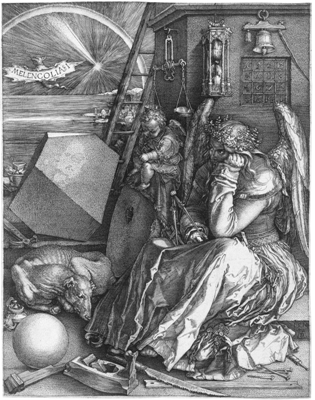
And on your right, you’ll see the broken instruments of human knowledge . . .
Melencolia I (Albrecht Dürer, 1514)
English hasn’t changed much, either. New authors may replace old ones, new words come into the vernacular and others fall out, and the way in which we communicate may vary, but English – as it is taught – remains largely unchanged from year to year.
History is not so – more is added to it every day and it all builds on what has happened before. For example, I cannot expect my students to understand the Arab-Israeli conflict without also understanding the origins of those particular people groups, the establishment of ancient Israel, the formation of Judaism and Islam, the Israeli diaspora under Roman rule, the re-creation of a modern Israeli state in 1948, and the various attempts (and failures) at co-existence since that time. How do you condense and revise to give an accurate overview without becoming swamped? Many teachers I know teach on themes or hit what they call “the highlights”. Some school districts have begun to expand the history requirements for graduation, making history a multi-year class (or multi-semester for those on block schedules). However, that doesn’t really solve that problem that . . .
And here is another point at which I disagree with the way in which you book presents . . .
An excellent podcast for supplemental material!
Some history is going to be cut. How do we decide what to leave out? What to expand? What to assign for individual research? Granted, this may vary from state to state, from district to district, and from class to class, but Common Core (like it or not) will change that. Who’s to decide what is important and what’s not. Isn’t it all important? Once we’ve decided what to cut and what to leave in we’re left wondering . . .
How do we teach the “truth” of history? Like science, history cannot necessarily deal with “truth” (for a given value of “truth”). We can use primary sources and make assumptions, but even if we were to possess a time machine with which to view history our perceptions would be colored by our cultural prejudices and biases. Textbooks often present information in such a way to make it appear that history had to happen a certain way, that there is a linear cause-and-effect of events, and that there is a clear black and white morality of people and events. Seldom is that the case. Many times I end up providing my students with supplemental materials – primary sources when possible – so they can compare the claims of their book with other viewpoints and learn to base an opinion on logical application of all available facts. At least, that’s my goal. Success depends on the student. As the old saying goes, you only get out of an education what you are willing to put into it.
Don’t get me wrong. I hope you haven’t thought I’ve been complaining all this time. I’m merely pointing out what history teachers go through all the time. We watch the news and read magazines because what happens today can quite literally change what we teach tomorrow. And you know what?












 Running In My Head