Boats Against the Current: The Great Gatsby

Banned_Great_Gatsby

Can’t repeat the past?…Why of course you can!

Warning: This post may contain politically incorrect language and expletives. They exist for the purpose of example and edification; they are not intended to disparage or defame any particular person, race, creed, color, or religion. If you feel you may be offended by such language, stop reading now. You have been warned.

SPOILERS AHEAD

From the Back Cover

Here is a novel, glamorous, ironical, compassionate – a marvelous fusion into unity of the curious incongruities of the life of the period – which reveals a hero like no other – one who could live at no other time and in no other place. But he will live as a character, we surmise, as long as the memory of any reader lasts.

It is the story of this Jay Gatsby who came so mysteriously to West Egg, of his sumptuous entertainments, and of his love for Daisy Buchanan – a story that ranges from pure lyrical beauty to sheer brutal realism, and is infused with a sense of the strangeness of human circumstance in a heedless universe.

It is a magical, living book, blended of irony, romance, and mysticism.

~ 1953 Scribner Edition

Why the Book was Banned

1. Language

2. Sexual references

3. Hedonism

4. Racism

Synopsis

Meet our main cast: Nick (the narrator), Daisy and Tom Buchanan (Nick’s cousins), Jordan Baker (Nick’s love interest), and Jay Gatsby (a mysterious, eccentric individual)

Tom introduces Nick to Myrtle, his mistress; Nick is unimpressed.

Gatsby throws open-invitation parties; Nick meets both Gatsby and Jordan at one of these affairs. Gatsby recounts some history: he had been in love with Daisy before the war (WWI) and lost her to Tom. Now, he wants her back and desires Nick’s help.

The plan works, an affair ensues. Everything is fine until Tom meets Gatsby, becomes suspicious, and starts researching his background. (Hint: Tom knows everything).

Eventually, the truth comes out and everyone parts ways in foul moods. Daisy accidentally kills Myrtle, Tom tells her husband, George, that Gatsby is to blame. George commits first-degree murder and then suicide. Daisy and Tom leave; Nick ends it with Jordan and arranges Gatsby’s funeral.

The book ends with an invective against nostalgia.

Here, have an infographic:

the-great-gatsby-character-map_514d045268c55
Photo Source: http://visual.ly/great-gatsby-character-map
I’d really like this as a poster…

My Thoughts

Fitzgerald packed a variety of themes into such a short book, i find it difficult to choose just a few to write about. Therefore, I picked three; two were at random, one was not. No prizes for guessing which one I purposefully chose.

First, in the Jazz Age, wealth and class went hand-in-hand. Gatsby tries to change his class by changing his wealth; people of a different era might call him nouveau riche. However, Gatsby never fully assimilates into the class he desires. Despite his wealth and lavish expenditures, Gatsby never becomes “one of them.” This begs the question: can America be a classless society? Even today, media pundits talk of “class division.” If we are to believe Fitzgerald, not only is a classless America a myth, but so is the American Dream. Gatsby’s life evidences that no matter what wealth one obtains, others will still judge him by his past. Taken to the extreme, any attempt to change class results in tragedy. Lotto winners, anyone?

Second, “only fools fall in love,” and Gatsby is the greatest fool of all. Other characters possess tolerance, infatuation, perhaps even affection, but only Gatsby is actually in love – and look how it ended for him. In this, Gatsby resembles Romeo and Juliet much more than The Sun Also Rises.

Third, history defines every character in Gatsby. Some, like Gatsby, try to hide or rewrite it. Others, like the Buchanans, base their way of life on it. Despite living in such a progressive era, everyone actually lives in the past (some despite their best intentions). It’s one thing to remember the past; it’s another to live in the past. No good comes from living in the past. Remembering the past helps us learn, grow, progress. Living in the past stunts growth and slows progress. (Trust me: I teach history for a living). Ultimately, living in the past results in insurmountable frustration. As Nick says in the last line of Gatsby:

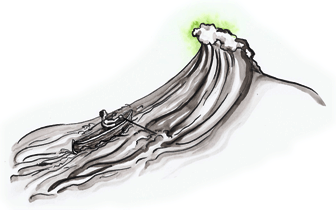
And so we beat on, boats against the current, borne back ceaselessly into the past.

boats_against_the_current

Sisyphus Gatsby by m.e.g
Photo Credit: http://www.themediares.com

The Best Laid Plans: Of Mice and Men

Banned_Mice_and_Men

A guy goes nuts if he ain’t got nobody . . .

I tell ya, I tell ya a guy gets too lonely an’ he gets sick.

Warning: This post may contain politically incorrect language and expletives. They exist for the purpose of example and edification; they are not intended to disparage or defame any particular person, race, creed, color, or religion. If you feel you may be offended by such language, stop reading now. You have been warned.

From the Back Cover

They are an unlikely pair: George is “small and quick and dark of face”; Lennie, a man of tremendous size, has the mind of a young child. Yet they have formed a “family,” clinging together in the face of loneliness and alienation.

Laborers in California’s dusty vegetable fields, they hustle work when they can, living a hand-to-mouth existence. For George and Lennie have a plan: to own an acre of land and a shack they can call their own. When they land jobs on a ranch in the Salinas Valley, the fulfillment of these dreams seems to be within their grasp. But even George cannot guard Lennie from the provocations of a flirtatious woman, nor predict the consequences of Lennie’s unswerving obedience to the things George taught him.

~ 1993 Penguin Book Edition

Why the Book was Banned

1. Offensive language

2. Racial slurs

3. Promoting euthanasia

4. Anti- business ideas

Synopsis

A short book begets a short synopsis. Lennie and George eke out a living in Depression-era California. Forced to leave town when Lennie causes a “misunderstanding,” the two find work on a ranch in Salinas County. Hoping to own their own land, this will be the last time they work for someone else. Then Lennie causes another “misunderstanding.” You know what Shakespeare said about “the best laid plans of mice and men…”

MouseTrapBox
The polar opposite of Ockham’s Razor

My Thoughts

Steinbeck covers a variety of themes in Of Mice and Men, including dreams, prejudice, weakness, and violence. Here’s several that stood out to me:

First, he addresses the idea of equality.

Ranch workers represent the plight of migrant workers. Set during the Depression, Lennie, George, and others are forced to find work where they can, often traveling long distances on the mere rumor of work. Employers negotiate pay upon their arrival and renegotiate at will. Workers receive substandard room and board while their masters (for lack of a better word) live in luxury. In his sympathy for the overworked and underpaid, Steinbeck calls attention to the abuses of impersonal corporations.

Crooks, the stable hand, highlights racial inequality. Although born and raised in California, Crooks is treated as an outsider. The men force him to live apart and constantly refer to him as “nigger.” Even the name Crooks is insulting; it refers not to his given name, but to his crooked back.  Nevertheless, Steinbeck shows Crooks to be a normal human being. Neat and bookish, Crooks dispels the “ignorant savage” stereotype common in the 1930s (and still existing today). Crooks even opens up to Lennie and begins to dream of partnering with George and Lennie in their dream to own some land. Sadly, Crooks’ dream dies when Curely’s wife threatens his life in front of Lennie and some other men.

Curley’s wife highlights gender inequality. She possess no name in the novel; she is the property of her husband. The only woman on the ranch, she must make do with “men talk” and tolerate Curley’s narcissism. Desiring her own form of freedom, she dreams of Hollywood. Admittedly, she is self-obsessed and cruel, but I also feel sympathy for her. When she dies, we see what she might have been under different circumstances:

[T]he meanness and the plannings and the discontent and the ache for attention were all gone from her face. She was very pretty and simple, and her face was sweet and young. Now her rouged cheeks and her reddened lips made her seem alive and sleeping very lightly.

Second, Steinbeck addresses the ruthlessness of big business. Curley, the boss’ son and main antagonist of the novel, embodies this idea. Relatively small and weak, Curley is obsessed with appearance and power. Some might say he possesses a Napoleon Complex, but that would be insulting to Napoleon. Curley habitually picks fights with larger men (often ambushing them) to “prove” his prowess (not unlike a corporate businessman in an unfriendly merger). To Curley, power is everything: sexual power, physical strength, and business acumen are his goals.

Third, Steinbeck’s overarching theme is friendship. The relationship between George and Lennie resembles that of a bromance, after all, their friendship is the only real constant in either of their lives. However, I’m not sure what Steinbeck meant to achieve with this theme.  For Lennie and George to be so close, why do they choose a job seemingly more well-suited to loners? Was Steinbeck trying to show that their friendship was solid, or that it was merely superficial? Was it even friendship, or was George just using Lennie? After all, he constantly had to protect Lennie from getting into trouble (something he wasn’t always successful at doing) and spends some time telling us how much better off he’d be if he didn’t have Lennie to look after. If that’s the case, why not just leave him? Furthermore, if that’s how he really felt, is George’s final act done to protect Lennie or to free George from further obligation?

To the chase: Overall, I’m not sure what to think about Of Mice and Men. Throughout most of the book, Steinbeck keeps the reader hopeful of a happy ending. George and Lennie’s friendship seems to last insurmountable odds. The men find work (and good work at that) and a partner to help make their dream a reality. Hope disappears in the last 17 pages. Lennie accidentally kills Curley’s wife and runs away. George tries to help him, but this time there is nothing to be done. George must either turn Lennie in, or . . .

This is too depressing. Here’s what another reader thought of the ending:

Even though the dream never becomes reality, Steinbeck does leave us with an optimistic message. George and Lennie do not achieve their dream, but their friendship stands out as a shining example of how people can live and love even in a word of alienation and disconnectedness.

I wonder what book this reviewer read; it certainly wasn’t Mice and Men. What optimism is there? Facing the loss of his dream and the necessity of turning Lennie over to the authorities, George opts to shoot Lennie and claim “self-defense.” How then does their friendship “stand out?” That the people you trust the most will be the one to stab you in the back? That the mentally challenged should be treated like animals, to the point of being “put down” if they pose a danger to society? I might be confused about the book as a whole, but I’m not confused about George and Lennie: George used Lennie, and, when Lennie was no longer useful, threw him to the wolves.

I wish I could end this review on a happy note, but I can’t. Instead, here’s a picture of my cat:

IMG_0995

The Most Terrific Liar: Catcher in the Rye

Banned_Catcher_in_the_Rye

How do you know what you’re going to do until you do it?

Warning: This post may contain politically incorrect language and expletives. They exist for the purpose of example and edification; they are not intended to disparage or defame any particular person, race, creed, color, or religion. If you feel you may be offended by such language, stop reading now. You have been warned.

From the Back Cover

This is one of the most remarkable books published in years. It is the story of sixteen-year-old Holden Caulfield, who wants desperately to find himself, but who goes underground in New York for forty-eight hours when he is overwhelmed by the perplexing circumstances of his life. Read the first page – and you will not be able to stop until you have completed this wild and magic adventure with him.

~ New American Library Edition

Why the Book was Banned

1. Profanity

2. Advocating Rebellion

Synopsis

Set in the 1950s, Catcher in the Rye is the story told by the central character, sixteen-year-old Holden Caulfield, of how he came to be at a sanatorium in California.

Saturday: Expelled from a prep school in Pennsylvania and annoyed by his professors, neighbors and roommates, Holden makes an early return his Manhattan home. Rather than face his parents, he checks into a hotel; there he spies on his neighbors, smokes cigarettes, attempts to find a stripper, and connives to get drunk. Holden ends up flirting with women twice his age and paying their tab.  Undefeated, Holden makes his way to a jazz club in Greenwich Village,  where he watches the other patrons and ignores a family acquaintance. When he returns to the hotel, Holden is swindled out of $10 by the elevator operator and a prostitute.

Sunday: Holden arranges a date with his old friend, Sally.  He eats breakfast with 2 nuns while discussing Romeo and Juliet. He starts to look for his sister, Phoebe, but instead heads to the Biltmore Hotel for his date. The date fails: Sally spends her time talking to someone else and she and Holden fail at ice skating. When Sally refuses to run away with him, Holden calls her a “pain in the ass” and she leaves.  After driving off another acquaintance with talk of homosexuals and foreigners, Holden drunk-calls Sally, visits the frozen lagoon in Central park, and breaks into his own apartment. Here he reveals to Phoebe his fantasy of being “the catcher in the rye.” His parents return, Holden creeps out and calls up an old English teacher, who in turn offers him a pace to sleep. When he perceives the man making homosexual advances, Holden instead spends the night in Grand Central Station. Later, Holden decides to run away for good, but he tells Phoebe, who tries to go with him. To make up for refusing her, Holden takes Phoebe to the carousel, where he is overcome with emotion and moved to tears. The story abruptly ends here with Holden declaring that he’s not going to tell anything else.

My Thoughts

Without a doubt two of Catcher‘s themes are alienation and adolescence. However, phoniness outshines all other contenders. On nearly every page Holden finds something hypocritical to complain about: a headmaster’s favoritism, a teacher’s mannerisms, jocks, nerds, football, his Dorm Mother, tabloids, taxis, magazines, and night trains. All this and more in the first 52 pages.

It is ironic, therefore, that Holden is the biggest phony in the book.

He considers magazine discussions phony, yet continues to buy them.

He can’t stand emotional girls; yet will do anything to keep his sister from crying.

He hates jocks who get it on in the back of cars, yet tries at least twice to hire a stripper.

He hates people who use other people, but he uses his brother to meet girls and old friends to get drunk.

He despises people who arbitrarily judge others, yet he constantly does the same.

He lies multiple times about who he is and why he is leaving Pencey.

He thinks people should work for their money when he hasn’t had to work a day in his life.

He wants people to act the same all the time, yet he act different every time he meets someone new.

He wishes people would be better than they are, yet he refuses to better himself.

In short, he is the exact definition of a hypocrite.

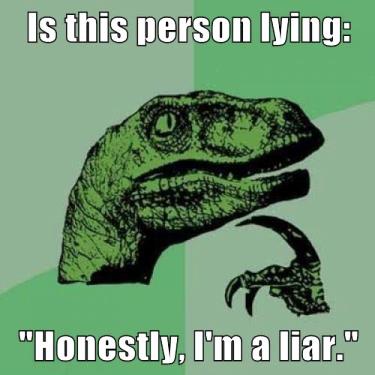
I’m the most terrific liar you ever saw in your life. It’s awful. If I’m on the way to the store to buy a magazine, even, and somebody asks me where I’m going, I’m liable to say I’m going to the opera. It’s terrible.

Holden Caulfield thinks Philosoraptor is a phony.

In my opinion, this quote throws the entire story into question. If Caulfield is such a terrific liar, what’s to keep him from inventing a story about how he came to the sanatorium? We’ve seen from his story that, above all else, he craves sympathetic attention. Perhaps we’ve spent several hours with Holden for nothing; the whole thing was an elaborate ruse to gain some sympathetic human contact. Challenge: read it for yourself and come to your own conclusion. Otherwise, Holden Caulfiend might think you’re a phony.

A Book is a Loaded Gun: Fahrenheit 451

Banned_Fahrenheit_451

A book is a loaded gun in the house next door.

Who knows who might be the target of the well-read man?

Ray Bradbury – Fahrenheit 451

Warning: This post may contain politically incorrect language and expletives. They exist for the purpose of example and edification; they are not intended to disparage or defame any particular person, race, creed, color, or religion. If you feel you may be offended by such language, stop reading now. You have been warned.

SPOILERS AHEAD

From the Back Cover

Guy Montag was a fireman whose job it was to start fires.

The system was simple. Everyone understood it. Books were for burning…along with the houses in which they were hidden.

Guy Montag enjoyed his job. He had been a fireman for ten years, and he had never questioned the pleasure of the midnight runs nor the joy of watching pages consumed by flames…Never questioned anything until he met a seventeen-year old girl who told him of a past when people were not afraid.

Then he met a professor who told him of a future in which people could think…and Guy Montag suddenly realized what he had to do!

~ 1991 Del Ray Edition

Why the Book was Banned

1. Profanity, especially for the use of the words “hell” and “damn”

2. Burning of the Christian Bible

3. Perceived opposition to Government (c.f. 1940s and 50s McCarthyism)

Book_Gun
Photo Source: quarterlyconversation.com

Synopsis

In the future, any home containing books must be immediately destroyed by firemen. Guy Montag is one such fireman.

Several events alter his worldview. First, he meets Clarisse McClellan, a teenage girl who opens his eyes to the world around him. Second, his wife Mildred ODs on sleeping pills, further reinforcing Clarisse’s declarations.

Montag reevaluates his life, going so far as to save a book from destruction. Clarisse vanishes, most likely killed by a motorist. Suspicious of Montag’s behavior, Beatty (his boss) lectures him on the origins of firefighting. The lecture bolsters Montag’s “rebellious” nature, and he goes beyond saving books and starts reading them.

One day, Montag meets an old English professor, Faber. Reluctantly, Faber agrees to help Montag fight the firemen. Headstrong, Montag reads poetry aloud to his wife and her friends. That night, Beatty forces Montag to torch his own house.

Running from the law, Montag hides with Faber, who helps him flee the city. On the outskirts of town, Montag meets the Book People: intellectual hobos led by a man named Granger. As the Book People memorize literature to keep it from extinction, Montag volunteers to memorize parts of the Bible.

As they are talking, war strikes home and the city destroyed. The novel ends with the Book People discussing how best to rebuild society.

My Thoughts

I knew going into this project that Fahrenheit 451 would top my list. No other book in all of literature has affected me in quite the same way. The book challenged me to think critically, to memorize passages I found important, to know my past, and to not accept blindly every “fact” that I was given. (Can you tell I like the book?) Therefore, I find it quite distressing that people like this consider it trash. That said, let’s begin.

Fahrenheit 451 isn’t about censorship. Bradbury intended Fahrenheit to highlight television’s negative impact on literature. According to Captain Beatty, literature dies a slow, agonizing death:

Step One: Make things simpler. Photography, radio, and television reduce the need to reading comprehension. A picture is worth a thousand words; a 4-hour speech becomes a 30-second sound bite. What books remain are further reduced in condensations, tabloids, and digests. Cut out the boring bits and get to the ending already! Classics are adapted to radio, book columns, and dictionary/encyclopedia entries.

Step Two: Reduce the need for critical thinking. Shorten school; relax discipline; drop subjects like philosophy, history, and languages; ignore English and spelling.

Step Three: Change society’s focus. Everyone needs a job, so ignore everything you “don’t need.” After work, find pleasure in sports, cartoons, and travel.

Step Four: Tolerance. Efforts to avoid offending anyone result in bland books (and entropy of critical thinking).

Note the absence of censorship from this litany. The anti-censorship “theme” appears once:

Colored people don’t like Little Black Sambo. Burn it. White people don’t feel good about Uncle Tom’s Cabin. Burn it. Someone’s written a book on tobacco and cancer of the lungs? The cigarette people are weeping? Burn the book. Serenity, Montag. Peace, Montag. Take your fight outside. Better yet, into the incinerator. Funerals are unhappy and pagan? Eliminate them, too. Five minutes after a person is dead he’s on his way to the Big Flue, the Incinerators serviced by helicopters all over the country. Ten minutes after death a man’s a speck of black dust. Let’s not quibble over individuals with memoriums. Forget them. Burn them all, burn everything. Fire is bright and fire is clean.

p. 59-60, 1991 Del Ray edition

The misconception persists thanks to the adage “If you tell a lie often enough, it becomes truth.” Over the past 50 years hundreds of critics, essayists, and reviewers promulgated the anti-censorship theory. Even Bradbury’s biographer got it wrong.  In reality, Bradbury warns us of a technology-dependent society. Taken to extremes, technology negatively influences everything it touches.

Technology kills diversity. Now, I don’t mean that technology somehow magically transforms everyone into the same race. In its attempt at diversity, technology cannot afford to offend anyone; in so doing, it kills a diversity of ideas. Society benefits from healthy dialogue and debate. These avenues allow us to progress, to move beyond the mistakes of the past, and to leave our world a better place than we found it. Ignoring “unpopular” issues or ideas solves nothing; outright suppression of opposing viewpoints breeds radicalism.

In education, technology limits the free exchange of ideas. “Impossible!” you say. “The internet provides access to more information than at any other time in human history.” Correct. But what happens when (not if) a government decides to limit access to that information? The internet transforms into an echo chamber for government-approved philosophies, resulting in citizens unable to think critically about their world.

Technology also has the power to help or harm the environment. Bradbury envisioned a future where people ignore the landscape; drivers on the superhighways can’t see it and couch potatoes can’t be bothered. It is notable that Montag’s moment of awakening occurs in the rain.

Consider, too, the implications on mental health. Cyber-bullying plagues countless teenagers. Unfiltered access to the internet warps ones perspective on self and society. In a society incapable of building real, lasting relationships, interpersonal skills break down. In Bradbury’s dystopia, teenagers succumb to violence and suicide on a regular basis and no-one bothers to ask why. Thankfully, our society is not that far gone (yet).

Speaking of violence, technology changes our morality. Consider how many studies link technology – especially video games – to violence. There’s a reason why the government uses simulation to prepare soldiers: desensitization. In Bradbury’s world, people ignore the reality of war and treat it like a game or a piece of celebrity gossip.

Bradbury’s overarching theme is inaction. The dystopia he foresees is not the result of cataclysm or military coup; it results from people not caring. They do not care to know, to learn, to grow. They care only for the immediate, for instant gratification, for the next reality show or technological “wonder.” The people voluntarily gave up their rights and chose to blindly follow their authority. Therefore, Bradbury does not warn us of a world where books are censored; he warns us of a world where they are not important. And that, dear reader, is a future most horrifying indeed.

It was a pleasure to burn.

Light the Bonfires: On Censorship

At this place, on May 10, 1933 Nazi, students burned the books of writers, scholars, journalists, and philosophers.
At this place, on May 10, 1933, Nazi students burned the books of writers, scholars, journalists, and philosophers.
Photo Source: Wikimedia Commons
Translation errors are mine alone.

Where they burn books, they will – in the end – burn people.
~ Heinrich Heine (1820)

Warning: This post may contain politically incorrect language. It exists for the purpose of example and is not intended to disparage or defame any particular person, race, creed, color, or religion.  If you feel you may be offended by such language, stop reading now. You have been warned.

First Things First

What is censorship? As a teacher, I advise my students that Wikipedia is not a scholarly source. Nevertheless, the site provides an accurate definition for censorship: “the suppression of speech or other public communication which may be considered objectionable, harmful, sensitive, politically incorrect or inconvenient.” In reality, this definition requires only one word: inconvenient. In our politically-correct, self-centered society, anything we disagree with must be the spawn of Hitler. Don’t believe me? Just check the comments section on any internet forum.

Censorship exists in many forms. Countries around the world censor the internet; the FCC regulates “radio, television, wire, satellite and cable” communications in the United States;  political and religious groups seek to enshrine their First Amendment rights at the expense of their opposition; media outlets and schoolteachers censor their messages in accordance with their audience. In our technology-dependent society, book censorship often goes overlooked. Banned Books Week exists to inform the public of such censorship.

On some level, literary censorship has always bothered me. I learned at an early age to avoid “condensed” or “abridged” novels. I assume most editors of these books desired to make classics more manageable. Hogwash. Anything worthwhile is worth working for. Now that I am older, I realize many of these books are censored for language and content, not just the “boring bits”. Imagine a world where Huckleberry Finn never says “nigger”, Holden Caufield never swears, and Jay Gatsby never has an affair. It’s one thing to disagree with a character’s actions or motives; it’s another thing entirely to make the character more “socially acceptable.”

Fuel for the Fire

There is more than one way to burn a book.

And the world is full of people running about with lit matches.

~ Ray Bradbury, Fahrenheit 451 (1953, Coda)

In general, book censorship takes on three forms.

First, some censors only edit books in their personal library. These puritanical critics take a black marker to the pages of literature and pass their objections on to others. My first copy of Catcher in the Rye, bought at a used book fair, had all the profanity blacked out. (Spoiler: profanity is essential to Holden’s character). I later bought a copy of Wicked in which all references to sexuality had been removed via Sharpie. In case you don’t know what happens when you use Sharpie on book paper, it (generally) bleeds through, effectively ruining the book.

BBWPoster2013
Like this, minus the motivational message.

Second, some censors seek to “protect” their communities via book bans. For the most part, these bans affect school reading lists, but public libraries are often targeted as well. It is this form of censorship that Banned Books Week was designed to fight.

Parental Advisory Banned Book
For some, this isn’t satire.

Finally, in its most extreme form, censors may seek to eradicate book by burning all known copies. The most infamous of these fires took place in Nazi Germany, but they also occurred in England during the 14th and 15th centuries. Even as recent as 2010, censorship zealots tried to keep the tradition alive and well.

Terry Jones Koran Burner
Terry Jones
Would-Be Koran Burner

Fighting the Thought Police

Ministry_of_Truth
From the “Ministry of Truth”

Many critics question the practice of allowing objectionable material in the first place. After all, if we disagree with something for religious or political reasons, or if we are offended by material of a certain nature, should we not have the right to protest it? Should parents not have the right to monitor what their children have access to?

I grew up in a conservative household, so I partially understand these concerns. However, what is most important: that our own beliefs advance or that people think for themselves? Is it not better to make an informed decision rather than simply relying on the words of others? In determining what a society – or a segment of society – can and cannot read, we deprive ourselves of opportunities to promote and develop critical thinking.

Productive citizens require discernment. It allows us to filter information and produce opinions based on fact and not emotions. Discernment allows us to see the big picture and make choices based on the long term. Reasoning helps us make sense of a chaotic world.

As a teacher, I see this deficiency every time I assign a “thought question” in one of my classes. No matter the grade, someone inevitably moans that the book (or my lecture) fails to fully answer the question. When this happens, I point to a poster hanging on my wall:

einsteinmotto

To me, it is not enough to simply know what you think; you must also know why you think it. I aim to teach my students to think for themselves, and then articulate their opinion in a rational manner. For example, some years ago I posed the following question: “Was Germany responsible for World War I as the Treaty of Versailles claimed? Explain your answer.” Among the varying answers I received this:  “Germany was responsible for World War I because Germany is stupid.” I gave zero credit. The student complained of unfairness; in class I had backed Germany. So I sat down and showed him how exactly he could have answered the question. Again, he complained that there was no clear-cut “correct” answer. “Exactly,” I said.

A Glimpse of Things to Come

Now you know my viewpoint. With this in mind, over the next seven days I will be reviewing seven banned books – one for each day of Banned Book Week.  Check back tomorrow  for Banned Book No. 1!

The fact is that censorship always defeats its own purpose, for it creates, in the end, the kind of society that is incapable of exercising real discretion.
~ Henry Steele Commager

Memory For Sale: Silver Saxophone

Beuscher Silver Saxophone

Some time ago, Daily Prompt asked us to imagine finding one of our childhood memories for sale in a thrift shop. I immediately thought of my mother; she lived that scenario 29 years ago. What follows is her account:

    I grew up in Rochester, New York. In 1955, I entered the fifth grade and started taking music lessons at school; my instrument was the saxophone. My mom and dad rented and then bought a second hand instrument for me. I hoped for a shiny gold sax, but received a silver one instead. No amount of cleaning, polishing, and repairing could change it in my eyes.  Nevertheless, I was happy to play. I took lessons and joined the school band. This gave me many great experiences: the school band gave concerts, joined other schools for county festivals, traveled to Canada twice and to Long Island once for exchange concerts, and my mom, sisters and I played together at church (our ensemble consisted of cello, flute, clarinet, sax, and piano).

      After high school, my sax traveled with me to Baptist Bible Seminary (located in Johnson City, NY at the time). Then I returned to Rochester for nursing school and occasionally played at church again. However, in 1966 I was planning to be married and thought I probably would play it very little.  Since I could use some extra cash, I sold it to a young student.

       I married my husband Glenn and moved 250 miles to Honesdale, Pennsylvania. Years passed and we started raising our family, enrolling them at Damascus Christian Academy in Damascus, PA. In 1984, Mrs. Barbara Teeple, the school music teacher, planned a parent-student band for the Spring Concert. I wanted to participate but had no saxophone. I borrowed one from a local cousin of Glenn’s, but it was extremely inconvenient to boil the mouthpiece each time. I went down to Adrien’s Music Store and asked about rentals. Yes, they could rent me one . . . “We have a silver Beuscher (brand) up on the top shelf.” I was again disappointed at the word “silver,” but I also remembered that my previous instrument had been a Beuscher. When the clerk took it down, the case looked familiar. Then he opened the case and I saw the same purple velvet lining and tarnished silver saxophone I remembered from my school years. Of course I rented the instrument, but the similarity was too much of a coincidence. I wrote my dad and asked if he still had the serial number for my sax (he kept those things for insurance purposes and rarely threw anything away). He wrote back and sent the old number. It matched! Obviously I could not let this sax go again. The music store applied our rent to the cost of the instrument and Glenn paid the balance to buy it back 19 years after I had sold it.

        I still enjoy playing at church on Sunday evenings and occasionally in an ensemble for special music. Maybe one day I will have it cleaned again and try to make it shiny silver. It never will be shiny gold, but it is MINE.

Website Powered by WordPress.com.

Up ↑