I Went Hunting This Year

I went hunting this year.

Some of you already stopped reading.

That’s okay.


Growing up in Pennsylvania, hunting was a way of life.

PA hunter-trapper patchOur rite of passage: the hunter’s safety course. (100%, thank you very much.)

A special holiday: schools closing on the first day of rifle season.

A test: waking up before dawn to sit in subfreezing temperatures hoping, praying, or – in my sister’s and my case – dancing for the deer to come. We called it the “OK, Deer. You Can Come Now” dance.

Celebration: a photograph of our first deer televised on the local news station. My deer didn’t make it; my turkey, though . . .

Pennsylvania Outdoor Life on WNEP

The same station that brought you the “Apparently” Kid

Reward: meat in the freezer. Horns on the wall (maybe). Head mounts? Ain’t nobody got time for that.

Then I moved – college, you know. I didn’t hunt for 4 years.

I moved again – marriage, you know. I hunted off and on for the past 6 years.


Never got anything.

 

300 savage pump
I hunt with a .300 Savage similar to this one


Until this year.


This year I harvested a doe and a buck – and found a slightly different perspective.


Some readers may find the following descriptions and photos distasteful.

Consider yourself warned.


I stood over my first harvest – the doe – and understood why Native Peoples thanked animals for their sacrifice. This doe had been alive moments before; I could feel the heat coming off her. I found myself praying she didn’t suffer. I never thought these thoughts when I was younger.

I had the meat processed into burger – 22 pounds, to be exact.

Enough to fill the freezer.


I was invited to go out again on the last day of the season – processing (if any) would be taken care of.

With two minutes remaining a buck walked out – literally under my stand. I couldn’t take a shot without shooting through the floor, so I waited. Seconds passed; I started to think: Should I take a shot?

I’ve never harvested a buck before; but as I’ve always said, you can’t eat antlers.

I had plenty of burger, but didn’t have any roasts.Would it be worth it?

It was getting late. What if I only wounded it and then couldn’t find it?


Then he started to run and I had to make a choice.

I took the shot – and missed.my first buck

He turned. I had time to make another shot.

I took it – he went down.


Then came the processing.

My uncle and I processed the whole thing.

It was gross; it was disgusting.

It was necessary.

It looked something like this:
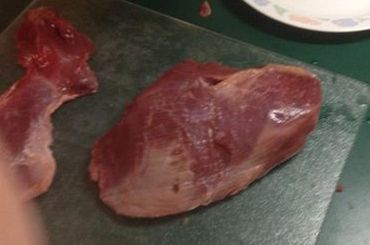
hams 2015


I’m not sure how to say it. I enjoyed the hunt, but it wasn’t fun. I derived no pleasure from killing these animals, although I’m thankful for the meat in my freezer. And my in-law’s freezer. And my uncle’s freezer.

I could never hunt for sport.

Contrary to PETA’s website, most hunters don’t hunt for “recreation.” It’s true: many don’t rely on hunting to survive, but those lucky enough to harvest an animal won’t have to buy that at the grocery. Case in point: this year “cost” me $146.  I only had to pay for my license and processing of the first deer, and those monies were given as gifts. This means I paid about $2.43 per pound of meat; try buying burger or roast from the deli for that price. I should have no need to buy beef for the next year.

Neither is hunting a necessity. I won’t starve because I didn’t get a deer.

But, hunting makes things easier; my bank account can stretch a bit further.

These are things I didn’t think of before.

Hunting: natural and organic.

Very Circle of Life, don’t you think?

circle of life quote

Review: A Burnable Book

Knowledge is currency.

It can be traded and it can be banked, and more secretly than money.

A Burnable BookLondon, 1385:

A book and a cloth prophesy regicide.

Two aspiring poets hide their own a dark secrets.

Two ambitious men plot revenge.

Two fallen women desire a better life.

This is the scene and these are the principal characters of Bruce Holsinger’s A Burnable Book. A book of heretical verse prophesying the death of Richard II circulates through London. When the only known copy goes missing, it’s up to John Gower – enlisted by his friend Geoffrey Chaucer – to track it down and stop the assassination.

[SPOILERS AHEAD]

Distraction, deception, subterfuge, mendacity, all those unspoken tools of the subtler crafts: government and trade, diplomacy and finance.

As far is intrigues go, I found A Burnable Book relatively easy. It is quite obvious that Chaucer is the author of De Mortibus, that Gower’s son Simon is in it up to his ears, and the identity of the so-called “mystery girl” is evident early on as well. History tells us that Richard II wasn’t assassinated in 1385, so we know the plot will fail. (I really shouldn’t have to give a spoiler alert for something over 600 years old, you know . . .) However, this did not stop me from enjoying the book and seeing how the characters would figure it out. For me, the only real plot twists were (a) just who was responsible for Simon’s involvement in the plot and (b) just how much Chaucer “knew” beforehand.

As a work of fiction, I found A Burnable Book to be about as satisfying as a bag of chips: It filled time but had little actual value. Adam Scarlett really turned me off. A relatively minor character, his rather violent end was not really necessary to the plot. Furthermore, coming as it did in the final ten pages of the book, it somewhat ruined the denouement of the overall storyline. I understand the motives behind his death; I simply think it should have come at a different point (preferably not at all).

I borrowed this book from my local library; otherwise, I would have felt robbed. I definitely wouldn’t pay $26 for the hardback edition, and even $8 for a paperback may be a bit much.

My overall rating:

2.5 stars

Lessons and Carols

Lessons and Carols CandlesPerhaps you have never heard of a Lessons and Carols service.

From Wikipedia:

The first Festival of Nine Lessons and Carols at King’s College, Cambridge, was held on Christmas Eve in 1918. It was conceived by Eric Milner-White, the Dean of the College, whose experience as an army chaplain had led him to believe that more imaginative worship was needed by the Church of England. The order of service was adapted from the order created by Benson for Truro Cathedral 38 years earlier, based on an idea from the future Bishop of Edinburgh, George Walpole . . .

The format of the first Festival of Nine Lessons and Carols did not differ substantially from the one known today. The order of the lessons was revised in 1919, and since that time the service has always begun with the hymn “Once in Royal David’s City” . . .

The Nine Lessons, which are the same every year, are read by representatives of the college and of the City of Cambridge from the 1611 Authorized King James Version of the Bible . . . The singing is divided into “carols” which are sung by the Choir of King’s College, Cambridge, and “hymns” sung by the Choir and congregation . . . The service ends with the hymn “Hark! The Herald Angels Sing” . . .

If you have never attended a Lessons and Carols service – or, if you are unable to attend one or find a broadcast – I would like to provide one for you.

AB INITIO

 Lessons and Carols Candles 2FIRST LESSON

Genesis 3:8-19

8. And they heard the voice of the Lord God walking in the garden in the cool of the day: and Adam and his wife hid themselves from the presence of the Lord God amongst the trees of the garden.

9. And the Lord God called unto Adam, and said unto him, Where art thou?

10. And he said, I heard thy voice in the garden, and I was afraid, because I was naked; and I hid myself.

11. And he said, Who told thee that thou wast naked? Hast thou eaten of the tree, whereof I commanded thee that thou shouldest not eat?

12. And the man said, The woman whom thou gavest to be with me, she gave me of the tree, and I did eat.

13. And the Lord God said unto the woman, What is this that thou hast done? And the woman said, The serpent beguiled me, and I did eat.

14. And the Lord God said unto the serpent, Because thou hast done this, thou art cursed above all cattle, and above every beast of the field; upon thy belly shalt thou go, and dust shalt thou eat all the days of thy life:

15. And I will put enmity between thee and the woman, and between thy seed and her seed; it shall bruise thy head, and thou shalt bruise his heel.

16. Unto the woman he said, I will greatly multiply thy sorrow and thy conception; in sorrow thou shalt bring forth children; and thy desire shall be to thy husband, and he shall rule over thee.

17. And unto Adam he said, Because thou hast hearkened unto the voice of thy wife, and hast eaten of the tree, of which I commanded thee, saying, Thou shalt not eat of it: cursed is the ground for thy sake; in sorrow shalt thou eat of it all the days of thy life;

18. Thorns also and thistles shall it bring forth to thee; and thou shalt eat the herb of the field;

19. In the sweat of thy face shalt thou eat bread, till thou return unto the ground; for out of it wast thou taken: for dust thou art, and unto dust shalt thou return.

[Continue to Second Lesson]

Pages: 1 2 3 4 5 6 7 8 9

A Rant about Music

[rant]

Many of my students suffer from the delusion that any time before the present day was “boring.”

You didn’t have internet? or cell phones? What did you do?

I used something called imagination. It’s nearly extinct, but you can see traces of it here and there . . .

In my experience, they find music the most tedious. Why? I don’t really know. Perhaps it’s because enjoying older styles of music takes work. Gregorian chant, polyphony, opera, and classical music all require effort, something today’s One Direction-crazed teenyboppers or Selena Gomez-infatuated prepubescents just aren’t willing to do.

Music? Effort? It took a whole minute to download this song, and now you want me to think about it?! I don’t think so, old man . . .

But music from days gone by simply isn’t boring. I get that you don’t like it, but it certainly isn’t boring.

Case in point:


“Gaudete”

Rejoice, rejoice! Christ is born
of the Virgin Mary – rejoice!

The time of grace has come—
what we have wished for,
songs of joy
Let us give back faithfully.

God has become man,
With nature marveling,
The world has been renewed
By Christ reigning.

The closed gate of Ezekiel
Is passed through,
Whence the light is raised,
Salvation is found.

Therefore let our gathering
Now sing in brightness
Let it give praise to the Lord:
Greeting to our King.


Did you even hear that tune?!

How on God’s green Earth is this boring?!

It’s not. That’s the point.

[/rant]

A Visit from Saint Nicholas

Clement Moore perpetrated a great crime against Church history when he penned and published the poem “A Visit from Saint Nicholas” in 1823. The mostly-benevolent Church Father known as Saint Nicholas of Myra was replaced with a magical man and equally magical reindeer who should – according to the laws of physics – immediately burst into flames and crash back to earth in a flaming ball of death and destruction the moment they attempt takeoff, simultaneously wiping out elven workshops and delivering barbecue to the North Pole. (I can only imagine Saint Nicholas’ reaction to this development . . .)

Therefore, in the spirit of historical accuracy (or – at the very least – greater historical accuracy than Mr. Clement’s epic failure), I present to you the real “Visit from Saint Nicholas.”


A Visit from Saint Nicholas

‘Twas the First Council of Nicaea, when all through the Church
Every Christian was stirring, and starting research.

Council of Nicea Sistine Chapel
The search for Truth, that is.

The Church Fathers had chosen their sides with great care,
For Nicholas of Myra soon would be there;

Nicholas of Myra
^ [this guy] ^

The Elders were settled all smug in their doctrine,
While allegations of heresy swarmed like a toxin;

Coptic Gnostic Cross
Gnosticism
Just say NO!

Constantine in his robes and Bishops in caps
Were just praying the Church wouldn’t collapse.

Great Schism Map
But it almost did . . . 1,000 years later.

When out of debate there arose such a clatter,
All heads turned around to see what was the matter.

Away to the Council I flew like a flash,
Threw open the doors and stopped in my tracks.

The lamps in their sockets were all aglow,
Giving lustre of mid-day to objects below,

Well, duh. That’s what lamps are for, right?

When, what to my wondering eyes should appear,
But a lively Church Council – no longer austere –

And a stately Church Father, so lively and quick,
I knew in a moment it was Bishop Nick.

Nicholas of Myra
^ [this guy] ^
in case you needed reminding

More rapid than eagles his discourses came,
And he whistled, and shouted, and I heard him proclaim:

“The deity of Christ cannot be refuted;
Equality with the Father cannot be disputed!”

From the back of the pack there came a loud call:
“That’s not what I think; no, not at all!”

Arius
Enter Scumbag Arius

As dry leaves that before the wild hurricane fly,
When they meet with an obstacle, mount to the sky;
So up to the naysayer Bishop Nick flew,
With a fist full of fury (and righteous wrath, too).

real santaAnd then, in a twinkling, I heard a great “Oomph!
We’re lucky that Nick didn’t kill the poor doof . . .

Constantine and the Bishops all gathered around,
And kicked Nick to the curb like an unwanted hound.

He was thrown into prison and stripped of his office,
His pallium confiscated – so were his Gospels.

Not quite the Santa you remember, is he?

He was left with only the clothes on his back –
Even a beggar had more in his pack.

But his eyes—how they twinkled! his dimples how merry!
His cheeks were like roses, his nose like a cherry!
His droll little mouth was drawn up like a bow
And the beard of his chin was as white as the snow.

Nicholas of Myra
artistic liberty taken

Arius was in favor of kicking his teeth,
But he was outvoted and started to seethe:

“Nick doesn’t deserve proper food for his belly,
Why don’t we just kill him? Someone, please tell me!”

Arius
Typical Arius . . .

It was then that they learned just how wrong they all were –
It all happened so fast, it seemed like a blur:

Christ and the Virgin visited his bed
– are we really quite certain this wasn’t all in his head? –

They restored his belongings and sent him to work
Helping poor children and building the Church.

Saint Nicholas Before and After
Before and After

And laying his finger aside of his nose,
And giving a nod, he walked down the road.

He rallied his strength, to his team gave a whistle,
And strait away they read from the Missal,

But I heard him exclaim, ere he trod out of sight,
“I’ll mess you up, too, should we get in a fight.”

Nicholas-Awkward-Meme


Some Notes on Historical Accuracy

Obviously, I have taken some artistic license. In some cases I was just too lazy to come up with anything thought the original worked just fine. For your consideration:

The Constantine mentioned here is Constantine I, founder of New Rome (aka Byzantium, Constantinople, and Istanbul).

Despite my caption, Arius may or may not have been a scumbag. He did, however, believe that Jesus Christ was inferior to God the Father, while Nicholas believed that Jesus was equal to God the Father. Hence, their disagreement.

By all accounts Arius was speaking when Nicholas couldn’t take it any more and laid into him. That just didn’t work for me. Oh well, deal with it and move on.

I really don’t know how Arius reacted to getting punched in the face. His response is based on what my reaction would have been. Honestly, how would you have reacted?

Although I have Nicholas’ followers reading from the Missal, I don’t think it existed at that time. However, neither do flying reindeer, and you probably like that poem just fine, don’t you?

Anyway, now you have a semi-historical background for the real Nicholas. Combat ignorance and share it!

Krampuskarte
Eine Krampuskarte.
Just because.

Public Opinion: Trial by Ordeal in the Modern Age

Please Note:

This Article Not Formatted for Mobile Devices

Mr Peabody let me borrow has absolutely no idea that I have the Wayback Machine, so we have to be quick. Pay close attention – there’s going to be a quiz later.


[INSERT FAVORITE TIME MACHINE NOISE HERE]

David Tennant Tardis
[The most appropriate response]


Monty Python Witch
We found a Witch!
May we burn her?

Look around; can you tell where we are?

That’s right! It’s the Middle Ages.

And what do we have here?

Someone’s been accused of a crime!

No, there’s no need of a jury; these fine people have something better: judicium Dei via trial by ordeal.

What’s that? You haven’t heard of trial by ordeal? Well, you’re in luck! Here’s a quick rundown:

People in the Bad Old Days widely believed God would protect an innocent person from harm, even if that meant suspending the laws of nature. That’s right; God would personally intervene with a miracle to help “prove” someone’s guilt or innocence! No need for evidence, witnesses, or anything of that kind; simply subject the accused to the ordeal du jour and let God do the rest.


Go ahead; pick your poison:


Trial by Combat

You and your accused fight it out. Last man standing wins is right.

Gerichtskampf_mair
May the Odds be Ever in Your Favor

Trial by Fire

Trial by FireWalk a given distance over red-hot ploughshares or while holding a red-hot iron. Wait three days and have a priest examine the affected area. If there’s no sign of injury: congratulations! You’re innocent and free to go. If the area is blistered, festering, or otherwise injured: prepare to die.

A variation of this trial requires you to remove a stone from boiling water or other substance (like oil or lead).

Famous – or infamous – people to undergo trial by fire include Emma of Normandy, Peter Bartholomew, and Girolamo Savonarola.

Trial by Water

Trail by WaterTrial by hot water is pretty much the same as the variation of ordeal by fire [see above].

Trial by cold water is found in the world’s oldest law codes (Code of Ur-Nammu and Code of Hammurabi) and appears reserved for those accused of sorcery/witchcraft. If you find yourself in this unfortunate position, expect to be submerged in the local stream/lake/river and declared innocent if you sink and guilty if they float. Apparently blessed water can’t receive sinners or something like that. Let’s just hope they fish you out in time (assuming you’re innocent). Either way, looks like you lose.

The witch-hunts of the 16th and 17th centuries relied on this method.

Trial by Cross

It’s essentially a staring contest where you risk your life. You and your accuser stand on either side of a cross and stretch out your arms. First one to lower his arms loses. I hope you’ve been doing your calisthenics!

Trial by Ingestion / Trial by Sacrament / Ordeal of the Eucharist / Trial by Poison

In this (somewhat tasty) ordeal, you’re given blessed dry bread and cheese. If you choke, you’re guilty.  A variation of this requires you to take the Eucharist after solemnly swearing you’re up to no good declaring innocence. If you’re guilty, you’ll die within one year. So lock your door and become a hermit and you should be just fine.

church host
I wonder if it works on those accused of gluttony?


Have you been paying attention? Good! It’s time for our quiz. Fair warning, though: it has absolutely nothing to do with anything on this page. Still think you’re ready? Then proceed to the next page!

Pages: 1 2 3

Website Powered by WordPress.com.

Up ↑