The rumors of my death have been greatly exaggerated.
As a matter of fact, I was only mostly dead – I mean sick.
And mostly dead is slightly alive . . .
I don’t get sick, except when I do.
According to my wife, I act like a baby when I’m sick.
Except that I don’t.
So there!
Neener! Neener!
I actually took something stronger than acetaminophen – always a risky venture. What might happen this time?
Six hours of hallucinations?
Three days of amnesia-ridden drunken stupor?
Death-like sleep?
None of the above, thank goodness.
I got better . . .
However, somewhere in that medication-induced bliss of recovery, I became inspired.
First, I found inspiration for a book. It combines my post “Haunted” and the inventory given me by @youarecarrying. Its raw form was inspired by Cloud Atlas, A Burnable Book, and M. Night Shyamalan. I haven’t quite decided if that’s good or bad.
Second, I decided to embark on a quest: a real-time version of Divine Comedy in tweet form. Look for it to begin on Good Friday! The handle and hashtag are in development. In fact, suggestions would be appreciated . . .
Third, I settled on a theme for my monthly “big idea” posts: Manifesto. Some time ago, Daily Prompt asked us to write a manifesto, and I never quite got around to it. Rather than write one extremely long post, I’ll break it into manageable sections. Look for Part 1 sometime before February!
Clement Moore perpetrated a great crime against Church history when he penned and published the poem “A Visit from Saint Nicholas” in 1823. The mostly-benevolent Church Father known as Saint Nicholas of Myra was replaced with a magical man and equally magical reindeer who should – according to the laws of physics – immediately burst into flames and crash back to earth in a flaming ball of death and destruction the moment they attempt takeoff, simultaneously wiping out elven workshops and delivering barbecue to the North Pole. (I can only imagine Saint Nicholas’ reaction to this development . . .)
Therefore, in the spirit of historical accuracy (or – at the very least – greater historical accuracy than Mr. Clement’s epic failure), I present to you the real “Visit from Saint Nicholas.”
A Visit from Saint Nicholas
‘Twas the First Council of Nicaea, when all through the Church Every Christian was stirring, and starting research.
The search for Truth, that is.
The Church Fathers had chosen their sides with great care, For Nicholas of Myra soon would be there;
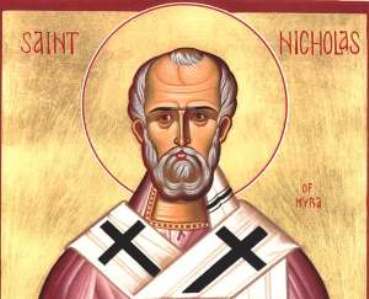
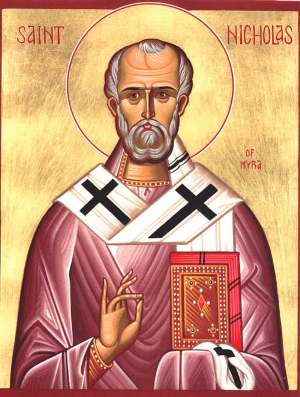
^ [this guy] ^
The Elders were settled all smug in their doctrine,
While allegations of heresy swarmed like a toxin;
Gnosticism Just say NO!
Constantine in his robes and Bishops in caps
Were just praying the Church wouldn’t collapse.
But it almost did . . . 1,000 years later.
When out of debate there arose such a clatter, All heads turned around to see what was the matter.
Away to the Council I flew like a flash, Threw open the doors and stopped in my tracks.
The lamps in their sockets were all aglow,
Giving lustre of mid-day to objects below,
Well, duh. That’s what lamps are for, right?
When, what to my wondering eyes should appear,
But a lively Church Council – no longer austere –
And a stately Church Father, so lively and quick,
I knew in a moment it was Bishop Nick.
^ [this guy] ^ in case you needed reminding
More rapid than eagles his discourses came,
And he whistled, and shouted, and I heard him proclaim:
“The deity of Christ cannot be refuted;
Equality with the Father cannot be disputed!”
From the back of the pack there came a loud call:
“That’s not what I think; no, not at all!”
Enter Scumbag Arius
As dry leaves that before the wild hurricane fly,
When they meet with an obstacle, mount to the sky;
So up to the naysayer Bishop Nick flew,
With a fist full of fury (and righteous wrath, too).
And then, in a twinkling, I heard a great “Oomph!”
We’re lucky that Nick didn’t kill the poor doof . . .
Constantine and the Bishops all gathered around,
And kicked Nick to the curb like an unwanted hound.
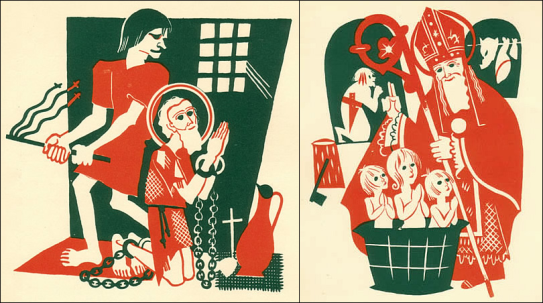
He was thrown into prison and stripped of his office,
His pallium confiscated – so were his Gospels.
Not quite the Santa you remember, is he?
He was left with only the clothes on his back –
Even a beggar had more in his pack.
But his eyes—how they twinkled! his dimples how merry!
His cheeks were like roses, his nose like a cherry!
His droll little mouth was drawn up like a bow
And the beard of his chin was as white as the snow.
artistic liberty taken
Arius was in favor of kicking his teeth,
But he was outvoted and started to seethe:
“Nick doesn’t deserve proper food for his belly,
Why don’t we just kill him? Someone, please tell me!”
Typical Arius . . .
It was then that they learned just how wrong they all were –
It all happened so fast, it seemed like a blur:
Christ and the Virgin visited his bed
– are we really quite certain this wasn’t all in his head? –
They restored his belongings and sent him to work
Helping poor children and building the Church.
Before and After
And laying his finger aside of his nose,
And giving a nod, he walked down the road.
He rallied his strength, to his team gave a whistle,
And strait away they read from the Missal,
But I heard him exclaim, ere he trod out of sight,
“I’ll mess you up, too, should we get in a fight.”
Some Notes on Historical Accuracy
Obviously, I have taken some artistic license. In some cases I was just too lazy to come up with anything thought the original worked just fine. For your consideration:
The Constantine mentioned here is Constantine I, founder of New Rome (aka Byzantium, Constantinople, and Istanbul).
Despite my caption, Arius may or may not have been a scumbag. He did, however, believe that Jesus Christ was inferior to God the Father, while Nicholas believed that Jesus was equal to God the Father. Hence, their disagreement.
By all accounts Arius was speaking when Nicholas couldn’t take it any more and laid into him. That just didn’t work for me. Oh well, deal with it and move on.
I really don’t know how Arius reacted to getting punched in the face. His response is based on what my reaction would have been. Honestly, how would you have reacted?
Although I have Nicholas’ followers reading from the Missal, I don’t think it existed at that time. However, neither do flying reindeer, and you probably like that poem just fine, don’t you?
Anyway, now you have a semi-historical background for the real Nicholas. Combat ignorance and share it!
I am the Collector of Lost Things, reclaiming the flotsam and refuse and orphaned detritus of life: keys and socks and cell phones and nail clippers and glasses and bank cards and jewelry . . .
I am the Out of Print Office, lining my shelves with books abandoned, neglected, and forgotten.
The best laid plans of mice and men oft are never read.
I am the Dead Letter Postman, waylaying love and inheritance and hate and loss indefinitely.
I know what they say about me. They say I’m too quiet, too observant, and too smart for my own good. They don’t ask me, so I don’t tell them. I learned that long ago.
And now, sitting here in the hot summer sun, I hear it all: the sirens fading in the distance, the crying behind closed doors, the statements given in hushed tones. I hear the excuses.
No, I never heard them argue.
No, I never saw her bruises.
They were such a quiet couple!
He seemed so nice, minding our house while we took vacation.
This is a peaceful neighborhood; nothing ever happens here!
Poor thing; do you think she’ll make it?
Who would’ve suspected?
Who would’ve known?
I suspected. I’m too quiet. I saw the signs. I’m too observant. I knew. I’m too smart for my own good.
They won’t ask me; they never do.
I’m the one who made the call, you know.
But people don’t want to know if they don’t ask.
So I won’t tell them.
It only causes problems.
I learned that long ago.
This post is being published as part of Writing 101. Challenge 18: Craft a story from the perspective of a twelve-year-old observing it all. Focus on specific character qualities, drawing from elements we’ve worked on in this course, like voice and dialogue. Think about more than simply writing in first-person point of view — build this twelve-year-old as a character. Reveal at least one personality quirk, for example, either through spoken dialogue or inner monologue.
A Note from the Author
I really don’t know why my fictional writing tends towards depressing subjects, but it’s what seems to come naturally. This account is semi-fictional: here was a case of abuse in our neighborhood several years ago, so I wrote it as if I lived in the house opposite.

 And mostly dead is slightly alive . . .
 I got better . . .












 Running In My Head